Have you ever wondered whether Unaffected vs. Uneffected is the correct spelling? You’re not alone. This common word confusion catches many writers off guard because both words look similar, yet only one is widely accepted in standard English.
The confusion often begins when people search for the unaffected meaning, unaffected definition, or the correct spelling of unaffected and come across the less familiar form uneffected. And here’s the kicker: using the wrong spelling in an email, essay, or professional document can make your writing appear less credible.
But don’t worry—there’s a simple explanation.
In this guide, you’ll learn the difference between Unaffected vs. Uneffected, discover the unaffected pronunciation, understand the unaffected meaning, and see practical unaffected examples in real sentences. You’ll also find out is uneffected a word, how to spell unaffected, and why this pair is considered a common spelling mistake.
By the end, you’ll know the correct usage of unaffected, understand unaffected vs uneffected once and for all, and feel confident using the right spelling in any situation
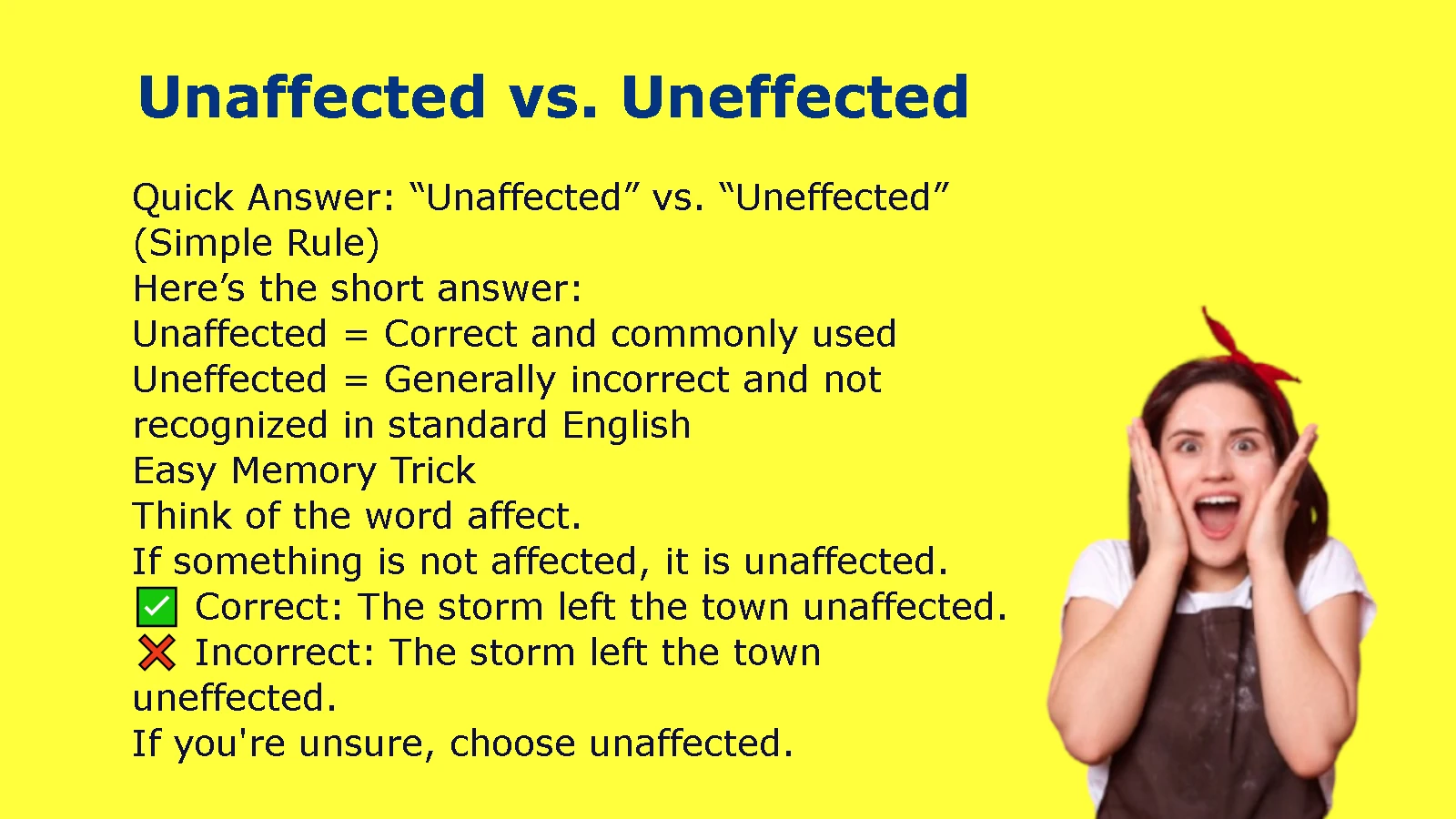
Quick Answer: “Unaffected” vs. “Uneffected” (Simple Rule)
Here’s the short answer:
Unaffected = Correct and commonly used
Uneffected = Generally incorrect and not recognized in standard English
Easy Memory Trick
Think of the word affect.
If something is not affected, it is unaffected.
✅ Correct: The storm left the town unaffected.
❌ Incorrect: The storm left the town uneffected.
If you’re unsure, choose unaffected.
What Does “Unaffected” Mean?
The word unaffected has two common meanings.
Meaning 1: Not Changed or Influenced
This is the most common use.
Examples:
- The neighboring village was unaffected by the flood.
- Her decision remained unaffected by criticism.
- Sales were largely unaffected by the market downturn.
In these examples, something remained unchanged despite outside influences.
Meaning 2: Natural and Genuine
Sometimes unaffected describes someone who behaves naturally without pretending.
Examples:
- She was warm and unaffected despite her fame.
- His unaffected manner made everyone comfortable.
- The actor seemed surprisingly unaffected by celebrity status.
Here, the word means sincere, genuine, and free from artificial behavior.
Is “Uneffected” a Real Word?
This is where most confusion begins.
The Short Answer
In standard modern English, uneffected is generally considered incorrect.
Most major dictionaries do not recognize it as a standard word for everyday writing.
Why People Use It
People often assume:
- Affect → affected → unaffected
- Effect → effected → uneffected
The pattern seems logical.
However, English doesn’t work that way in this case.
The accepted opposite of affected is unaffected, not uneffected.
Key Takeaway
If you’re writing an email, article, essay, report, or social media post, avoid uneffected and use unaffected instead.
Why “Unaffected” and “Uneffected” Get Confused
The confusion comes from two similar English words:
Affect
Usually means:
- To influence
- To change
Example:
- The weather affected our plans.
Effect
Usually means:
- A result
- An outcome
Example:
- The new policy had a positive effect.
Because these words are closely related, many writers mistakenly create the word uneffected when they mean unaffected.
The Root of the Mistake
People think:
Affected → Unaffected
Effected → Uneffected
But English only commonly accepts the first form.
The Grammar Behind “Unaffected”
To understand why unaffected is correct, let’s look at how it’s formed.
Word Structure
Prefix:
un- = not
Base word:
affected
Meaning:
not affected
Example:
- The backup system was unaffected by the outage.
The structure follows a standard English pattern.
Why It Works
English frequently forms opposites using un-:
- happy → unhappy
- fair → unfair
- affected → unaffected
This construction is widely accepted and understood.
“Affected,” “Effected,” and “Unaffected” Compared
Many people mix up all three words.
| Word | Meaning | Example |
| Affected | Influenced or changed | The rain affected traffic. |
| Effected | Brought about or caused | The new manager effected several changes. |
| Unaffected | Not influenced or changed | Traffic was unaffected by the event. |
Notice Something?
Affected and effected are both legitimate words.
Unaffected is also legitimate.
Uneffected is generally not.
Common Mistakes People Make
Let’s look at some examples.
Mistake #1: Using “Uneffected” Instead of “Unaffected”
❌ The results were uneffected by the delay.
✅ The results were unaffected by the delay.
Mistake #2: Confusing Affect and Effect
❌ The changes effected my decision.
✅ The changes affected my decision.
Mistake #3: Assuming Every Word Has an “Un-” Version
English doesn’t always create opposites predictably.
Just because effected exists doesn’t mean uneffected is commonly accepted.
Real-Life Examples of “Unaffected”
Here are examples you’ll actually encounter.
In Business
- Company profits remained unaffected by the temporary disruption.
- Customer demand was largely unaffected.
News Reports
- Several areas were unaffected by the earthquake.
- Essential services remained unaffected throughout the crisis.
Everyday Conversation
- I was unaffected by the criticism.
- The cold weather left the indoor event unaffected.
Personal Descriptions
- She remained unaffected by fame.
- His unaffected personality impressed everyone.
Examples of Incorrect “Uneffected” Usage
Here are sentences that should be corrected.
❌ The building was uneffected by the fire.
✅ The building was unaffected by the fire.
❌ Our plans were uneffected by the weather.
✅ Our plans were unaffected by the weather.
❌ The economy remained uneffected.
✅ The economy remained unaffected.
Why Spell Check Often Flags “Uneffected”
Most spelling and grammar tools recognize that uneffected is not standard usage.
What Happens?
When you type:
uneffected
Many tools suggest:
unaffected
This happens because standard English overwhelmingly prefers unaffected.
Key Insight
If your spell checker flags uneffected, it’s usually right.
Side-by-Side Comparison Table
| Feature | Unaffected | Uneffected |
| Standard English Word | Yes | Generally No |
| Commonly Used | Yes | Rarely |
| Found in Modern Writing | Frequently | Almost Never |
| Accepted in Academic Writing | Yes | No |
| Recommended Usage | Yes | No |
How to Avoid the Mistake Every Time
Want a foolproof method?
Step 1
Ask:
“Do I mean not influenced or not changed?”
If yes, use unaffected.
Step 2
Ignore the temptation to build a word from effected.
Step 3
When in doubt, check a dictionary or grammar tool.
Step 4
Read the sentence aloud.
Most native speakers immediately recognize that unaffected sounds natural.
Better Alternatives to “Unaffected”
Sometimes another word fits better.
Possible Alternatives
- Unchanged
- Uninfluenced
- Untouched
- Unaltered
- Unmoved
- Independent
Examples
Instead of:
The region was unaffected by the storm.
You could write:
The region remained unchanged by the storm.
Or:
The region was untouched by the storm.
Quick Decision Guide (Use This Instantly)
When writing:
Do you mean not influenced, not changed, or untouched?
➡ Use unaffected
Thinking about writing uneffected?
➡ Don’t. Use unaffected instead.
Need a professional, academic, or business-safe choice?
➡ Use unaffected
Simple. Reliable. Done.
FAQ: “Unaffected” vs. “Uneffected”
Is “uneffected” a real word?
It is generally not recognized as a standard modern English word and should be avoided in most writing.
Which is correct: unaffected or uneffected?
Unaffected is the correct choice in almost all situations.
Why do people write “uneffected”?
Because they confuse affect and effect and assume the opposite of effected should be uneffected.
Can I use “uneffected” in formal writing?
No. Professional, academic, and business writing should use unaffected.
Does “unaffected” only mean not changed?
No. It can also describe someone who is natural, sincere, and not pretentious.
Case Study: A Costly Writing Error
A marketing team prepared an important report for a client.
One section stated:
“Sales remained uneffected by seasonal changes.”
What Happened?
The client noticed the spelling immediately.
The report appeared less professional, despite containing accurate data.
The Fix
The sentence was changed to:
“Sales remained unaffected by seasonal changes.”
The correction improved clarity and professionalism instantly.
Lesson
Small word choices can have a big impact on credibility.
Key Facts You Should Remember
- Unaffected is the correct and accepted word.
- Uneffected is generally considered incorrect.
- Unaffected means not influenced, not changed, or natural and genuine.
- Many people confuse the word because of affect/effect similarities.
- Spell checkers usually flag uneffected for a reason.
- Professional writing should always use unaffected.
Final Takeaway: The One Rule That Never Fails
When comparing “unaffected” vs. “uneffected,” the simplest rule is also the most reliable.
Use unaffected whenever you mean something was not influenced, not changed, or remained untouched.
Avoid uneffected in normal writing because it is not accepted in standard modern English and will often be viewed as a mistake.
Think of it this way:
If something wasn’t affected, it is unaffected.
That’s the word readers expect, dictionaries recognize, and professional writers use.
When in doubt, choose unaffected and move on with confidence.