
Alumnuses vs. Alumni is a common grammar question among English learners, students, and even native speakers. If you’ve ever wondered which word is correct when referring to graduates of a school, college, or university, you’re not alone. These two words look similar, but only one is considered standard English in most situations. Understanding the difference will help you communicate more accurately in academic, professional, and everyday settings.
In simple terms, Alumni is the correct plural form of alumnus or a general term for graduates, while Alumnuses is generally considered nonstandard and is rarely used in modern English. The confusion often arises because many English nouns form their plural by adding -es, leading people to assume that alumnuses follows the same rule. However, alumnus comes from Latin, so it follows a different plural pattern.
This confusion leads many people to search for phrases such as alumnuses meaning, alumni meaning, difference between alumnuses and alumni, is alumnuses correct, alumnuses vs. alumni, and how to use alumni correctly. Since both words appear to refer to former students, it’s easy to assume they’re interchangeable. Learning the correct usage will strengthen your grammar, improve your writing, and help you avoid a common English mistake.
In this guide, you’ll learn the complete difference between Alumnuses and Alumni, including their definitions, pronunciation, grammar rules, gender-specific forms, regional usage, real-life examples, common mistakes, and easy memory tricks. By the end, you’ll know exactly which word to use with confidence.
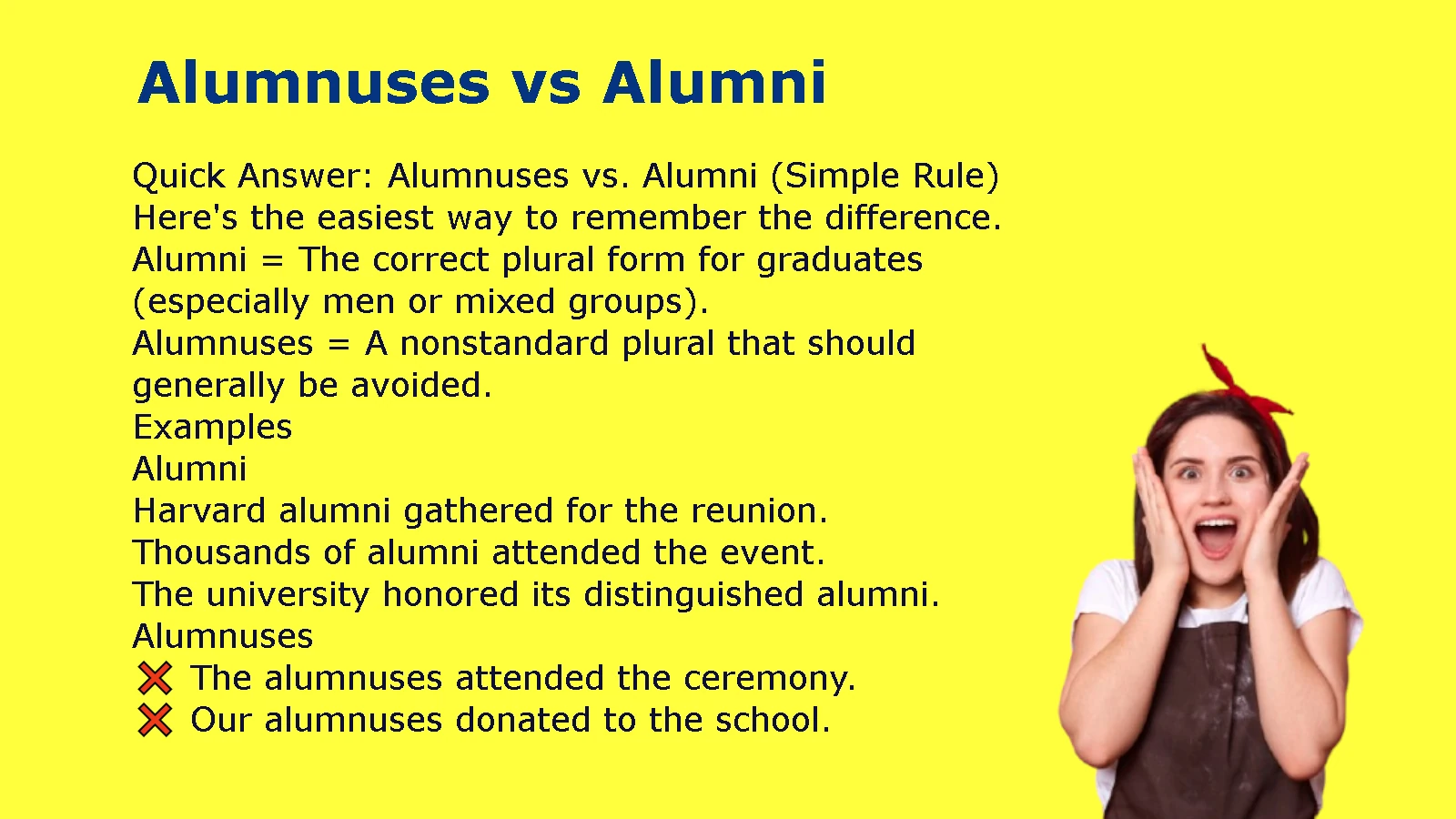
Quick Answer: Alumnuses vs. Alumni (Simple Rule)
Here’s the easiest way to remember the difference.
Alumni = The correct plural form for graduates (especially men or mixed groups).
Alumnuses = A nonstandard plural that should generally be avoided.
Examples
Alumni
- Harvard alumni gathered for the reunion.
- Thousands of alumni attended the event.
- The university honored its distinguished alumni.
Alumnuses
- ❌ The alumnuses attended the ceremony.
- ❌ Our alumnuses donated to the school.
The Simple Rule
If you’re talking about more than one graduate, use alumni.
Avoid using alumnuses because it is not accepted in standard academic or professional English.
Easy Memory Trick
Think of the word Alumni Association.
Almost every school and university has an Alumni Association, not an Alumnuses Association.
If you’ve seen it on university websites, you’ve already learned the correct form.
Easy Formula
One male graduate → Alumnus
One female graduate → Alumna
Many male or mixed graduates → Alumni
Many female graduates → Alumnae
Never use Alumnuses in formal writing.
How People Actually Use “Alumnuses” and “Alumni”
Here’s where things become interesting.
Many English speakers aren’t familiar with Latin plural forms. Because most English nouns simply add -s or -es to become plural, some people naturally assume that alumnuses must be correct.
In Everyday Conversations
Someone might say:
“The alumnuses are coming back for homecoming.”
Although listeners may understand the meaning, educated speakers and academic institutions almost always use:
“The alumni are coming back for homecoming.”
At Schools and Universities
Educational institutions consistently use:
- Alumni Association
- Alumni Network
- Alumni Reunion
- Alumni Directory
You’ll almost never see:
- ❌ Alumnuses Association
Why This Happens
English has borrowed many words from Latin.
Instead of following regular English plural rules, these words keep their original Latin plurals.
Examples include:
- Cactus → Cacti
- Fungus → Fungi
- Radius → Radii
- Alumnus → Alumni
The Real Difference Between Alumnuses and Alumni
To understand these words clearly, think about correct grammar, not just pronunciation.
Alumni
- Standard English
- Accepted worldwide
- Used by universities
- Used in professional writing
- Preferred in dictionaries
Alumnuses
- Rare
- Considered nonstandard
- Sounds unnatural to most native speakers
- Best avoided in formal English
Why the Difference Matters
Using alumni makes your writing sound educated and professional.
Using alumnuses may make readers think you’re unfamiliar with the correct plural form.
This is especially important in:
- College applications
- University websites
- Business writing
- Academic papers
- LinkedIn profiles
“Alumni” Explained Clearly (With Examples)
The word alumni refers to former students who graduated from a school, college, or university.
Although it technically refers to multiple male graduates or a mixed group, modern English often uses alumni as a general plural for graduates regardless of gender.
Common Examples of Alumni
- University graduates
- Former high school students
- College graduates
- Members of alumni organizations
- Reunion attendees
Example Sentences
- “Thousands of alumni returned for the anniversary celebration.”
- “Our alumni support scholarships for current students.”
- “The alumni association organized a networking event.”
- “Many alumni volunteer during orientation week.”
When “Alumni” Sounds Most Natural
You’ll hear alumni in discussions about:
- Universities
- Colleges
- Schools
- Professional networking
- Fundraising events
- Graduation ceremonies
Common Expressions
- Alumni Association
- Alumni Network
- Alumni Reunion
- Alumni Directory
- Alumni Event
- Alumni Magazine
- Alumni Relations
Because these expressions are so common, alumni has become the standard plural term.
“Alumnuses” Explained Clearly (With Examples)
The word alumnuses is an English-style plural created by adding -es to alumnus.
Although it occasionally appears in informal writing, it is not considered standard English.
Example Sentences
Incorrect:
- ❌ The alumnuses gathered for lunch.
- ❌ Our alumnuses donated generously.
Correct:
- ✅ The alumni gathered for lunch.
- ✅ Our alumni donated generously.
When Does “Alumnuses” Sound Natural?
Almost never.
Most dictionaries, universities, and style guides recommend using alumni instead.
The Biggest Mistake People Make
The most common mistake is assuming every English noun forms its plural by adding -s or -es.
Since alumnus ends in -us, many learners naturally create:
alumnus → alumnuses
But that’s not how this Latin word works.
The correct plural is:
alumnus → alumni
Real-Life Scenario
Imagine you’re writing a university newsletter.
You write:
“The alumnuses attended the annual banquet.”
Your editor changes it to:
“The alumni attended the annual banquet.”
Why?
Because alumni is the accepted grammatical form used by educational institutions worldwide.
Side-by-Side Comparison Table
| Feature | Alumnuses | Alumni |
| Standard English | ❌ No | ✅ Yes |
| Grammar | Nonstandard plural | Correct plural |
| Used by Universities | No | Yes |
| Formal Writing | Avoid | Recommended |
| Dictionaries | Rare | Standard |
| Sounds Natural | No | Yes |
| Professional English | No | Yes |
| Academic English | No | Yes |
Key Takeaway So Far
Remember these three simple ideas:
- Alumni is the correct plural form.
- Alumnuses is generally considered incorrect in standard English.
- Universities, colleges, and professional organizations consistently use alumni.
Real-Life Examples of Alumni
Let’s see how native speakers use alumni.
Common Situations
- “Our alumni raised funds for new classrooms.”
- “The alumni reunion is scheduled for October.”
- “Several alumni returned to mentor students.”
- “The university recognized outstanding alumni.”
- “Alumni donations help fund scholarships.”
Mini Scenario
David graduates from college.
Five years later, he attends a reunion.
He is now one of the university’s alumni.
Real-Life Examples of Incorrect “Alumnuses”
Here are examples you should avoid.
- ❌ The alumnuses attended the conference.
- ❌ Our alumnuses formed a networking group.
- ❌ The alumnuses received awards.
Correct versions:
- ✅ The alumni attended the conference.
- ✅ Our alumni formed a networking group.
- ✅ The alumni received awards.
Regional Differences: Alumnuses vs. Alumni Around the World
English-speaking countries generally follow the same rule.
In the United States
Universities always use alumni.
Examples:
- Alumni Weekend
- Alumni Association
- Alumni Giving
In Canada
Canadian schools also prefer alumni in official communication.
In the United Kingdom
Although British English more commonly says former students or graduates, universities still use alumni for official events and organizations.
In Australia and New Zealand
Educational institutions consistently use alumni for graduates and alumni programs.
Why Regional Differences Matter
Unlike many vocabulary differences, this isn’t mainly a regional issue.
Across English-speaking countries, alumni is the recognized plural form.
Common Expressions Using Alumni
Learning these expressions will help you sound more natural.
- Alumni Association
- Alumni Reunion
- Alumni Event
- Alumni Relations
- Alumni Magazine
- Alumni Network
- Alumni Directory
- Distinguished Alumni
Example
“Our university’s Alumni Association supports students through mentoring programs.”
The Impact of Choosing the Right Word
Using alumni instead of alumnuses makes your writing more professional.
At School
Universities expect official documents to use alumni.
At Work
Companies often describe former interns or employees connected to training programs as alumni.
In Professional Writing
Correct terminology improves credibility and reflects a strong understanding of standard English.
How to Avoid Confusion Every Time
Remember the Latin Rule
Words ending in -us sometimes have -i plurals.
Examples:
- Alumnus → Alumni
- Fungus → Fungi
- Stimulus → Stimuli
Read University Websites
You’ll consistently see alumni in official publications.
Practice Correct Usage
The more you use alumni, the more natural it will feel.
What to Say Instead (Clear Alternatives)
Sometimes another word works even better.
| Word | Best Used For |
| Graduates | General English |
| Former students | Everyday conversation |
| Alumni | Academic and professional writing |
| Ex-students | Informal British English |
| Graduating class | Referring to a specific year |
Quick Decision Guide (Use This Instantly)
Still unsure?
Talking about one male graduate?
→ Alumnus
Talking about one female graduate?
→ Alumna
Talking about many graduates?
→ Alumni
Thinking about using alumnuses?
→ Don’t. Use alumni instead.
Which word is more common?
Alumni is overwhelmingly more common in books, universities, media, and professional writing.
Is “alumnuses” ever correct?
Although it occasionally appears in informal writing, it is not considered standard English and should generally be avoided.
Should English learners use “alumni”?
Yes.
If you’re referring to more than one graduate, alumni is the correct and widely accepted choice.
What if the group is all women?
Traditionally, the correct plural is alumnae.
However, many organizations now use alumni as a gender-inclusive term for all graduates.
Case Study: A University Newsletter Mistake
Sophia was preparing a newsletter for her college reunion.
She wrote:
“All alumnuses are invited to attend.”
Before publication, the communications office revised the sentence to:
“All alumni are invited to attend.”
Sophia later learned that alumni is the standard plural used by universities around the world. From then on, she always checked whether a word came from Latin before assuming it followed regular English plural rules.
Key Facts You Should Remember
- Alumni is the correct plural of alumnus.
- Alumnuses is generally considered nonstandard.
- Universities almost always use alumni.
- Alumna refers to one female graduate.
- Alumnae refers to multiple female graduates.
- Modern English often uses alumni for mixed or general groups.
- Using the correct term makes your writing sound more professional.
Fill in the Blanks: Alumnuses vs. Alumni
Fill in the blank with the correct word: Alumnuses or Alumni.
- The university invited all its __________ to the annual reunion.
- More than 500 __________ attended the homecoming celebration.
- The college honored its distinguished __________ during the ceremony.
- Our school’s __________ have gone on to successful careers around the world.
- The newsletter is sent to all __________ every semester.
- Several __________ donated funds for the new library.
- The principal welcomed former __________ back to campus.
- The association helps __________ stay connected after graduation.
- Hundreds of __________ returned for the school’s 100th anniversary.
- The university’s __________ network offers career support to graduates.
- The event celebrated the achievements of the college’s __________.
- Many __________ volunteer to mentor current students.
- The dean thanked all __________ for their continued support.
- The organization recognizes outstanding __________ each year.
- Scholarships are funded by generous __________.
- The __________ gathered to celebrate their graduation anniversary.
- The university maintains a database of its __________.
- Former __________ often return to give guest lectures.
- The __________ association organized a charity fundraiser.
- The school encourages __________ to participate in networking events.
Answers
- Alumni
- Alumni
- Alumni
- Alumni
- Alumni
- Alumni
- Alumni
- Alumni
- Alumni
- Alumni
- Alumni
- Alumni
- Alumni
- Alumni
- Alumni
- Alumni
- Alumni
- Alumni
- Alumni
- Alumni
Final Takeaway: The One Rule That Makes It Easy
Here’s the simple truth.
The difference between Alumnuses and Alumni is straightforward once you understand the word’s Latin origin. While alumnuses may seem like a logical English plural, it is not the standard form used in academic, professional, or everyday English. Alumni is the accepted plural and is the word you’ll see on university websites, graduation announcements, alumni associations, and official publications.
If you’re writing or speaking about more than one graduate, alumni is almost always the right choice. For a single graduate, use alumnus (male) or alumna (female), and for a group of women, the traditional plural is alumnae.
When in doubt, remember this simple rule:
One graduate → Alumnus / Alumna
Many graduates → Alumni
Choosing the correct word isn’t just about grammar—it’s about communicating clearly, confidently, and professionally. Once you understand the difference between Alumnuses vs. Alumni, you’ll avoid a common mistake and use the correct term in every situation.