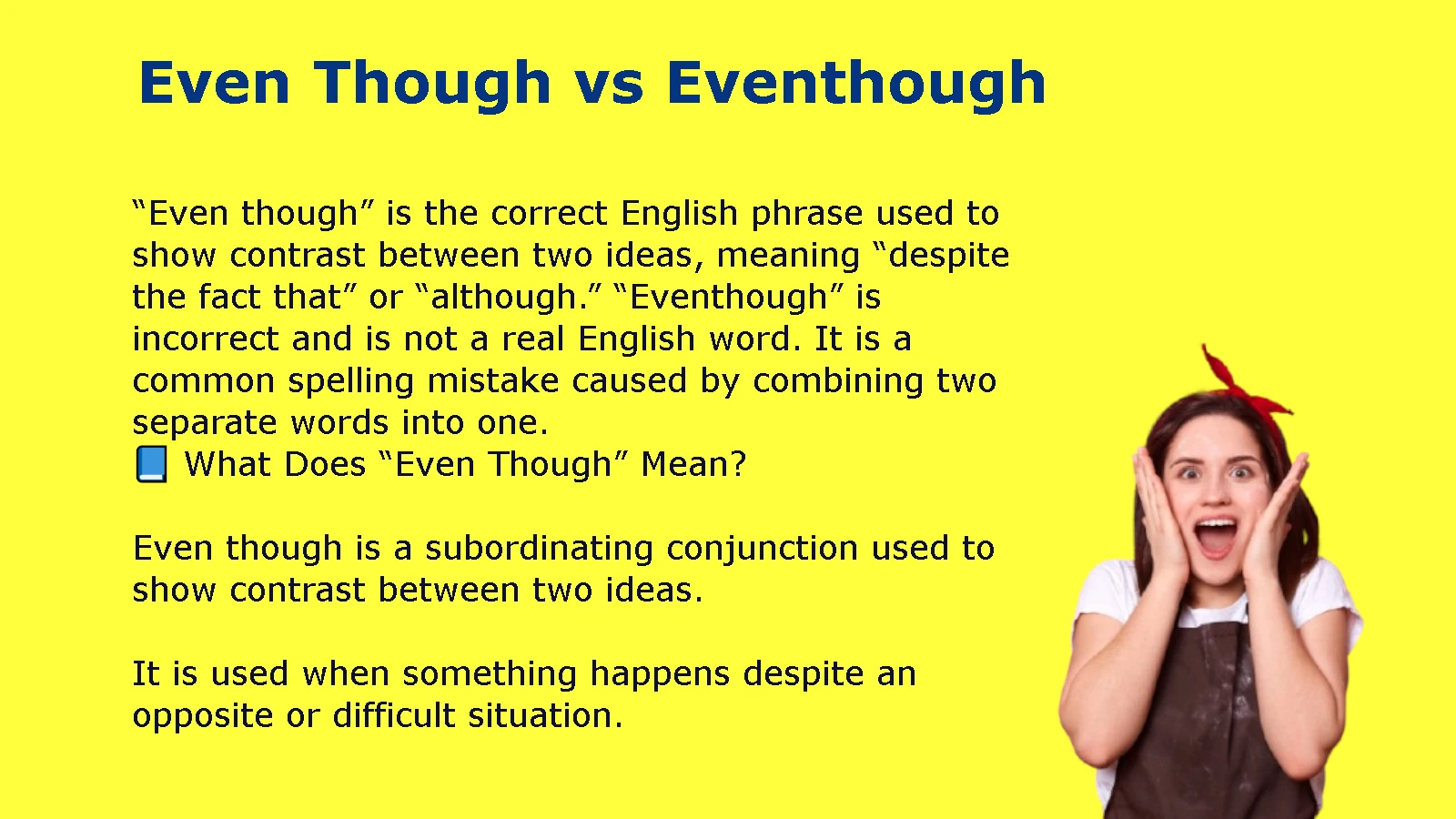
Even Though vs Eventhough is one of the most common English spelling confusions among learners and writers. The correct form is “even though” (two separate words), while “eventhough” is incorrect and not accepted in standard English grammar or dictionaries. This mistake usually happens because both words sound like a single unit when spoken quickly, leading many people to write them incorrectly.
The phrase “even though” is a subordinating conjunction used to show contrast between two ideas, meaning “despite the fact that” or “although.” It is widely used in academic writing, professional communication, exams, and everyday English because it clearly connects unexpected or opposite situations in a sentence.
In this guide on Even Though vs Eventhough, you will learn the correct usage, grammar rules, common mistakes, memory tricks, and real-life examples. By the end, you will clearly understand why only “even though” is correct and how to avoid this error in writing and exams.
🧠 Quick Comparison Table
| Word | Correct? | Meaning |
| even though | ✅ Yes | Despite the fact that / although |
| eventhough | ❌ No | Incorrect spelling (not a valid English word) |
Even Though vs Eventhough is one of the most common spelling mistakes in English writing. Many learners, students, and even fluent speakers sometimes write “eventhough” as one word. However, this is incorrect in standard English grammar.
The correct form is always “even though,” written as two separate words. This phrase is widely used in academic writing, professional communication, exams, and everyday conversation.
The confusion happens because when spoken, “even though” sounds like a single connected phrase. But English grammar often separates words even when they sound joined.
In this guide, you will learn everything about this confusion, including meaning, grammar rules, real-life examples, mistakes learners make, memory tricks, and FAQs. By the end, you will never confuse these two again.
📘 What Does “Even Though” Mean?
Even though is a subordinating conjunction used to show contrast between two ideas.
It is used when something happens despite an opposite or difficult situation.
✔ Simple Meaning
It means:
- although
- despite the fact that
- while
✔ Real-Life Understanding
We use “even though” when something unexpected happens:
- Even though it was raining → they went outside
- Even though he was tired → he kept working
- Even though she was nervous → she spoke confidently
✔ Basic Idea
👉 One situation does NOT stop another situation from happening.
📊 Simple Examples
- Even though it was cold, they went swimming.
- She passed the exam even though she didn’t study much.
- He finished the work even though he was sick.
- Even though the road was long, they continued walking.
❌ Is “Eventhough” a Real English Word?
No. “Eventhough” is NOT a real English word.
It is always considered incorrect in:
- grammar books
- dictionaries
- academic writing
- professional communication
❌ Why It Is Incorrect
“Eventhough” is wrong because:
- It combines two separate words incorrectly
- It breaks English grammar rules
- It is not recognized officially
👉 Only “even though” is correct.
🔍 Why People Confuse “Even Though” and “Eventhough”
This mistake is extremely common. Here’s why:
1. Spoken Language Confusion
When spoken quickly:
👉 “even though” sounds like one word
So learners assume it is written as one word.
2. Fast Typing Habits
People often type quickly on mobile phones:
- even + though → eventhough (mistake)
3. Lack of Grammar Awareness
Many learners assume all phrases are single words.
But English has many fixed phrases written separately.
4. Internet Influence
On social media, informal writing often ignores grammar rules.
🧠 Easy Memory Tricks
Here are simple tricks to always remember the correct form:
✔ Trick 1: Two Words = Two Meanings
- even = emphasis
- though = contrast
👉 Two meanings = two words
✔ Trick 2: Separation Rule
If ideas are separate, words must be separate.
✔ Trick 3: Visual Rule
Always imagine:
EVEN + space + THOUGH
❌ never joined
📊 Real Usage Examples
✔ Correct Sentences
- Even though he was tired, he kept working.
- She smiled even though she was sad.
- Even though it was expensive, I bought it.
- They continued even though it was difficult.
❌ Incorrect Sentences
- Eventhough he was tired, he kept working.
- She smiled eventhough she was sad.
- They succeeded eventhough it was difficult.
📌 When to Use “Even Though”
Use it when:
- showing contrast
- expressing unexpected results
- connecting opposite ideas
✔ Everyday Use Cases
- weather contrast
- emotional contrast
- effort vs result
- expectation vs reality
🚫 When NOT to Use “Eventhough”
Never use it in:
- essays
- IELTS writing
- job applications
- emails
- exams
- reports
👉 It is always marked incorrect.
🔄 Even Though vs Although (Important Bonus)
Many learners confuse these two.
Both are correct but slightly different.
✔ Even Though
- stronger emphasis
- emotional contrast
- spoken English
Example:
- Even though it hurt, she smiled.
✔ Although
- formal tone
- academic writing
- neutral contrast
Example:
- Although it hurt, she smiled.
👉 Both are correct, but usage depends on tone.
🧪 Common Mistakes Learners Make
- Writing “eventhough” ❌
- Using it too frequently
- Confusing it with “even if”
- Incorrect sentence placement
🧠 Grammar Insight (Advanced Understanding)
“Even though” is a subordinating conjunction, which means it connects two parts of a sentence:
- a dependent clause (cannot stand alone)
- an independent clause (complete idea)
✔ Sentence Structure
👉 Even though + situation A, situation B
Example:
- Even though he was tired, he finished the work.
Breakdown:
- Dependent clause: Even though he was tired
- Independent clause: he finished the work
🧠 Why This Matters
Understanding this helps you:
- write better essays
- avoid grammar mistakes
- improve IELTS/academic writing score
- sound more natural in English
📘 Deeper Meaning of “Even Though”
“Even though” is not just a linking phrase — it adds emphasis and surprise.
It shows:
- unexpected results
- strong contrast
- emotional situations
✔ Emotional Examples
- Even though she was hurt, she forgave him.
- Even though he lost everything, he stayed hopeful.
- Even though they were scared, they kept going forward.
👉 This makes writing more expressive and powerful.
🔍 Common Confusion: Even Though vs Even If
Many learners also confuse these two.
✔ Even Though (REALITY)
Used when something is true:
- Even though it was raining, we went out. (It really rained)
✔ Even If (POSSIBILITY)
Used when something is hypothetical:
- Even if it rains, we will go out. (Maybe it rains, maybe not)
📊 Quick Comparison
| Phrase | Type | Example |
| even though | real situation | Even though it rained, we went out |
| even if | possible situation | Even if it rains, we will go out |
🧪 More Real-Life Examples (Advanced)
✔ Academic Writing
- Even though the results were limited, the study provides useful insights.
✔ Business English
- Even though the market is competitive, the company is growing.
✔ Daily Life
- Even though I was busy, I called her.
✔ Emotional Context
- Even though he was disappointed, he stayed calm.
❌ Common Learner Mistakes Explained
❌ Mistake 1: Writing it as one word
- eventhough ❌
👉 This is always wrong
❌ Mistake 2: Confusing with “even if”
Learners often mix:
- even though (real)
- even if (possible)
❌ Mistake 3: Wrong punctuation
- Even though he was tired he continued ❌
- Even though he was tired, he continued ✔
❌ Mistake 4: Overusing in writing
Using “even though” too many times can make writing repetitive.
🧠 Memory Master Trick (Very Powerful)
👉 Think:
EVEN = emphasis
THOUGH = contrast
So:
👉 Emphasis + contrast = two words
✔ even though
❌ eventhough
A Quick Look Back: Origin & Historical Usage of “Even Though”
Understanding the origin of a phrase helps you remember it more deeply and use it correctly.
📘 Historical Development
The phrase “even though” developed from Middle and Early Modern English, where writers combined:
- “even” → used for emphasis
- “though” → used to show contrast
Over time, English grammar standardized this as a fixed two-word conjunction.
📚 Why It Stayed Two Words
Unlike some English words that merge over time (like today or cannot), “even though” remained separate because:
- It functions as two grammatical units
- It carries emphasis + contrast separately
- It behaves like a phrase, not a single word
🧠 Linguistic Insight
In linguistics, “even though” is called a:
👉 complex subordinating conjunction
This means:
- it connects ideas
- but still keeps words structurally independent
📌 Key Historical Rule
Even though:
✔ always remained two words in formal writing
❌ never evolved into a single word in standard English
👉 That is why “eventhough” never existed historically or grammatically.
❌ H2: Why “Eventhough” Will Never Be Correct — Linguistically or Grammatically
This is one of the most important sections for SEO clarity and authority.
🚫 1. It Breaks English Word Structure
English does NOT combine these two words because:
- “even” is an adverb
- “though” is a conjunction
👉 They perform different grammatical roles.
So merging them destroys sentence structure logic.
🚫 2. It Has No Dictionary Recognition
“Eventhough” does NOT appear in:
- Oxford Dictionary
- Cambridge Dictionary
- Merriam-Webster
- Collins Dictionary
👉 If a word is not in dictionaries, it is not standard English.
🚫 3. No Native Usage Exists
Native English writers:
- never use “eventhough” in formal writing
- only produce it accidentally as a typo
👉 It is purely a typing error phenomenon, not a real word.
🚫 4. Grammar Rules Do Not Allow It
English grammar requires separation because:
- “even” modifies emphasis
- “though” introduces contrast
If combined:
👉 sentence meaning becomes grammatically unclear
🚫 5. Spellcheck Logic Rejects It
Modern tools like:
- Grammarly
- Microsoft Word
- Google Docs
automatically correct:
👉 eventhough → even though
🧠 Linguistic Truth
👉 “Eventhough” is not evolving English
👉 It is not informal English
👉 It is not British or American English
✔ It is simply a spelling mistake.
Common Myths & Misconceptions About “Eventhough”
Many learners continue using “eventhough” because of misunderstandings. Let’s clear them one by one.
❌ Myth 1: “Eventhough is informal English”
👉 False
There is NO informal version of this phrase.
✔ Correct: even though
❌ Incorrect: eventhough
❌ Myth 2: “Both spellings are acceptable”
👉 False
English has only ONE correct form.
✔ even though only
❌ Myth 3: “Native speakers also write eventhough”
👉 Partially misleading
Native speakers may:
- mistype it
- type quickly on mobile
But they NEVER use it in correct grammar.
❌ Myth 4: “It depends on region (US/UK)”
👉 False
There is:
- no American version
- no British version
Both use the same rule:
👉 even though
❌ Myth 5: “It is evolving into a single word”
👉 False
English does not merge this phrase because:
- grammar structure prevents it
- usage requires separation
- dictionaries reject it
🧠 Key Insight
Most confusion comes from:
- fast typing
- pronunciation illusion
- lack of grammar awareness
👉 Not from actual language rules.
📌 Final Summary of Myths
| Myth | Truth |
| It is informal | ❌ False |
| Both are correct | ❌ False |
| Native speakers use it | ❌ Only as typo |
| It depends on region | ❌ False |
| It is evolving | ❌ False |
Self Assessment
Test your understanding of Even Though vs Eventhough with these 23 practice questions. Fill in the blanks with the correct phrase (even though).
✍️ Self Assessment Questions
- ______ it was raining, they continued their journey.
- She passed the exam ______ she didn’t study much.
- ______ he was tired, he finished his homework.
- I went to work ______ I was feeling sick.
- ______ the road was long, we kept walking.
- He smiled ______ he was very sad inside.
- ______ it was expensive, she bought the dress.
- They kept playing ______ it was getting dark.
- I helped him ______ he didn’t ask for it.
- ______ she was nervous, she gave a great speech.
- He went out ______ it was cold outside.
- ______ the task was difficult, they completed it on time.
- She kept working ______ she was exhausted.
- ______ it was late, they continued studying.
- I stayed calm ______ I was under pressure.
- ______ he had no money, he started the business.
- She forgave him ______ he hurt her feelings.
- ______ the weather was bad, we went hiking.
- He kept trying ______ he failed many times.
- ______ it was a small room, it felt comfortable.
- They succeeded ______ many people doubted them.
- ______ I was busy, I answered the call.
- She kept smiling ______ she was going through hardship.
✔️ Answer Key
- even though
- even though
- even though
- even though
- even though
- even though
- even though
- even though
- even though
- even though
- even though
- even though
- even though
- even though
- even though
- even though
- even though
- even though
- even though
- even though
- even though
- even though
- even though
❓ FAQ
Is “eventhough” correct in English?
No. It is always incorrect.
Why is “eventhough” wrong?
Because it combines two separate grammatical words incorrectly.
What is the correct form?
The correct form is even though.
Can I use “eventhough” in exams?
No. It will be marked as wrong in all exams.
Is “even though” formal or informal?
It can be used in both:
- informal speech ✔
- academic writing ✔
- professional communication ✔
What is the easiest way to remember it?
Always remember:
👉 two meanings = two words
🏁 FINAL RULE (VERY IMPORTANT)
👉 Always write: even though
👉 Never write: eventhough
📌 FINAL TAKEAWAY
The difference between Even Though and Eventhough is simple but very important in English grammar. “Even though” is the correct and standard phrase used to show contrast, while “eventhough” is always a spelling mistake.
Using the correct form improves:
- writing accuracy
- grammar score
- professional communication
- overall English fluency
👉 Mastering this small detail makes your English look much more polished and confident.