long term vs long-term — have you ever wondered which form is correct while writing, or whether both are acceptable in English? This is one of the most common grammar and spelling confusions, especially among learners, content writers, and professionals who want to maintain accuracy in their communication. Even a small hyphen can change how a word functions in a sentence, which is why understanding the difference between “long term” and “long-term” is important.
In simple terms, “long term” is usually used as a noun phrase, referring to an extended period of time, while “long-term” works as an adjective used to describe something that lasts for a long duration, such as long-term goals, long-term planning, or long-term effects. Although they look almost identical, their grammatical roles are different, and using them correctly can significantly improve the clarity and professionalism of your writing.
This confusion often appears in searches like long term vs long-term, long term meaning, how to use long-term in a sentence, and common English grammar mistakes. If you’ve ever hesitated while writing sentences like “long-term investment” or “in the long term,” this guide will help you understand the difference with simple explanations and practical examples.
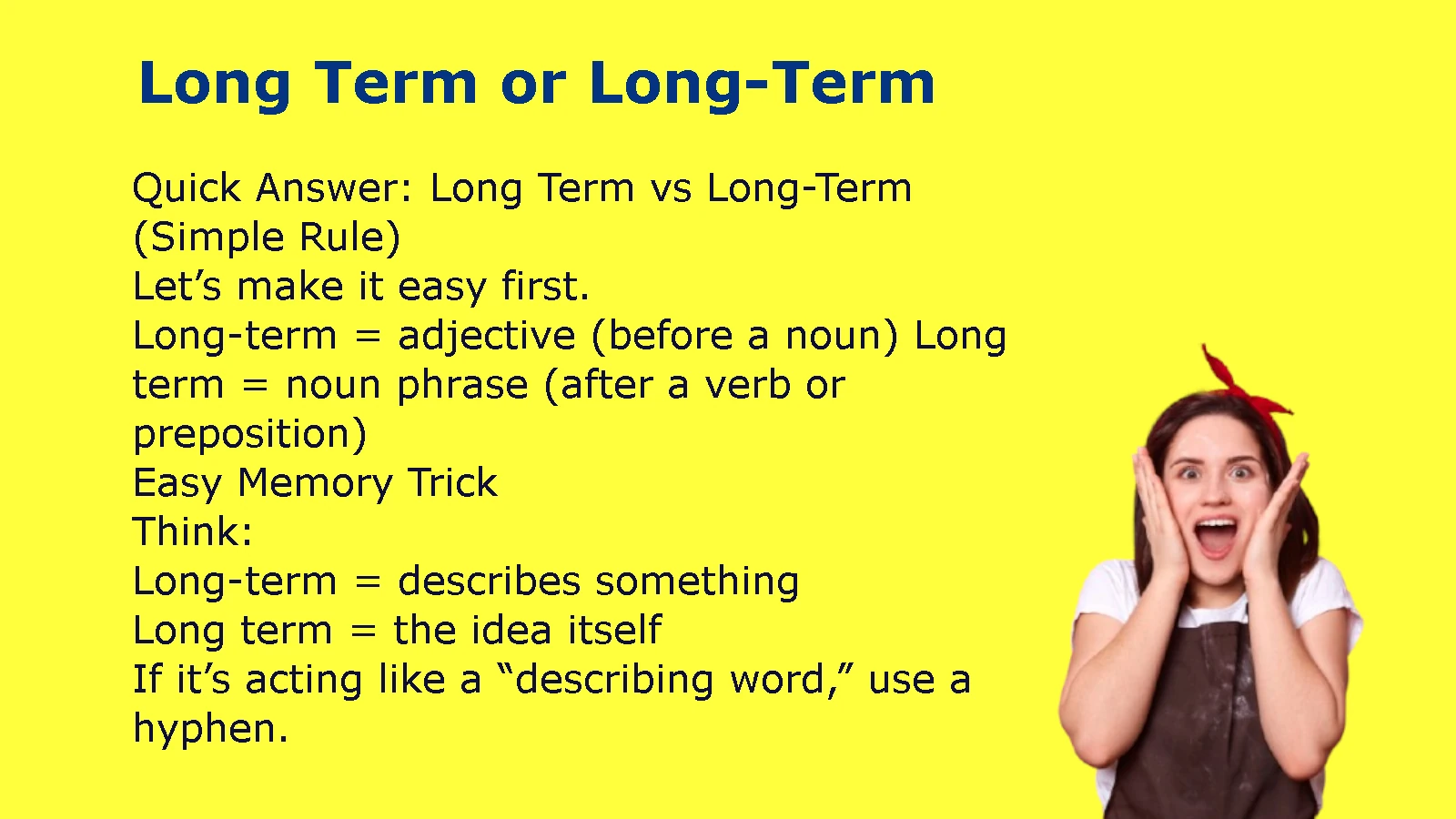
Quick Answer: Long Term vs Long-Term (Simple Rule)
Let’s make it easy first.
Long-term = adjective (before a noun) Long term = noun phrase (after a verb or preposition)
Easy Memory Trick
Think:
- Long-term = describes something
- Long term = the idea itself
If it’s acting like a “describing word,” use a hyphen.
Why “Long Term or Long-Term” Confuses So Many People
The confusion comes from one thing: English punctuation rules feel inconsistent.
People often see both versions in books, articles, and social media, so they assume both are interchangeable. But they’re not.
The real problem:
- Writers focus on meaning, not grammar structure
- Hyphens are often ignored in casual writing
- Both phrases sound identical when spoken
So the difference is invisible—until you write it.
The Grammar Logic Behind “Long-Term” vs “Long Term”
Let’s break it down simply.
When it becomes “Long-Term”
Use long-term when it comes before a noun.
Examples:
- Long-term plan
- Long-term investment
- Long-term strategy
Here, “long-term” is acting like a single describing unit.
When it becomes “Long Term”
Use long term when it is used as a noun phrase.
Examples:
- In the long term, this will help you
- We are thinking about the long term
- It pays off in the long term
Here, it refers to a period of time, not a description.
Is “longterm” correct?
No, “longterm” is not correct in standard English. It is commonly seen in informal writing, typing errors, or unedited content. In formal writing, grammar, and professional communication, you should avoid it.
The correct forms are:
- long term (noun phrase)
- long-term (adjective)
When to use “long term”
Use long term (two words) when it functions as a noun phrase.
Examples:
- We are planning for the long term.
- Success in the long term requires patience.
- He is thinking about the long term, not short-term gains.
👉 Here, “long term” refers to a period of time in general.
When to use “long-term”
Use long-term (with a hyphen) when it acts as an adjective before a noun.
Examples:
- This is a long-term investment.
- She has a long-term goal.
- The company needs a long-term strategy.
👉 Here, “long-term” describes something.
One-line grammar rule you can memorize
Use “long-term” before a noun, and “long term” after a verb or preposition.
What Does “Long-Term” Mean?
Long-term refers to something that continues or is planned over a long period of time, usually years rather than days or months.
It is commonly used in:
- Business planning
- Finance and investment
- Education goals
- Health strategies
- Career development
What Does “Long Term” Mean?
Long term refers to the general concept of an extended period of time.
It is not used to describe a noun directly but instead functions as a standalone phrase.
Example usage:
- In the long term, habits matter more than motivation.
The Simple Grammar Rule (Easy Memory Trick)
Think of it this way:
- If it comes before a noun → hyphen (-) ✔ long-term plan ✔ long-term effects
- If it stands alone → no hyphen ✔ in the long term ✔ for the long term
Comparison Table
| Feature | Long Term | Long-Term |
| Part of Speech | Noun phrase | Compound adjective |
| Meaning | A long period of time in the future | Describes something lasting a long time |
| Hyphen Needed? | No | Yes |
| Position in Sentence | Usually after a verb or preposition | Usually before a noun |
| Example | We are planning for the long term. | We need a long-term strategy. |
| Common Usage | Future planning, goals, results | Plans, investments, relationships, projects |
| Grammar Function | Acts as a thing or concept | Acts as a describing word |
Grammar Guide
Understanding the difference between long term and long-term is simple once you know their grammatical roles. Although both expressions relate to an extended period of time, they are not always interchangeable.
How Each Term Is Used in Sentences
Long term functions as a noun phrase.
Examples:
- We must think about the long term.
- The company focuses on success in the long term.
- These changes will benefit us over the long term.
Long-term functions as a compound adjective that describes a noun.
Examples:
- She created a long-term business plan.
- We need a long-term solution.
- The organization has long-term goals.
Common Mistakes Learners Make
Many English learners make these mistakes:
❌ We need a long term plan. ✅ We need a long-term plan.
The project is focused on long-term. ✅ The project is focused on the long term.
They discussed long-term. ✅ They discussed the long term.
Simple Rules to Remember
- If the phrase describes a noun, use long-term.
- If the phrase stands alone as a thing or concept, use long term.
- Compound adjectives before nouns typically require a hyphen.
Quick Tips for Writing and Speaking
- Ask yourself whether a noun follows the phrase.
- If a noun comes immediately after it, choose long-term.
- If not, choose long term.
- Business and academic writing frequently use long-term because it often modifies nouns like strategy, growth, or investment.
When to Use Each One
Use Long Term When:
Use long term when referring to an extended future period.
Examples:
- We are investing for the long term.
- Consider the consequences in the long term.
- The benefits will appear over the long term.
Use Long-Term When:
Use long-term when describing a noun.
Examples:
- We need a long-term solution.
- She has a long-term vision.
- The company follows a long-term strategy.
When NOT to Use Each One
Do Not Use Long Term
Avoid long term directly before a noun.
❌ long term investment ✅ long-term investment
❌ long term plan ✅ long-term plan
Do Not Use Long-Term
Avoid long-term when no noun follows it.
❌ We are thinking about the long-term. ✅ We are thinking about the long term.
❌ Success comes in the long-term. ✅ Success comes in the long term.
Which One to Use (Decision Guide)
Follow this quick decision guide:
- Is the phrase describing a noun?
- Yes → Use long-term.
- No → Continue.
- Is the phrase referring to an extended future period?
- Yes → Use long term.
Examples:
- Long-term goal → adjective + noun.
- In the long term → noun phrase.
- Long-term relationship → adjective + noun.
- Over the long term → noun phrase.
Why Do People Get Confused?
People often confuse these forms because:
- Spoken English sounds the same
- Fast typing removes hyphens
- Informal writing ignores grammar rules
- Auto-correct sometimes misses hyphenation
Also, many compound words in English evolve over time, which adds to confusion.
Common Mistakes Writers Make
1. Writing “longterm”
❌ Incorrect: longterm planning ✔ Correct: long-term planning
2. Mixing forms
❌ Incorrect: long term investment strategy ✔ Correct: long-term investment strategy
3. Overusing hyphens
❌ Incorrect: in the long-term ✔ Correct: in the long term
Is “Longterm” Correct?
No, “longterm” is not accepted in formal English writing.
However, you may occasionally see it in:
- Social media posts
- Draft notes
- Informal messaging
Still, for SEO, academic writing, or professional content, avoid it completely.
Is “long-term” always hyphenated?
No. It is only hyphenated when used as an adjective before a noun.
- ✔ long-term growth
- ❌ in the long-term (wrong in most cases)
Is it long term or long-term?
Both are correct, but usage depends on grammar:
- long-term → adjective (before noun)
- long term → noun phrase (general idea of time)
Can I write “longterm”?
No. It is considered incorrect in standard English writing.
What is the difference between long term and long-term?
- Long term = general time period
- Long-term = describing something that lasts a long time
Why is hyphen used in long-term?
The hyphen is used to:
- Connect two words acting as one adjective
- Improve readability
- Avoid confusion in sentence structure
Example:
- long-term plan (clear adjective) Without hyphen, meaning becomes less clear.
Simple Position Rule (Easy Visual Trick)
Think of it like placement:
- Before noun → Long-term
- After verb/preposition → Long term
Example:
- Long-term success (✔ before noun)
- Success in the long term (✔ after phrase)
Position decides everything.
“Long-Term” Explained Clearly (With Examples)
“Long-term” is used when describing something that lasts for a long time.
Common Uses:
- Long-term goals
- Long-term relationship
- Long-term effects
Real-Life Example:
“She has a long-term career plan.”
Here, “long-term” describes the type of plan.
Key Insight:
If you can replace it with “sustainable” or “lasting,” hyphen is usually needed.
“Long Term” Explained Clearly (With Examples)
“Long term” refers to time in general—not as a descriptor.
Common Uses:
- We should think in the long term
- This decision benefits us in the long term
- In the long term, things improve
Real-Life Example:
“This strategy will help in the long term.”
Here, it refers to a period of time.
Key Insight:
If it feels like “a time period,” no hyphen is needed.
The Most Common Mistake People Make
Here’s where things go wrong.
People either:
- Add hyphens everywhere (over-correcting)
- Or remove hyphens completely (informal writing)
Wrong Examples:
- Long term plan ❌
- In the long-term ❌ (when used as noun phrase)
Why it happens:
People don’t check grammatical role—they just guess.
Real-Life Examples of “Long-Term”
Correct Usage:
- “We need a long-term solution.”
- “He made a long-term investment.”
- “They are in a long-term partnership.”
What it means:
It describes something designed to last.
Real-Life Examples of “Long Term”
Correct Usage:
- “In the long term, it will work.”
- “We should think about the long term.”
- “This decision benefits us in the long term.”
What it means:
It refers to future time, not description.
Why This Mistake Matters in Writing
It may look small, but it affects:
- Academic writing
- Business communication
- SEO content quality
- Professional credibility
A missing hyphen can change tone and clarity.
Quick Fix Strategy (Never Get It Wrong Again)
Use this simple checklist:
Ask yourself:
- Is it before a noun? → Use hyphen
- Is it talking about time? → No hyphen
- Still unsure? → Rephrase sentence
Better Alternatives You Can Use
Instead of guessing, you can also write:
- “Over a long period”
- “For the future”
- “Over time”
- “Sustainable”
These remove confusion completely.
Real-World Practical Examples
Long Term Examples
- Investors often focus on the long term.
- The policy may help in the long term.
- Think about your career in the long term.
- The benefits will become clear over the long term.
- We should plan for the long term.
Long-Term Examples
- The company adopted a long-term growth strategy.
- She is looking for a long-term commitment.
- They developed a long-term financial plan.
- The project requires long-term funding.
- We need a long-term solution to the problem.
Self-Assessment (Fill in the Blanks)
Choose long term or long-term.
- We need a ______ strategy.
- Think about the ______ effects.
- The company invests for the ______.
- She wants a ______ relationship.
- Success often comes in the ______.
- They created a ______ business plan.
- Consider the ______ consequences.
- We are planning for the ______.
Answers
- long-term
- long-term
- long term
- long-term
- long term
- long-term
- long-term
- long term
FAQ: Long Term vs Long-Term
Is “long term” ever incorrect?
No. It is correct when used as a noun phrase.
Is “long-term” always hyphenated?
Only when it is used as an adjective before a noun.
Why do books use both?
Because grammar changes based on sentence structure.
Which one is more common?
“Long-term” is more common in writing.
Final Takeaway: The Simple Rule That Always Works
Here’s everything in one line:
- Long-term = describing word before a noun
- Long term = time period or idea
If you remember just one thing, remember this:
👉 If it describes something, hyphen it. 👉 If it’s just time, don’t.
That’s it. No confusion needed.
Because in the end, mastering “Long Term or Long-Term” isn’t about memorizing rules—it’s about recognizing how the word is used in context.