Trash vs Garbage is one of the most common vocabulary questions among English learners and even native speakers. Have you ever stopped while speaking or writing and wondered whether these two words mean exactly the same thing? Although they are often used interchangeably in everyday conversation, Trash and Garbage have slightly different meanings and are preferred in different contexts. Understanding the distinction can improve your vocabulary, make your writing more accurate, and help you communicate naturally in both casual and professional situations.
In simple terms, Garbage usually refers to kitchen or food waste that is likely to decompose, while Trash is a broader term for dry waste such as paper, plastic, cardboard, clothing, packaging, and other unwanted items. Although the distinction isn’t always strict—especially because regional English varies—knowing the traditional meanings will help you choose the right word in different situations. You’ll also notice that Trash and Garbage are commonly used in American English, whereas speakers of British English often prefer words like Rubbish or Waste instead.
This confusion leads many people to search for phrases such as trash meaning, garbage meaning, difference between trash and garbage, when to use trash or garbage, and trash vs. garbage. Since both words refer to things we throw away, it’s easy to mix them up. However, learning the subtle differences will strengthen your grammar, expand your vocabulary, and help you avoid common English word mistakes.
In this guide, you’ll learn the complete difference between Trash and Garbage, including their definitions, pronunciation, grammar rules, regional usage, real-life examples, common mistakes, and simple memory tricks. By the end, you’ll know exactly when to use each word confidently in both writing and everyday conversation.
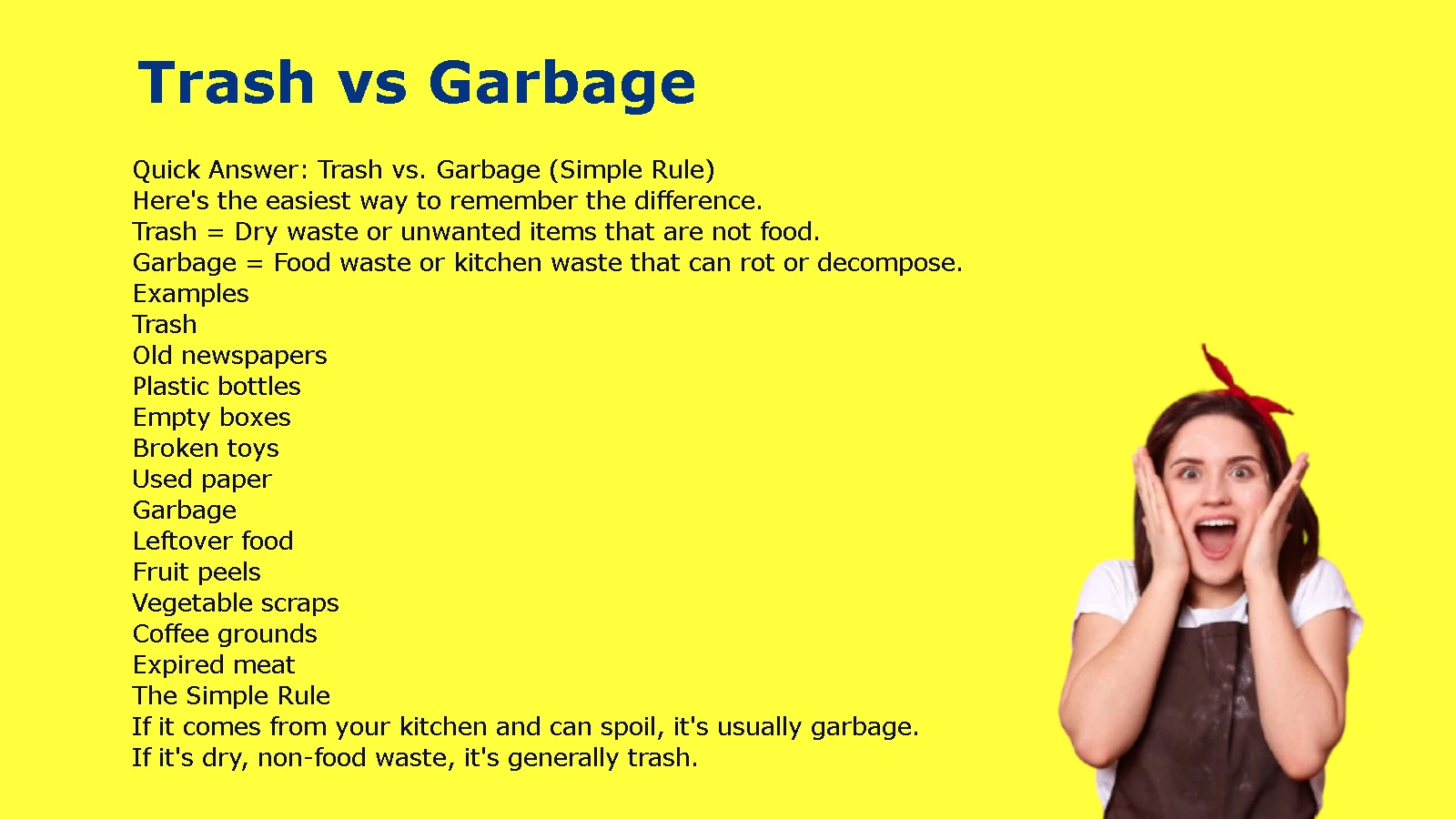
Quick Answer: Trash vs. Garbage (Simple Rule)
Here’s the easiest way to remember the difference.
Trash = Dry waste or unwanted items that are not food.
Garbage = Food waste or kitchen waste that can rot or decompose.
Examples
Trash
- Old newspapers
- Plastic bottles
- Empty boxes
- Broken toys
- Used paper
Garbage
- Leftover food
- Fruit peels
- Vegetable scraps
- Coffee grounds
- Expired meat
The Simple Rule
If it comes from your kitchen and can spoil, it’s usually garbage.
If it’s dry, non-food waste, it’s generally trash.
Easy Memory Trick
Think of the letter G in Garbage.
G = Groceries
Anything left over from groceries or meals usually becomes garbage.
Now think of Trash.
Imagine throwing away random household items like paper, plastic, or cardboard.
Easy Formula
Kitchen waste → Garbage
Everything else → Trash
This simple trick works in most everyday situations.
How People Actually Use “Trash” and “Garbage”
Here’s where things become interesting.
Although dictionaries define these words differently, many people don’t follow those definitions in daily conversation.
In Everyday Conversations
Many Americans say:
“Take out the trash.”
Even if the trash bag contains leftover food.
Others say:
“Take out the garbage.”
Even when it includes paper, cans, and plastic bottles.
For many families, both expressions mean exactly the same thing.
At Home
Parents might say:
- “Don’t forget the trash.”
- “Can you empty the garbage?”
Both usually refer to the household waste bin.
At Work
Offices almost always use trash because office waste mostly consists of paper, packaging, and disposable items rather than food.
You’ll often hear:
- Trash can
- Trash bin
- Trash room
Instead of:
- Garbage can
Why This Happens
Language changes through everyday use.
People often choose the word they’ve grown up hearing rather than following a strict dictionary definition.
That means context usually matters more than technical accuracy.
The Real Difference Between Trash and Garbage
To understand these words clearly, think about what you’re throwing away, not just the word itself.
Think About the Type of Waste
Trash
Dry materials
- Paper
- Plastic
- Glass
- Cardboard
- Clothing
- Furniture
- Packaging
Garbage
Organic materials
- Leftover meals
- Fruit skins
- Vegetable peels
- Meat scraps
- Eggshells
- Food that has spoiled
Why the Difference Matters
Garbage can:
- Smell bad
- Attract insects
- Rot quickly
- Require frequent disposal
Trash usually:
- Stays dry
- Doesn’t decompose quickly
- Can often be recycled
This is why many cities separate garbage collection from recycling or general trash collection.
“Trash” Explained Clearly (With Examples)
The word trash refers to unwanted items that are generally dry and not biodegradable food waste.
Think of it as everyday household junk.
Common Examples of Trash
- Empty cereal boxes
- Plastic shopping bags
- Old magazines
- Broken pencils
- Worn-out shoes
- Tissue boxes
- Wrapping paper
- Aluminum foil
- Plastic containers
Example Sentences
“I forgot to take out the trash.”
“The trash can is full.”
“Please throw this wrapper in the trash.”
“The office trash is collected every evening.”
When “Trash” Sounds Most Natural
You’ll hear trash frequently when talking about:
- Homes
- Offices
- Schools
- Parks
- Public places
Common Expressions
Take out the trash.
Trash bag.
Trash can.
Trash bin.
Trash pickup.
Trash collection.
Trash truck.
Because these phrases are so common, many people use trash as a general word for all household waste.
“Garbage” Explained Clearly (With Examples)
The word garbage traditionally refers to waste from cooking or eating.
It usually includes materials that spoil over time.
Common Examples of Garbage
- Banana peels
- Apple cores
- Leftover pizza
- Chicken bones
- Coffee filters
- Vegetable scraps
- Eggshells
- Spoiled milk
- Moldy bread
Example Sentences
“The garbage smells terrible.”
“Please throw the food scraps into the garbage.”
“We need to empty the garbage before it starts smelling.”
“The garbage disposal is clogged.”
When “Garbage” Sounds Most Natural
You’ll often hear garbage in situations involving food waste.
For example:
Restaurants
Commercial kitchens
Food preparation
Waste management
Kitchen cleaning
Garbage Disposal
One place where garbage is almost always used is in the phrase:
Garbage disposal
This is the machine installed under many kitchen sinks that grinds food waste.
People don’t normally say:
❌ Trash disposal
Instead, they say:
✅ Garbage disposal
The Biggest Mistake People Make
The most common mistake isn’t using the wrong word.
It’s assuming that trash and garbage always have different meanings.
In reality, millions of native English speakers use them interchangeably.
What Goes Wrong?
One person follows dictionary definitions.
Another simply says whatever sounds natural.
Both understand each other.
That’s why learners become confused.
Real-Life Scenario
Imagine you’re visiting an American friend’s house.
You ask:
“Where should I put these banana peels?”
Your friend replies:
“Just throw them in the trash.”
Technically, banana peels are garbage.
But the household waste container is commonly called the trash can, regardless of what’s inside.
This isn’t incorrect.
It’s simply natural everyday English.
Side-by-SSide Comparison Table
| Feature | Trash | Garbage |
| Main Meaning | Dry household waste | Food and kitchen waste |
| Includes Food? | Usually no | Yes |
| Can Rot? | Rarely | Yes |
| Common Location | Home, office, school | Kitchen |
| Smells Quickly | Usually no | Yes |
| Dictionary Difference | Dry waste | Organic waste |
| Everyday Use | Often used for all waste | Often used for food waste |
| Common Expression | Trash can | Garbage disposal |
| Formal Accuracy | Dry materials | Food materials |
| Everyday Flexibility | Very high | High |
Key Takeaway So Far
Remember these three simple ideas:
- Trash usually refers to dry, non-food waste.
- Garbage traditionally means food or kitchen waste.
- In everyday American English, people often use both words interchangeably, so context matters more than strict definitions.
Real-Life Examples of Trash
Let’s see how trash is used in everyday situations. These examples reflect the way native English speakers commonly talk about household and public waste.
Common Situations
- “Please take out the trash before dinner.”
- “The trash can is overflowing.”
- “Throw the empty bottle in the trash.”
- “Our trash is collected every Tuesday morning.”
- “Don’t leave trash on the beach.”
What They Mean
In all of these examples, trash refers to general household or public waste. It may include paper, plastic, cardboard, packaging, and even some food scraps because people often use the word broadly.
Mini Scenario
Sarah finishes opening a package.
She asks:
“Where’s the trash can?”
She throws away:
- The cardboard box
- Plastic wrapping
- Packing paper
Since none of these items are food waste, trash is the perfect choice.
Real-Life Examples of Garbage
Now compare how garbage is used.
Common Situations
- “The garbage smells awful.”
- “Throw the leftover pasta into the garbage.”
- “Don’t leave garbage outside overnight.”
- “The garbage needs to be taken out.”
- “Please separate the garbage from the recycling.”
What They Mean
These examples usually involve food waste or organic materials that can spoil, smell, or attract insects.
Mini Scenario
After dinner, James cleans the kitchen.
He throws away:
- Chicken bones
- Vegetable peels
- Coffee grounds
- Leftover rice
These items are traditionally called garbage because they come from food preparation and meals.
Regional Differences: Trash vs. Garbage Around the World
English isn’t spoken the same way everywhere. Different countries prefer different words for waste.
In the United States
Both trash and garbage are widely used.
Generally:
- Trash = dry waste
- Garbage = food waste
However, many Americans use trash as a general term for all household waste.
You’ll commonly hear:
- Trash can
- Trash pickup
- Trash bag
Even if the bag contains food scraps.
In Canada
Canadian English is similar to American English.
Both words are understood, although garbage is often heard more frequently in everyday conversation.
Examples:
- Garbage day
- Garbage truck
- Garbage collection
At the same time, people also say:
- Trash bin
- Trash can
In the United Kingdom
British English rarely uses trash in everyday speech.
Instead, people usually say:
- Rubbish
- Bin
- Waste
Examples:
- Put it in the bin.
- Take out the rubbish.
- The rubbish collection is tomorrow.
If you use trash in the UK, people will still understand you because of American movies and TV shows, but it isn’t the most natural choice.
In Australia and New Zealand
People commonly say:
- Rubbish
- Bin
- Waste
For example:
- Put it in the rubbish bin.
- Take the rubbish out.
The word garbage appears less often except in technical or American-influenced contexts.
Why Regional Differences Matter
If you’re writing for an international audience, choose words your readers expect.
For example:
American audience
✅ Trash can
British audience
✅ Rubbish bin
Choosing the right regional vocabulary makes your English sound more natural.
Common Expressions Using Trash and Garbage
Learning common phrases is often more useful than memorizing dictionary definitions.
Popular Expressions with “Trash”
- Trash can
- Trash bin
- Trash bag
- Trash pickup
- Trash collection
- Trash truck
- Trash room
- Trash day
Example
“Our neighborhood has trash pickup every Wednesday.”
Popular Expressions with “Garbage”
- Garbage can
- Garbage bag
- Garbage truck
- Garbage collection
- Garbage disposal
- Garbage day
- Garbage service
Example
“The garbage disposal isn’t working.”
Notice that garbage disposal is the standard phrase for the kitchen appliance that grinds food waste.
The Impact of Choosing the Right Word
In casual conversations, using trash instead of garbage usually doesn’t cause problems.
However, in certain situations, the distinction can be important.
At Home
If someone asks you to separate waste, they may expect you to divide:
- Garbage
- Recycling
- Trash
Understanding the difference helps you sort waste correctly.
At Work
Restaurants often separate food waste from other waste.
Employees may receive instructions like:
- Put food scraps in the garbage container.
- Put cardboard in the recycling.
- Throw broken packaging in the trash.
Knowing the difference improves communication.
In Environmental Discussions
Waste management often classifies materials into different categories.
Examples include:
- Garbage (organic waste)
- Trash (general waste)
- Recycling
- Compost
- Hazardous waste
Here, the distinction becomes more meaningful.
How to Avoid Confusion Every Time
If you’re unsure which word to use, these simple strategies will help.
Think About the Waste
Ask yourself:
Is it food?
If yes, garbage is usually correct.
If not, trash is often the better choice.
Listen to Native Speakers
Pay attention to movies, podcasts, and everyday conversations.
You’ll notice that many speakers simply use trash for everything.
That’s perfectly natural in American English.
Match Your Audience
Writing for Americans?
Use trash naturally.
Writing for British readers?
Use rubbish instead.
Matching your audience makes your writing more authentic.
What to Say Instead (Clear Alternatives)
Sometimes another word is even better.
Here are some useful alternatives.
| Word | Best Used For |
| Waste | Formal writing |
| Rubbish | British English |
| Refuse | Legal or official documents |
| Litter | Waste left in public places |
| Debris | Broken materials after damage |
| Scrap | Leftover materials for reuse |
| Recycling | Reusable materials |
| Compost | Organic waste for gardening |
Quick Decision Guide (Use This Instantly)
Still unsure?
Follow this simple guide.
Food scraps?
→ Garbage
Paper, plastic, boxes, bottles?
→ Trash
Writing for the UK?
→ Rubbish
Writing formally?
→ Waste
Simple. Practical. Easy to remember.
Which word is more common?
In the United States, trash is slightly more common in casual conversation.
You’ll hear phrases like:
- Trash can
- Take out the trash
- Trash bag
very frequently.
Is “garbage” only food waste?
Traditionally, yes.
In modern conversation, however, many speakers use garbage to mean all household waste.
Which word should English learners use?
If you’re unsure, trash is usually the safest choice in American English because it’s widely understood and commonly used.
What do British people say instead?
Most British speakers prefer:
- Rubbish
- Bin
- Waste
rather than trash or garbage.
Case Study: A Small Household Mix-Up
Emma had recently moved from London to New York.
One evening, her roommate said:
“Could you take out the trash?”
Emma looked around the apartment.
She gathered newspapers, empty boxes, and plastic bottles.
She left the bag of leftover food in the kitchen because she thought trash meant only dry waste.
Later, her roommate asked:
“Why didn’t you take the food out?”
Emma replied:
“You said the trash, not the garbage.”
Both were technically correct based on the traditional definitions.
However, the roommate simply used trash as a general term for all household waste.
After that conversation, Emma realized that many Americans use trash to refer to everything in the household waste bin.
Key Facts You Should Remember
- Trash usually means dry, non-food household waste.
- Garbage traditionally refers to food and kitchen waste.
- Many Americans use the two words interchangeably.
- Trash can is more common than garbage can in everyday American English.
- Garbage disposal is the standard name for the kitchen appliance that grinds food waste.
- British English usually prefers rubbish instead of trash or garbage.
- Always consider your audience and regional English when choosing the word.
Final Takeaway: The One Rule That Makes It Easy
Here’s the simple truth.
The traditional difference between Trash and Garbage is easy to remember: trash refers to dry, non-food waste, while garbage refers to food and kitchen waste. However, everyday English doesn’t always follow strict dictionary definitions. In many American homes, people use trash and garbage interchangeably without causing confusion.
If you’re speaking casually in the United States, either word will usually be understood. But if you want to be precise, remember this simple rule:
- Food waste → Garbage
- Dry household waste → Trash
And if you’re writing for an international audience, be aware of regional preferences. British and Australian English generally favor rubbish, while American English commonly uses trash and garbage.
When in doubt, think about what you’re throwing away and who you’re speaking to. Choosing the right word isn’t just about grammar—it’s about communicating clearly and naturally. Once you understand the difference between Trash vs. Garbage, you’ll sound more confident in both everyday conversations and professional writing.