Have you ever come across the words “Cannon” vs “Canon” and wondered whether they mean the same thing or are just spelling variations? This is a common point of confusion in English because both words look and sound almost identical, yet they carry completely different meanings and are used in very different contexts.
In simple terms, a cannon refers to a large, heavy weapon that fires projectiles, often associated with war, military history, or powerful explosive force. You may also hear it in modern contexts like sports or machinery to describe something strong or forceful. On the other hand, canon refers to a set of rules, standards, or accepted principles, especially in literature, religion, or official bodies of work. For example, in storytelling, “canon” means the officially recognized content of a fictional universe.
Because of their similar spelling and pronunciation, learners often confuse these two words in writing and speech. However, understanding the difference between cannon vs canon is important for improving vocabulary accuracy, grammar confidence, and overall communication skills.
In this guide, you’ll learn the clear definitions of both words, real-life examples, and simple memory tricks to help you always choose the correct term in writing and conversation.
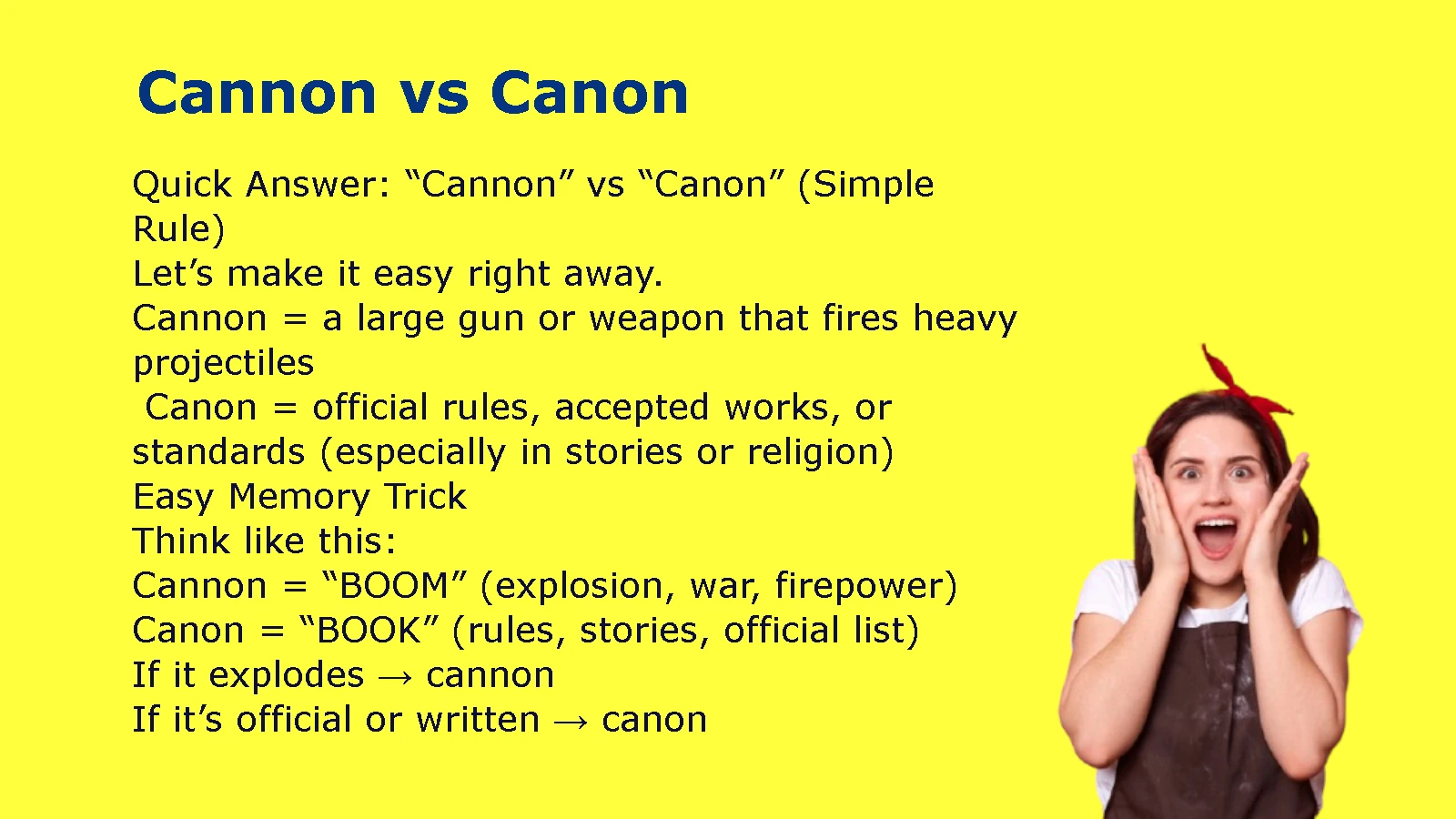
Quick Answer: “Cannon” vs “Canon” (Simple Rule)
Let’s make it easy right away.
Cannon = a large gun or weapon that fires heavy projectiles
Canon = official rules, accepted works, or standards (especially in stories or religion)
Easy Memory Trick
Think like this:
- Cannon = “BOOM” (explosion, war, firepower)
- Canon = “BOOK” (rules, stories, official list)
If it explodes → cannon
If it’s official or written → canon
Why People Confuse “Cannon” and “Canon”
The confusion is very common because:
- They are pronounced almost the same
- Spellcheck doesn’t always catch context errors
- Both are used in serious writing (military vs literature/fandom)
But meaning-wise, they are worlds apart.
“Cannon” Explained Clearly (With Real Meaning)
A cannon is a heavy weapon that fires large projectiles, often used in war or military history.
Standard Meaning
A cannon is:
- A large artillery gun
- Used in wars or historical battles
- Designed to fire explosive shells or heavy balls
Real-Life Examples
- “The castle was protected by a row of cannons.”
- “They fired a cannon during the celebration.”
- “Old naval ships carried massive cannons on deck.”
Where You See It Today
- Military history books
- Museums
- Movies about wars or pirates
- Historical reenactments
Key Idea
If it involves war, explosions, or heavy weapons → it’s cannon
“Canon” Explained Clearly (With Meaning in Language & Culture)
Now let’s move to the tricky one.
Canon has nothing to do with weapons. It refers to what is considered official, accepted, or authentic.
Main Meanings of Canon
- Official story/material in fiction
- Accepted rules or principles
- Religious laws or texts (in some contexts)
Canon in Storytelling (Most Common Use Today)
In books, movies, and TV shows, “canon” means what is officially part of the story universe.
Examples
- “That scene is not canon in the movie series.”
- “The spin-off is not part of the official canon.”
- “According to canon, the hero survived.”
Key Idea
If it belongs to the official story universe → canon
Canon in Religion (Traditional Use)
In religious contexts, canon refers to:
- Official sacred texts
- Accepted laws or teachings
Examples
- “The biblical canon includes these books.”
- “This text is part of the canon of scripture.”
Side-by-Side Comparison Table
| Word | Meaning | Category | Example |
| Cannon | Large weapon | Military / weapon | “The cannon fired at dawn.” |
| Canon | Official rules or stories | Literature / religion | “That scene is canon in the series.” |
The Biggest Mistake People Make
Here’s the real problem:
People mix them up in writing—especially in fandoms and online discussions.
What Goes Wrong
- “That movie isn’t cannon” ❌ (wrong)
- “The castle used a canon” ❌ (wrong)
Correct Versions
- “That movie isn’t canon” ✔
- “The castle used a cannon” ✔
Real-Life Confusion Examples
Example 1: Movies & Fandom
Wrong:
- “This theory is part of Star Wars cannon.”
Correct:
- “This theory is part of Star Wars canon.”
Example 2: History Writing
Wrong:
- “The army fired a canon at the fortress.”
Correct:
- “The army fired a cannon at the fortress.”
Example 3: Casual Conversation
Wrong:
- “Is this canon in the story?”
Correct:
- “Is this canon in the story universe?”
Why This Confusion Happens So Often
There are 3 main reasons:
- They sound almost identical
- Auto-correct doesn’t always help context
- People learn them in different subjects (history vs media)
So even fluent English speakers mix them up.
How to Never Confuse Them Again
Use this simple system:
Step 1: Ask yourself
- Is it about war or weapons? → cannon
- Is it about story rules or official truth? → canon
2: Use the sound trick
- Cannon = BOOM (explosion sound)
- Canon = BOOK (written rules)
3: Double-check writing
If you’re unsure, replace it:
- weapon → cannon
- story → canon
Quick Decision Guide
- Explosions, war, artillery → cannon
- Movies, books, story rules → canon
- Still unsure → check context carefully
FAQ: Cannon vs Canon
Is “canon” always about fiction?
No. It’s also used in religion and official rule systems.
Are “cannon” and “canon” pronounced the same?
Almost yes, which is why people confuse them.
Which is more commonly used?
“Canon” is more common in modern internet and media discussions.
Can they ever mean the same thing?
No. They are completely different words with unrelated origins.
Final Takeaway: The One Rule That Never Fails
Here’s the simplest way to lock it in:
- If it fires something → cannon
- If it is official or accepted → canon
Think of it this way:
One destroys walls.
The other defines stories.
And once you remember that, the confusion between “cannon vs canon” disappears forever.