Have you ever stopped while writing and wondered whether to use Color vs Colour and which spelling is actually correct? This is one of the most common spelling differences in English, especially for learners who encounter both American and British English in reading, writing, and online content.
In simple terms, Color is the American English spelling, while Colour is the British English spelling. Both words mean exactly the same thing and refer to the appearance of something as perceived by the eye—such as red, blue, green, and all other shades. The only difference lies in regional spelling conventions, not in meaning or usage.
This variation often appears in searches like color meaning, colour meaning, difference between color and colour, American vs British spelling rules, and commonly confused English words. It is especially important for students, content writers, and professionals who want to maintain consistency in their writing style depending on their audience.
If you’ve ever hesitated while writing sentences like “What is your favorite color/colour?” or “The sky has a beautiful color/colour today,” you are not alone. This is a classic example of how English spelling changes based on geography, even when the meaning stays the same.
In this guide, you’ll learn the clear difference between Color and Colour, their usage rules, regional variations, and simple tips to always choose the correct spelling in your writing.
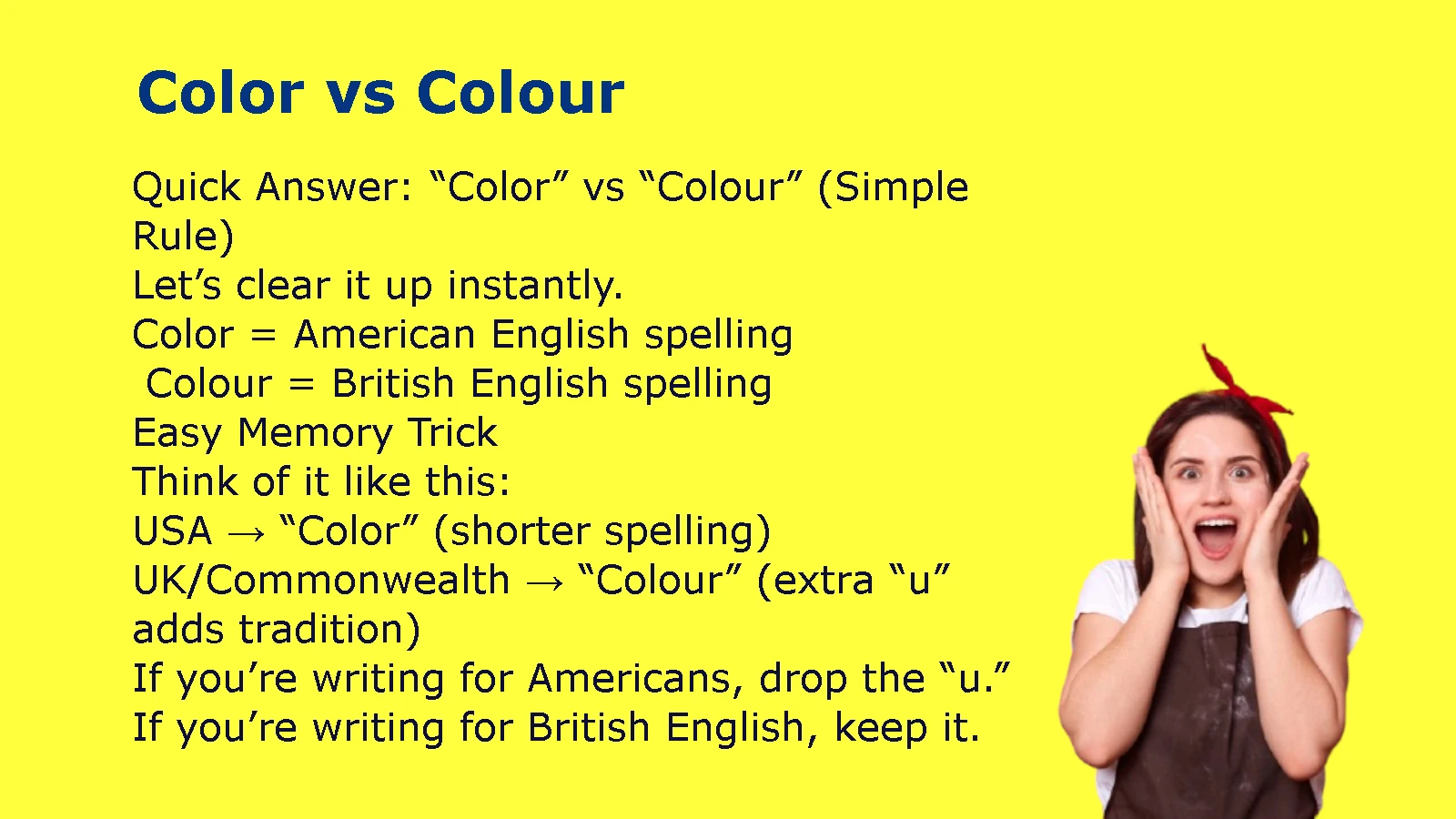
Quick Answer: “Color” vs “Colour” (Simple Rule)
Let’s clear it up instantly.
Color = American English spelling
Colour = British English spelling
Easy Memory Trick
Think of it like this:
- USA → “Color” (shorter spelling)
- UK/Commonwealth → “Colour” (extra “u” adds tradition)
If you’re writing for Americans, drop the “u.” If you’re writing for British English, keep it.
How People Actually Use “Color” and “Colour”
Here’s where it gets interesting.
Even though the rule is simple, real-world usage depends on audience, not personal preference.
In Everyday Writing
- Americans always write color
- British, Indian, Australian, Canadian writers usually write colour
In Digital Content
- Websites often choose one version for consistency
- Global brands may switch based on region (e.g., “color” in the US site, “colour” in the UK site)
Why This Happens
- English has multiple standardized versions
- There is no single global spelling authority
- Style guides decide usage more than grammar rules
The Geography Logic Behind “Color” vs “Colour”
To understand it better, think of English like a divided map.
American English Simplification
Mon → Reduced spellings
Wed → Simplified grammar
Fri → Color, honor, favor
British English Tradition
Mon → Traditional spellings
Wed → Preserved French influence
Fri → Colour, honour, favour
Key Insight
American English often removes extra letters for simplicity, while British English preserves older spelling forms.
“Color” Explained Clearly (With Usage)
At its core, “color” refers to the American English spelling of a word meaning hue, shade, or appearance.
Standard Meaning
- The sky has a deep blue color
- Choose your favorite color
- This shirt has no color contrast
Where It’s Used
- United States schools and books
- American media and publishing
- Tech companies (Google Docs default: American English)
Key Takeaway
If your audience is American, “color” is always correct.
“Colour” Explained Clearly (With Usage)
Now let’s look at the British version.
Standard Meaning
- The sky has a deep blue colour
- What is your favorite colour?
- The dress has bright colour tones
Where It’s Used
- UK, Ireland, Australia, New Zealand
- Commonwealth countries
- British academic writing systems
Key Insight
“Colour” is standard outside the United States and preserves traditional English spelling.
The Biggest Mistake People Make
Here’s where confusion actually happens.
People mix both spellings in the same document.
What Goes Wrong
- Writing “color” in one paragraph
- Then “colour” later
- Result: inconsistent writing
Real Scenario
A student writes an essay:
- Introduction → “colour”
- Body → “color”
- Conclusion → “colour”
The teacher marks it as inconsistent English style.
Lesson
Pick one system and stick to it throughout your writing.
Side-by-Side Comparison Table
| Word | Region | Meaning | Consistency Risk |
| Color | American English | Hue/shade | Low (if US style) |
| Colour | British English | Hue/shade | Low (if UK style) |
Real-Life Examples of “Color”
Common Situations
- “What color is your car?”
- “I love the color of this painting.”
- “The app lets you change the color theme.”
What It Means
Always American spelling, used in global tech and US content.
Real-Life Examples of “Colour”
Common Situations
- “What colour is your car?”
- “This painting has vibrant colour.”
- “The dress has beautiful colour patterns.”
What It Means
Standard British/Commonwealth spelling used in formal writing.
Regional and Cultural Differences
English changes depending on where it is used.
In the United States
- Always “color”
- Simplified spelling system
the UK and Commonwealth
- Always “colour”
- Traditional spelling preserved
Global Writing
- Choose based on audience
- Consistency is more important than preference
How to Avoid Confusion Every Time
Want to never make mistakes again? Follow this.
Step 1: Choose Your Style
- American English → color
- British English → colour
Step 2: Stick to It
Don’t mix both styles in one document.
Step 3: Use Tools
- Grammarly
- Microsoft Word language settings
- Google Docs language preferences
What to Say Instead (Clear Alternatives)
If you’re writing for a global audience, you can stay consistent by choosing one:
Better Approach
- “Color” throughout the document (US style)
- “Colour” throughout the document (UK style)
Pro Tip
Most tech and SEO content uses American English (“color”) for wider global reach.
Quick Decision Guide (Use This Instantly)
- Writing for the US → Color
- Writing for UK/Commonwealth → Colour
- Not sure → Pick one and stay consistent
Simple. Clean. Professional.
FAQ: “Color” vs “Colour”
Is “colour” wrong in American English?
No, but it is considered British spelling.
Is “color” wrong in British English?
No, but it is American spelling.
Which one is more correct?
Both are correct—depends on region.
Which should I use for SEO?
Usually “color” because it has higher global search volume.
Case Study: Content Consistency Issue
A blog team wrote articles using both spellings:
- Some posts: “color”
- Others: “colour”
What Happened
- Confused readers
- Lower content quality score
- SEO inconsistency
Fix
They standardized to “color” for all content.
Result: improved clarity and ranking consistency.
Key Facts You Should Remember
- Both spellings are correct
- Difference is regional, not grammatical
- “Color” = American English
- “Colour” = British English
- Consistency is the real rule
Final Takeaway: The One Rule That Never Fails
Here’s the truth.
English doesn’t have one global spelling system—it has variations. That’s why both “color” and “colour” exist.
So instead of asking which is right, ask:
👉 Who is my audience?
Because in writing, clarity beats correctness debates.
And when it comes to “Color” vs “Colour,” consistency is everything.