Have you ever stopped while writing and wondered whether Consistent or Consistant is the correct spelling? You’re not alone. This is one of the most common English spelling mistakes because the two words look almost identical, differing by just one letter. However, only one of them is accepted in standard English, while the other is simply a misspelling. Understanding the difference is essential for improving your writing, grammar, vocabulary, and overall communication skills.
In simple terms, consistent is the correct spelling. It describes something that is steady, reliable, uniform, or unchanged over time. Whether you’re talking about consistent effort, consistent performance, consistent results, or consistent behavior, the word is widely used in academic writing, business communication, professional emails, and everyday conversations. On the other hand, consistant is an incorrect spelling and should be avoided in all forms of English writing.
Many English learners search for phrases like consistent or consistant, how to spell consistent, consistent meaning, is consistant a word, and common English spelling mistakes when trying to improve their spelling and grammar. This confusion often occurs because English pronunciation doesn’t always match spelling, making certain words difficult to remember.
In this guide, you’ll learn the difference between consistent and consistant, why only one spelling is correct, its meaning and pronunciation, common usage examples, grammar tips, and simple memory tricks to help you spell consistent correctly every time.
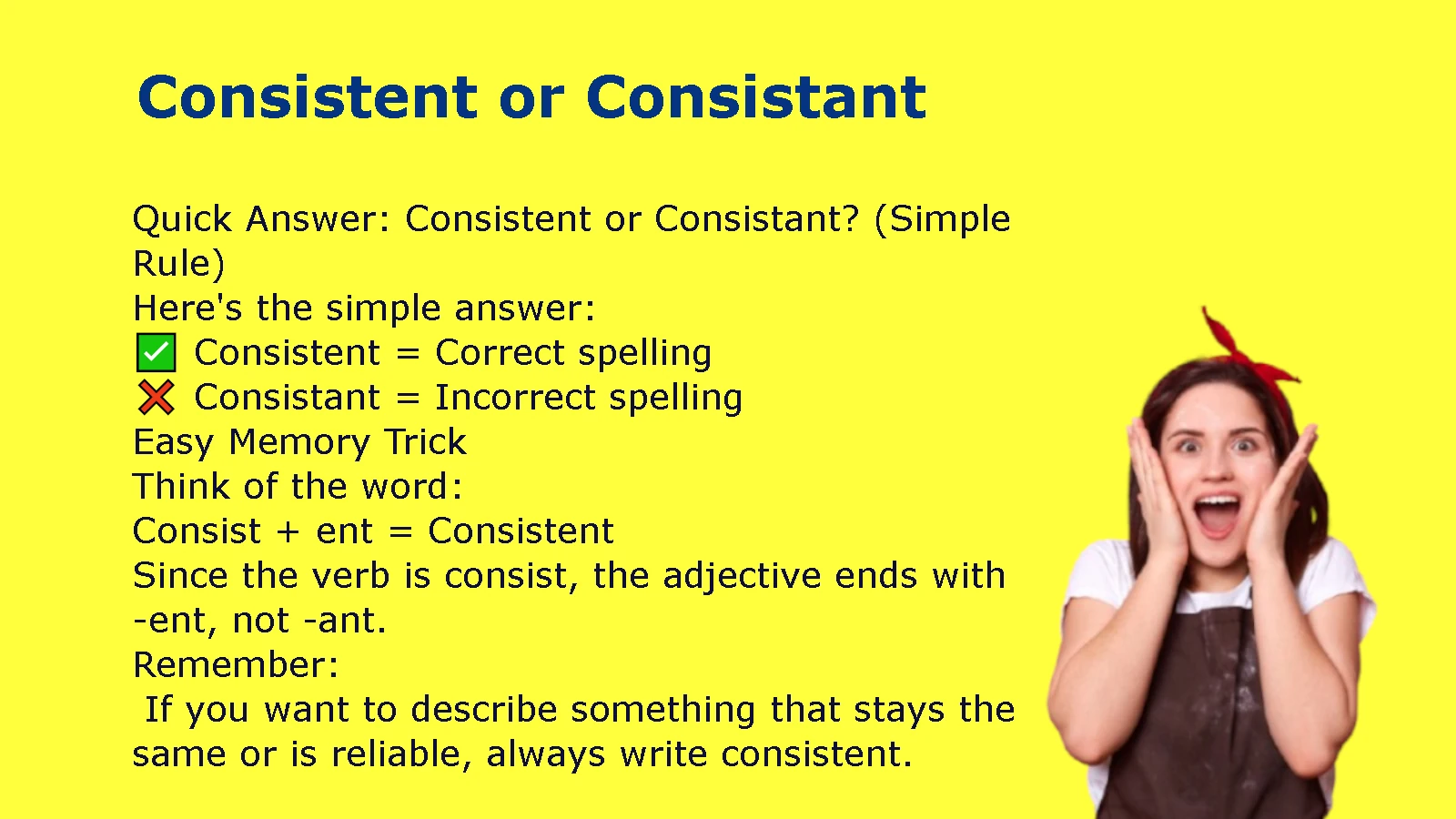
Quick Answer: Consistent or Consistant? (Simple Rule)
Here’s the simple answer:
✅ Consistent = Correct spelling
❌ Consistant = Incorrect spelling
Easy Memory Trick
Think of the word:
Consist + ent = Consistent
Since the verb is consist, the adjective ends with -ent, not -ant.
Remember:
If you want to describe something that stays the same or is reliable, always write consistent.
Why Do People Confuse “Consistent” and “Consistant”?
The confusion isn’t surprising.
Many English words end in -ant, such as:
- Important
- Assistant
- Constant
- Brilliant
Because of these familiar patterns, many writers mistakenly assume consistent should also end in -ant.
Other Reasons
- Both spellings sound almost identical.
- Spellcheck isn’t always available.
- Fast typing often leads to accidental spelling errors.
- English spelling rules aren’t always predictable.
The Spelling Logic Behind “Consistent”
Let’s break it down.
The word comes from the verb:
Consist
When forming the adjective, English uses the suffix -ent.
Word Family
- Consist
- Consistency
- Consistent
- Consistently
Notice that every correct form keeps the same spelling pattern.
Key Insight
If the word belongs to the consist family, it always uses -ent, never -ant.
“Consistent” Explained Clearly
Consistent means:
- staying the same
- reliable
- regular
- not changing unexpectedly
Common Examples
- She is consistent with her daily exercise.
- His performance has been consistent all year.
- The results were consistent across every test.
- Try to be consistent when practicing English.
Where You’ll See It
- Academic writing
- Business communication
- Sports
- Science
- Everyday conversation
Key Takeaway
Whenever you want to describe reliability or stability, consistent is always the correct spelling.
Is “Consistant” Ever Correct?
No.
Consistant is simply a spelling mistake.
It doesn’t appear in standard English dictionaries and isn’t accepted in formal or informal writing.
Common Mistake
❌ She is consistant with her work.
✅ She is consistent with her work.
Key Insight
If you write consistant, most grammar checkers will recommend changing it to consistent.
The Biggest Mistake People Make
Many people assume that because words like assistant and important end in -ant, consistent should follow the same pattern.
Unfortunately, English doesn’t always work that way.
What Goes Wrong
Someone writes:
“Our service is consistant.”
Readers immediately notice the spelling mistake.
Better Version
“Our service is consistent.”
Lesson
Never rely on pronunciation alone when choosing between consistent or consistant.
Side-by-Side Comparison Table
| Word | Correct? | Meaning | Best Use |
| Consistent | ✅ Yes | Reliable, steady, unchanged | All writing |
| Consistant | ❌ No | Incorrect spelling | Never use |
Real-Life Examples of “Consistent”
Here are some natural examples.
In School
“My grades became consistent after I started studying every day.”
At Work
“Our company provides consistent customer service.”
In Sports
“The athlete delivered consistent performances throughout the season.”
Everyday Conversation
“Try to be consistent with your bedtime.”
What They Mean
In every example, consistent describes something dependable or steady.
Common Examples of the Incorrect Spelling
These sentences contain the mistake.
❌ He is consistant with his routine.
✅ He is consistent with his routine.
❌ The quality remains consistant.
✅ The quality remains consistent.
❌ She gives consistant effort.
✅ She gives consistent effort.
Why Spellcheck Sometimes Doesn’t Save You
Most writing apps will flag consistant, but not always.
Some situations include:
- Older software
- Disabled spellcheck
- Handwritten work
- Exams
- Quick notes
That’s why it’s worth memorizing the correct spelling yourself.
How to Remember the Correct Spelling Every Time
Use these simple tricks.
Think of the Base Word
Consist → Consistent
If you remember consist, the spelling becomes much easier.
Remember the Ending
The correct ending is always:
-ent
Never -ant.
Practice in Sentences
Writing the word a few times helps reinforce the correct spelling.
Example:
“I want to be consistent every day.”
What to Say Instead (Similar Words)
Sometimes another word fits your sentence even better.
Alternatives
- Reliable
- Steady
- Regular
- Dependable
- Stable
- Predictable
- Uniform
When to Use Them
- Formal writing
- Business emails
- Academic papers
- Creative writing
Quick Decision Guide (Use This Instantly)
When you’re unsure, follow this:
Need the adjective meaning reliable or steady?
→ Consistent
Thinking about writing consistant?
→ Don’t. It’s always incorrect.
Still unsure?
→ Remember consist → consistent.
FAQ: Consistent or Consistant?
Is “consistant” a real English word?
No. It is considered a misspelling of consistent.
Why do people spell it “consistant”?
Because many English words end in -ant, making it an easy mistake to assume the same pattern applies.
Which spelling should I use in professional writing?
Always use consistent.
How can I remember the correct spelling?
Think:
Consist → Consistent
If the base word is consist, the adjective ends with -ent.
Case Study: A Small Spelling Mistake with a Big Impact
A university student submitted a scholarship essay that repeatedly used the word consistant.
Although the ideas were strong, the repeated spelling mistake distracted reviewers and made the writing seem less polished.
After proofreading and changing every instance to consistent, the essay appeared much more professional.
Lesson
Correct spelling strengthens your credibility and helps readers focus on your message instead of your mistakes.
Key Facts You Should Remember
- Consistent is the only correct spelling.
- Consistant is always incorrect.
- Consistent means reliable, steady, or unchanged.
- The word comes from consist, which ends with -ent.
- Remember consist → consistent to avoid mistakes.
- Proofreading can help catch this common spelling error.
Final Takeaway: The One Rule That Never Fails
The confusion between consistent or consistant is common, but the solution is simple. Only consistent is correct, while consistant is always a misspelling. Whenever you want to describe something that is reliable, steady, or unchanged, choose consistent with confidence.
If you’re ever in doubt, remember this simple rule:
Consist → Consistent
It’s an easy connection that will help you spell the word correctly every time. Whether you’re writing an email, an essay, a report, or a social media post, using the correct spelling makes your writing clearer and more professional. When it comes to consistent or consistant, there is only one right choice: consistent