Have you ever typed Damnit vs. Dammit and wondered which spelling is actually correct? You’re not alone. This common spelling confusion leaves many writers unsure because both versions appear frequently in text messages, social media posts, and casual conversations.
The confusion comes from the fact that people often search for the correct spelling of dammit, damnit meaning, dammit meaning, and even how to spell dammit before using it in writing. But here’s the kicker: although both spellings are widely seen online, only one is generally recognized as the standard form in most dictionaries and style guides.
The good news? The answer is simpler than you might think.
In this guide, you’ll learn the difference between Damnit or Dammit, discover the correct spelling, understand why people spell dammit as damnit, and see dammit vs damnit examples in real sentences. You’ll also learn how to pronounce dammit, when each spelling appears in informal writing, and how to avoid this common mistake.
By the end, you’ll know exactly which version to use, why the confusion exists, and how to write it confidently in everyday English.
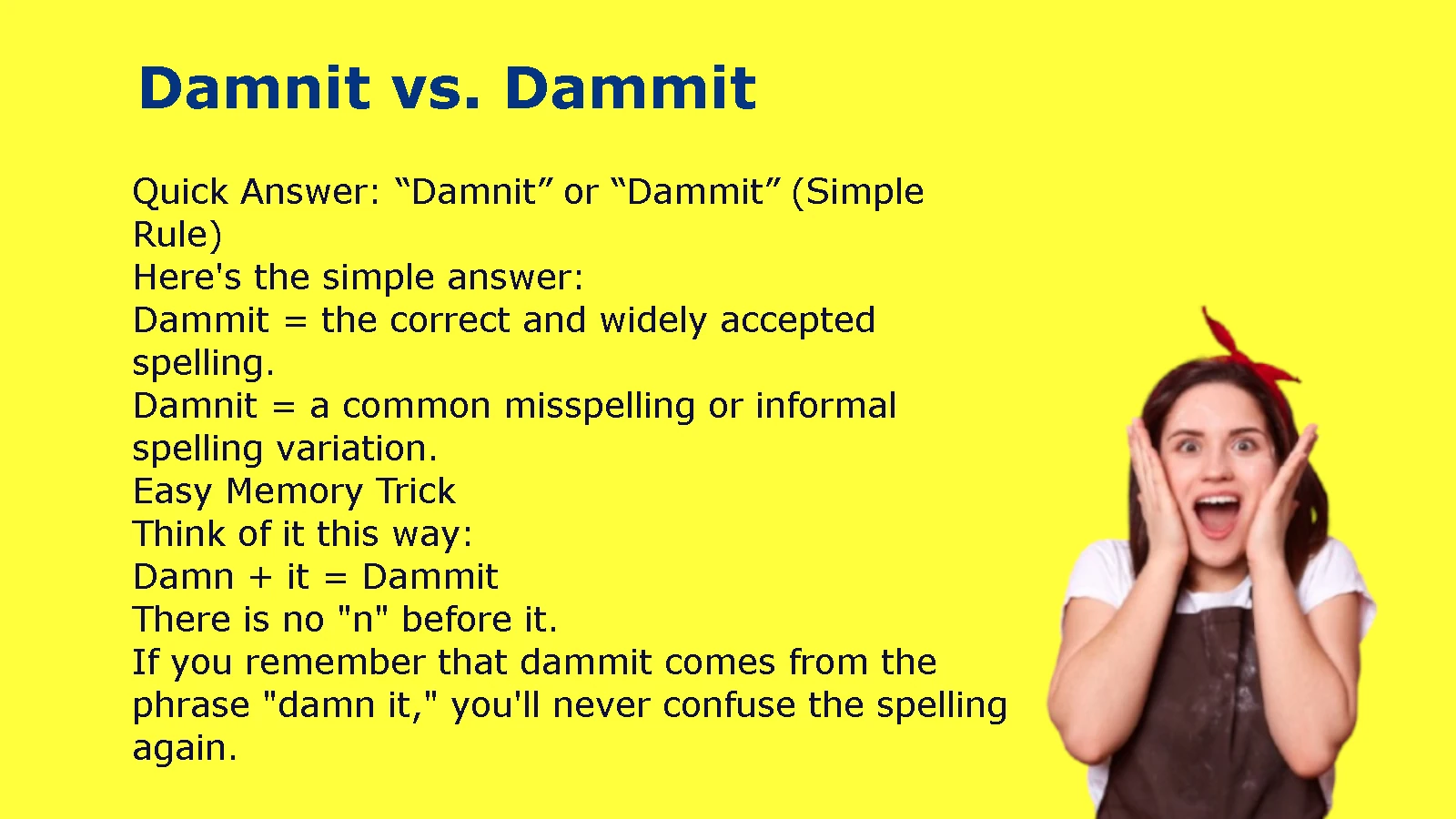
Quick Answer: “Damnit” or “Dammit” (Simple Rule)
Here’s the simple answer:
Dammit = the correct and widely accepted spelling.
Damnit = a common misspelling or informal spelling variation.
Easy Memory Trick
Think of it this way:
- Damn + it = Dammit
- There is no “n” before it.
If you remember that dammit comes from the phrase “damn it,” you’ll never confuse the spelling again.
How People Actually Use “Damnit” and “Dammit”
Although dammit is considered the correct spelling, you’ll still find damnit all over the internet.
In Casual Conversations
People often type quickly when they’re frustrated.
Examples:
- “Dammit, I forgot my keys!”
- “Damnit, I missed the bus!”
Both usually express the same emotion, even though only one is standard.
On Social Media
Many users spell words phonetically.
Since dammit is often pronounced quickly, some people assume an n belongs in the word and write damnit instead.
In Books and Professional Writing
Editors almost always use dammit.
Published novels, scripts, and dictionaries recognize dammit as the standard spelling.
The Grammar Behind “Dammit”
Understanding the origin makes everything easier.
Dammit is simply a contracted form of:
Damn it!
When spoken quickly:
Damn it → Dammit
Notice what disappears:
- The space disappears.
- The pronunciation blends together.
- No extra n is added.
Key Insight
The spelling follows pronunciation and history—not guesswork.
“Dammit” Explained Clearly
At its core, dammit is an interjection.
People use it to express:
- Frustration
- Anger
- Disappointment
- Surprise
- Annoyance
Common Examples
- “Dammit, I left my phone at home.”
- “Dammit! The game crashed.”
- “Oh, dammit—I forgot the meeting.”
Tone
Depending on the situation, dammit can sound:
- Mildly annoyed
- Extremely angry
- Humorous
- Dramatic
Context determines the intensity.
Key Takeaway
If you’re writing in standard English, choose dammit.
“Damnit” Explained Clearly
Now let’s look at the alternative spelling.
Is “Damnit” a Real Word?
Not officially.
Most dictionaries do not list damnit as the standard spelling.
Instead, it’s considered:
- A misspelling
- A phonetic spelling
- An informal internet variation
Why Do People Use It?
People often hear:
“Damnit!”
Instead of:
“Damn it!”
Since the n sound is noticeable in speech, they naturally insert it into the spelling.
Key Insight
Although many people recognize damnit, it isn’t considered standard English.
The Biggest Mistake People Make
The most common mistake is assuming both spellings are equally correct.
What Goes Wrong
Someone learns the word from social media.
Later, they use damnit in:
- School essays
- Professional emails
- Published articles
This creates an unnecessary spelling mistake.
Lesson
Use dammit whenever spelling matters.
Side-by-Side Comparison Table
| Spelling | Standard English | Dictionary Accepted | Best Use |
| Dammit | ✅ Yes | ✅ Yes | All informal writing and dialogue |
| Damnit | ❌ No | Usually No | Informal internet usage only |
Real-Life Examples of “Dammit”
Here are some common examples.
Everyday Situations
- “Dammit, I spilled my coffee.”
- “Dammit! We missed the train.”
- “Dammit, I forgot your birthday.”
- “Dammit, my laptop won’t start.”
Mini Scenario
You’re running late for work.
You discover your car won’t start.
You say:
“Dammit! Now I’ll be late.”
That sounds natural and correctly spelled.
Real-Life Examples of “Damnit”
Although considered nonstandard, you’ll still encounter examples like these online.
Internet Examples
- “Damnit, not again!”
- “Damnit, I lost my save file.”
- “Damnit, why today?”
These communicate the intended emotion but aren’t recommended in formal writing.
Mini Scenario
A friend texts:
“Damnit, my internet stopped working.”
You’ll understand the meaning, but the standard spelling would be dammit.
Why the Confusion Exists
Several factors contribute to the confusion.
Fast Pronunciation
“Damn it” is usually spoken quickly.
The sounds blend together, making the spelling less obvious.
Internet Habits
Many people spell words the way they sound instead of checking a dictionary.
Repetition
After seeing damnit repeatedly online, people begin to think it’s correct.
Key Tip
Popularity doesn’t always equal correctness.
How to Avoid the Mistake Every Time
Follow these simple strategies.
Remember the Original Phrase
Always think:
Damn it
Then remove the space.
You get:
Dammit
Read It Aloud
If you imagine the original phrase, the spelling becomes easier to remember.
Double-Check Before Publishing
If you’re writing professionally, proofread emotional expressions just like any other word.
What to Say Instead
Sometimes you may want a milder alternative.
Similar Expressions
- Darn it!
- Shoot!
- Oh no!
- Good grief!
- Rats!
- Oh, come on!
- Seriously?
These work well in family-friendly writing.
Quick Decision Guide (Use This Instantly)
Unsure which spelling to choose?
Follow this:
- Standard English → Dammit
- Professional writing → Dammit
- Dictionary spelling → Dammit
- Internet slang → You may see Damnit, but it’s considered nonstandard.
Simple. Reliable. Done.
FAQ: “Damnit” or “Dammit”
Is “damnit” a real word?
It’s widely used online but isn’t considered the standard spelling in English.
Which spelling is correct?
Dammit is the accepted spelling.
Why do people write “damnit”?
Because they spell it the way it sounds when spoken quickly.
Can I use “damnit” in formal writing?
No. Use dammit instead.
Does “dammit” come from “damn it”?
Yes. It’s simply the contracted spelling of “damn it.”
Case Study: A Simple Spelling Mistake
A content writer prepared dialogue for a fictional character.
Throughout the article, the writer used:
“Damnit!”
During editing, the publisher corrected every instance to:
“Dammit!”
Why?
Because dammit is the recognized spelling in standard English.
Result
The dialogue remained natural while following accepted spelling conventions.
Key Facts You Should Remember
- Dammit is the correct spelling.
- Damnit is a common misspelling or informal variation.
- Dammit comes directly from the phrase “damn it.”
- Most dictionaries recognize dammit, not damnit.
- Use dammit whenever accuracy matters.
Final Takeaway: The One Rule That Never Fails
The confusion between Damnit or Dammit is easy to understand because both spellings appear frequently online. However, standard English has a clear preference.
Keep this simple rule in mind:
- Dammit = correct spelling.
- Damnit = nonstandard spelling you’ll often see online.
When you’re writing messages to friends, either may be understood. But for articles, books, professional communication, or any situation where correct spelling matters, dammit is the safer and more accurate choice.
Think of it this way: if it comes from “damn it,” then the correct written form is “dammit.” Remember that one rule, and you’ll never have to wonder which spelling to use again.