Have you ever hesitated while writing Partners vs. Partner’s vs. Partners’ because you weren’t sure where the apostrophe belongs? You’re not alone. This is one of the most common punctuation mistakes in English, and using the wrong form can completely change the meaning of your sentence.
The confusion often comes from knowing when to use a singular possessive, plural noun, or plural possessive. Many people search for partners or partner’s, partners vs partner’s, partners’ meaning, and how to use partners’ correctly because the rules aren’t always obvious. And here’s the kicker: a misplaced apostrophe can make your writing look unprofessional in emails, academic papers, and business documents.
But don’t worry—it’s much simpler than it seems.
In this guide, you’ll learn the difference between Partners vs. Partner’s vs. Partners’, discover the correct use of partner’s and partners’, understand when to use partners or partner’s, and see practical partners examples in sentences. You’ll also learn how apostrophes change meaning, common possessive noun mistakes, and easy memory tricks to help you choose the correct form every time.
By the end, you’ll know exactly which version fits your sentence and avoid one of the most common apostrophe errors in English writing.
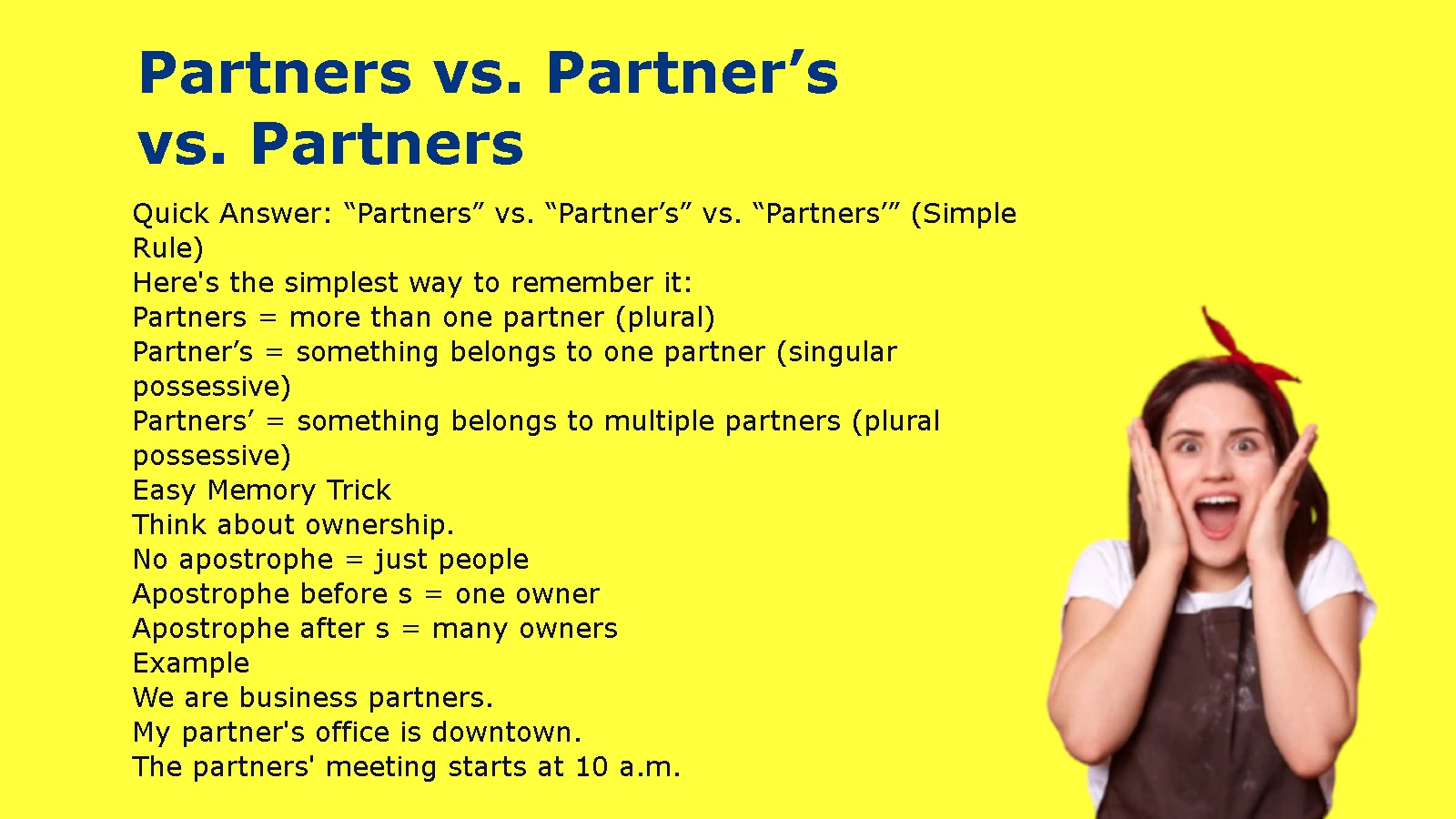
Quick Answer: “Partners” vs. “Partner’s” vs. “Partners’” (Simple Rule)
Here’s the simplest way to remember it:
- Partners = more than one partner (plural)
- Partner’s = something belongs to one partner (singular possessive)
- Partners’ = something belongs to multiple partners (plural possessive)
Easy Memory Trick
Think about ownership.
- No apostrophe = just people
- Apostrophe before s = one owner
- Apostrophe after s = many owners
Example
- We are business partners.
- My partner’s office is downtown.
- The partners’ meeting starts at 10 a.m.
How People Actually Use “Partners,” “Partner’s,” and “Partners’”
Many writers know these words but still misuse the apostrophe.
In Everyday Writing
People often write partner’s when they simply mean partners.
Example:
❌ We are business partner’s.
✅ We are business partners.
In Business Communication
Emails and contracts frequently contain apostrophe mistakes.
Examples:
- Partners meeting
- Partner’s meeting
- Partners’ meeting
Each phrase can mean something different depending on the context.
Why This Happens
The apostrophe is small but powerful.
People remember the spelling but forget whether they’re talking about:
- one partner,
- several partners,
- or ownership.
The Grammar Logic Behind “Partners” vs. “Partner’s” vs. “Partners’”
The easiest way to understand these words is to identify two things:
- How many partners?
- Is something being owned?
Simple Decision Chart
| If you mean… | Use |
| More than one partner | Partners |
| One partner owns something | Partner’s |
| Multiple partners own something | Partners’ |
Key Insight
Ownership determines where the apostrophe goes.
“Partners” Explained Clearly
Partners is simply the plural form of partner.
There is no ownership.
Standard Meaning
Use partners whenever you’re talking about two or more people who are partners.
Examples
- They became business partners.
- The partners agreed on the proposal.
- Our partners are arriving tomorrow.
- The law firm has five partners.
Key Takeaway
If nothing belongs to the partners, don’t use an apostrophe.
“Partner’s” Explained Clearly
Partner’s is the singular possessive form.
It means one partner owns or has something.
Standard Meaning
One partner possesses something.
Examples
- My partner’s laptop is new.
- The partner’s signature is missing.
- We visited our partner’s office.
- The partner’s advice helped everyone.
Key Insight
One owner = apostrophe before the s.
“Partners’” Explained Clearly
Partners’ is the plural possessive form.
It shows that multiple partners share ownership.
Standard Meaning
Several partners own the same thing.
Examples
- The partners’ agreement was approved.
- The partners’ responsibilities were divided equally.
- The partners’ profits increased this year.
- We attended the partners’ conference.
Key Insight
More than one owner = apostrophe after the s.
The Biggest Mistake People Make
The most common mistake is adding an apostrophe just because a word ends in s.
Incorrect
- Our business partner’s are experienced.
Correct
- Our business partners are experienced.
Another common mistake:
- The partners meeting starts at noon.
If the meeting belongs to the partners, it should be:
- The partners’ meeting starts at noon.
Side-by-Side Comparison Table
| Word | Meaning | Example |
| Partners | More than one partner | We are business partners. |
| Partner’s | One partner owns something | My partner’s office is nearby. |
| Partners’ | Multiple partners own something | The partners’ decision was unanimous. |
Real-Life Examples of “Partners”
Here are common examples.
- The partners signed the contract.
- Business partners should communicate openly.
- Our partners support the project.
- The partners celebrated their success.
Mini Scenario
Two friends open a company.
They are business partners.
Simple—no ownership is being shown.
Real-Life Examples of “Partner’s”
Now look at singular ownership.
- My partner’s phone is ringing.
- The partner’s report was impressive.
- I borrowed my partner’s notebook.
- Everyone appreciated the partner’s presentation.
Mini Scenario
One business partner owns a laptop.
That becomes:
“My partner’s laptop.”
Real-Life Examples of “Partners’”
Now multiple owners.
- The partners’ office was renovated.
- The partners’ investment paid off.
- The partners’ decision changed the company.
- The partners’ responsibilities were clearly defined.
Mini Scenario
Three partners jointly own one office.
It’s the partners’ office.
Common Mistakes and How to Fix Them
Here are mistakes learners frequently make.
| Incorrect | Correct |
| Business partner’s | Business partners |
| Partners meeting | Partners’ meeting (if owned by the partners) |
| My partners office | My partner’s office |
| The partner agreement | The partner’s agreement (if one partner owns it) |
Quick Tip
Always ask:
“Who owns this?”
If nobody owns anything, don’t use an apostrophe.
How to Avoid Confusion Every Time
Follow these three simple steps.
Step 1
Count the partners.
One?
Or more than one?
Step 2
Ask whether ownership exists.
If no:
Use partners.
Step 3
If ownership exists:
- One owner → partner’s
- Multiple owners → partners’
This method works every time.
What to Say Instead (Clear Alternatives)
Sometimes you can rewrite your sentence to avoid confusion.
Instead of:
- The partners’ meeting
You can write:
- The meeting for the partners
Instead of:
- My partner’s opinion
You can write:
- The opinion of my partner
These alternatives are especially useful in formal writing.
Quick Decision Guide (Use This Instantly)
When you’re unsure, remember this:
- Talking about several people? → Partners
- One person owns something? → Partner’s
- Several people own something? → Partners’
Still unsure?
Remove the apostrophe and ask whether ownership disappears.
FAQ: “Partners” vs. “Partner’s” vs. “Partners’”
Is “partners” a possessive noun?
No. Partners is simply the plural form of partner.
When do I use “partner’s”?
Use partner’s when one partner owns or possesses something.
Example:
“My partner’s car.”
When should I use “partners'”?
Use partners’ when two or more partners share ownership.
Example:
“The partners’ office.”
Can “partners” be used without an apostrophe?
Yes. Whenever you’re referring to multiple partners without showing ownership.
Example:
“They are business partners.”
Case Study: A Business Email Mistake
A company sent this email:
“The partner’s meeting begins at 9 a.m.”
Employees became confused.
Did the meeting belong to one partner?
Or was it a meeting involving all the partners?
The intended meaning was:
“The partners’ meeting begins at 9 a.m.”
One missing apostrophe completely changed the meaning.
Key Facts You Should Remember
- Partners = plural noun
- Partner’s = singular possessive
- Partners’ = plural possessive
- Apostrophes show ownership—not plurals
- Count the owners before placing the apostrophe
- When in doubt, ask who owns the object
Final Takeaway: The One Rule That Never Fails
The difference between partners, partner’s, and partners’ is easier than it first appears. The key is to separate plural forms from possessive forms. If you’re simply talking about more than one partner, use partners. If something belongs to one partner, choose partner’s. If it belongs to several partners, write partners’.
Before adding an apostrophe, pause and ask one simple question:
“Is anyone owning something here?”
If the answer is no, skip the apostrophe. If the answer is yes, determine whether there’s one owner or many.
That one habit will help you use partners, partner’s, and partners’ correctly every time.