Have you ever wondered whether Creativity vs. Creativeness is just a small change in wording or two different ideas in the English language? This is a common confusion among learners, writers, and students who often come across similar abstract nouns in everyday reading, academic writing, and communication.
In simple terms, Creativity refers to the ability to generate new ideas, think imaginatively, and produce original work that is both useful and meaningful. It is widely used in fields like art, writing, business, technology, and problem-solving, where innovation plays a key role. On the other hand, Creativeness is a less common term that also refers to the quality or state of being creative, though it is rarely used in modern English compared to creativity.
Understanding the difference between these two words helps improve vocabulary accuracy, grammar confidence, and overall writing skills. Many learners often search for terms like creativity meaning, creativeness definition, and difference between creativity and creativeness when trying to strengthen their English usage.
If you’ve ever paused while choosing the right word in a sentence about imagination, innovation, or idea generation, you’re not alone—this is exactly where understanding subtle word differences makes your writing more precise and professional.
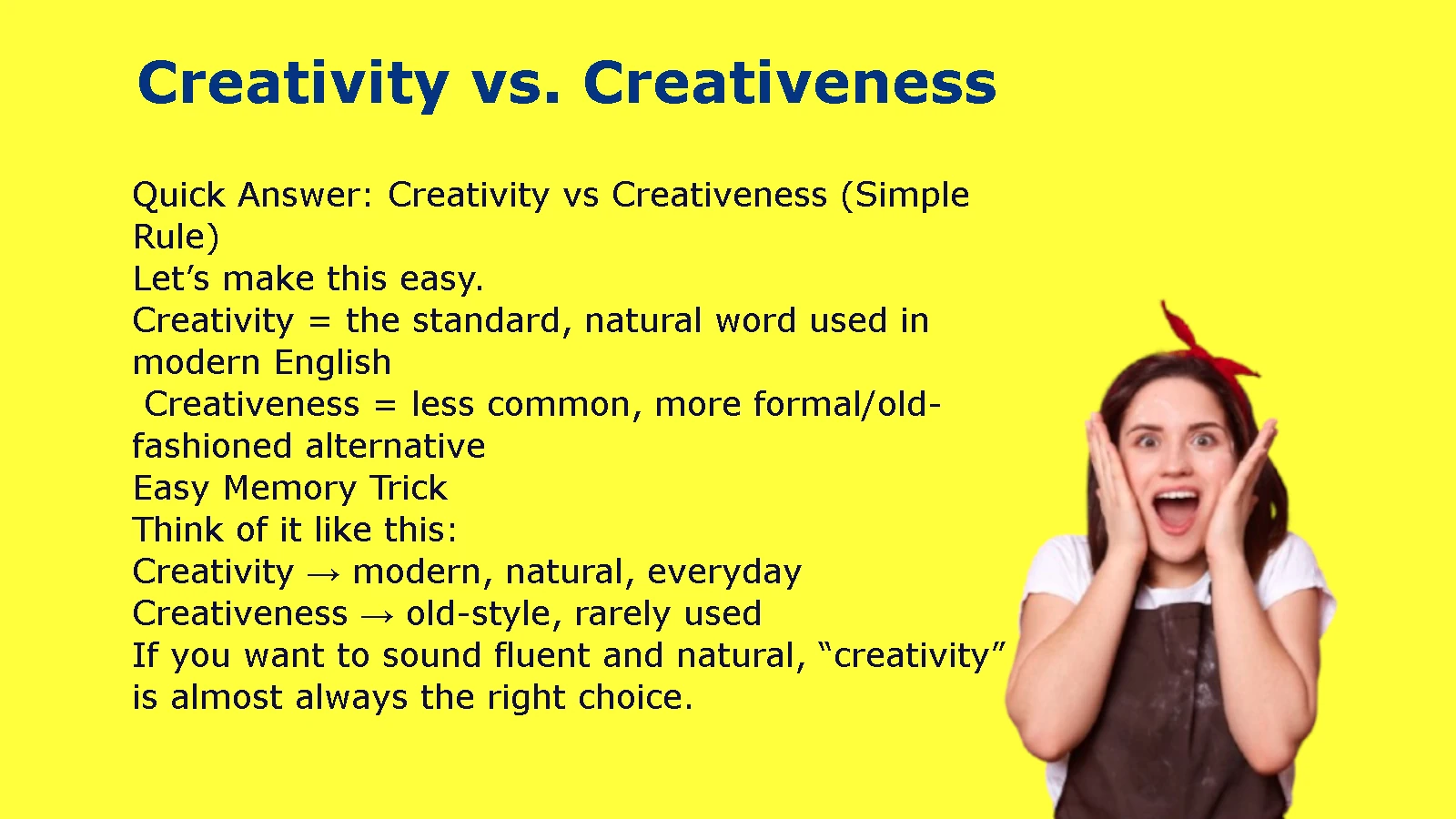
Quick Answer: Creativity vs Creativeness (Simple Rule)
Let’s make this easy.
Creativity = the standard, natural word used in modern English
Creativeness = less common, more formal/old-fashioned alternative
Easy Memory Trick
Think of it like this:
- Creativity → modern, natural, everyday
- Creativeness → old-style, rarely used
If you want to sound fluent and natural, “creativity” is almost always the right choice.
Why This Confusion Exists
The confusion happens because English often allows multiple noun forms from the same root word.
From create, we get:
- create (verb)
- creative (adjective)
- creativity (noun – preferred)
- creativeness (noun – secondary form)
Both nouns are technically understandable, but they are not equally used in real life.
Creativity Explained Clearly (With Real Meaning)
At its core, creativity means the ability to generate new ideas, solutions, or expressions.
It is used in almost every modern context.
Common Uses
- Artistic expression
- Problem-solving
- Innovation in business
- Writing, design, music, and education
Real Examples
- “Her creativity helped the brand go viral.”
- “We need more creativity in solving this issue.”
- “Children show natural creativity in play.”
Key Insight
“Creativity” is the standard noun you’ll see in exams, books, workplaces, and media.
Creativeness Explained Clearly (Less Common Usage)
Now let’s talk about creativeness.
At its core, it means the same idea: the quality of being creative. However, it feels more formal, outdated, or stylistically heavy.
Where It Appears
- Older academic writing
- Literary or philosophical texts
- Rare stylistic usage in essays
Example Sentences
- “The creativeness of the artist was admired by critics.”
- “His creativeness in storytelling is evident.”
Key Insight
While correct, “creativeness” sounds less natural in modern English.
Most native speakers simply avoid it.
The Key Difference (Simple Comparison Table)
| Word | Meaning | Usage Level | Natural Sound | Best Use |
| Creativity | Ability to create new ideas | Very common | Very natural | Everyday communication |
| Creativeness | Quality of being creative | Rare | Slightly formal/dated | Academic or stylistic writing |
Why “Creativity” Wins in Modern English
English evolves based on usage, not strict rules. Over time, one form becomes dominant.
Here’s why creativity became the preferred choice:
- It is shorter and smoother to say
- It is widely adopted in education and media
- It fits naturally in modern sentences
- It is used globally in professional contexts
Because of this, “creativeness” slowly faded into the background.
Real-Life Usage Examples
Let’s see how both words appear in real situations.
In Daily Life
- “I love your creativity in decorating the room.”
❌ “I love your creativeness…” (sounds unnatural)
School or Exams
- “The essay demonstrates strong creativity.”
✔ Preferred form
Business
- “We value creativity in our marketing team.”
✔ Standard usage
The Biggest Mistake Learners Make
Here’s the real issue:
Many learners assume both words are interchangeable in modern usage.
What Goes Wrong
- They use “creativeness” in formal writing
- It sounds outdated or unnatural
- It may reduce clarity or fluency impression
Simple Truth
Even if “creativeness” is grammatically valid, it is not commonly used today.
Side-by-Side Clarity Check
Creativity:
- Modern ✔
- Natural ✔
- Widely used ✔
- Professional ✔
Creativeness:
- Rare ✔
- Slightly old-fashioned ✔
- Limited usage ✔
- Less preferred ❌
When Should You Use “Creativeness”?
Even though it’s rare, there are a few cases:
- Literary writing with stylistic tone
- Academic discussions about word formation
- Intentional variation in poetry or essays
But in 95% of cases, you should avoid it.
Better Alternatives You Can Use
Instead of “creativeness,” you can safely use:
- Creativity (best choice)
- Creative ability
- Imagination
- Innovative thinking
These sound more natural and modern.
Quick Decision Guide
When you’re unsure, follow this:
- Modern writing → Creativity
- Academic/history of language → Creativeness (rare)
- Professional communication → Creativity
- Everyday speech → Creativity
Still unsure? Stick with creativity—it never fails.
FAQ: Creativity vs Creativeness
Is “creativeness” wrong?
No, but it is rarely used in modern English.
What is more correct, creativity or creativeness?
Both are correct, but creativity is the preferred standard form.
Can I use creativeness in IELTS or exams?
It’s better to use creativity for natural, high-scoring writing.
Why do both words exist?
Because English allows multiple noun formations from adjectives.
Final Takeaway: The One Rule That Never Fails
Here’s the simplest truth:
If you want natural, modern English—always choose “creativity.”
“Creativeness” exists, but it lives mostly in older or formal layers of language.
Think of it like this:
One word is actively living in everyday conversation. The other is sitting quietly in historical usage.
So when it comes to Creativity vs Creativeness, clarity wins—and clarity means choosing creativity every time.