Have you ever wondered whether Confidence vs. Self-Confidence are the same thing? Although the two terms are often used interchangeably, they have different meanings, and understanding that difference can improve both your communication and personal growth.
Many people search for confidence meaning, self-confidence meaning, confidence vs self-confidence difference, and confidence examples because the distinction isn’t always obvious. And here’s the kicker: using the wrong term can make your writing, conversations, or even motivational advice less accurate.
The good news? The difference is simpler than you might think.
In this guide, you’ll learn Confidence vs. Self-Confidence, explore the meaning of confidence and the meaning of self-confidence, discover when to use confidence and when to use self-confidence, and see practical examples of confidence and self-confidence in everyday situations. You’ll also find easy tips to remember the distinction so you can use both words correctly.
By the end, you’ll clearly understand the difference between confidence and self-confidence and know which term best fits the context every time.
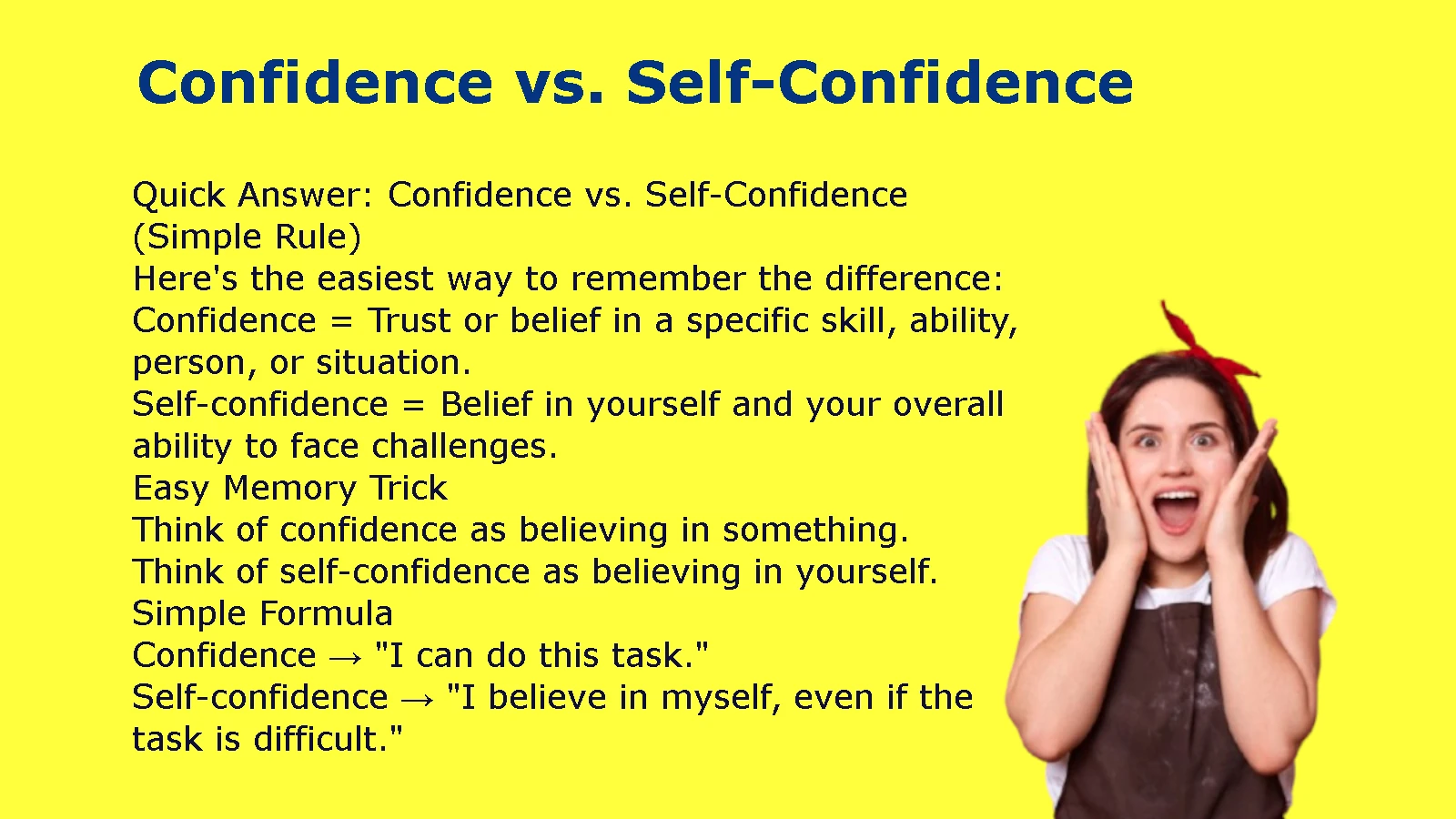
Quick Answer: Confidence vs. Self-Confidence (Simple Rule)
Here’s the easiest way to remember the difference:
Confidence = Trust or belief in a specific skill, ability, person, or situation.
Self-confidence = Belief in yourself and your overall ability to face challenges.
Easy Memory Trick
Think of confidence as believing in something.
Think of self-confidence as believing in yourself.
Simple Formula
Confidence → “I can do this task.”
Self-confidence → “I believe in myself, even if the task is difficult.”
How People Actually Use “Confidence” and “Self-Confidence”
Although dictionaries distinguish these words, everyday conversations often blur the line.
In Casual Conversations
People often say:
- “She has so much confidence.”
Even if they really mean:
- “She has strong self-confidence.”
Because of this, the terms frequently overlap.
In Personal Development
Coaches and psychologists usually make a clearer distinction.
They describe:
- Confidence as skill-based.
- Self-confidence as identity-based.
Why the Confusion Happens
The word confidence is broader.
Self-confidence is simply one specific type of confidence.
That’s why people often substitute one for the other.
The Core Difference Between Confidence and Self-Confidence
The easiest way to understand the distinction is by looking at where the belief comes from.
Confidence Depends on Experience
You become confident after practicing.
Examples:
- Driving a car
- Solving math problems
- Giving presentations
- Cooking meals
The more experience you gain, the stronger your confidence becomes.
Self-Confidence Comes From Self-Belief
Self-confidence isn’t limited to one activity.
Instead, it’s your belief that you can handle challenges, learn new skills, and recover from setbacks.
Key Insight
Confidence says:
“I know how to do this.”
Self-confidence says:
“I trust myself to figure it out.”
“Confidence” Explained Clearly (With Examples)
Confidence usually develops through repetition, knowledge, and success.
Standard Meaning
Confidence means having trust in your ability regarding a particular situation or task.
Examples:
- A swimmer feels confident before a race.
- A teacher feels confident explaining grammar.
- A chef feels confident preparing a signature dish.
In each case, confidence is tied to experience.
Can Confidence Change?
Absolutely.
Someone may be:
- Confident in mathematics
- Nervous about dancing
Confidence varies from one activity to another.
Key Takeaway
Confidence is often specific, earned, and dependent on practice.
“Self-Confidence” Explained Clearly (With Examples)
Self-confidence goes beyond one particular skill.
It reflects your overall trust in yourself.
Standard Meaning
Self-confidence means believing you can face challenges, adapt, and improve.
Examples:
- Applying for a new job.
- Speaking to strangers.
- Starting a business.
- Learning a new language.
Even without experience, a self-confident person believes they can learn.
Can Self-Confidence Fluctuate?
Yes.
Life events, failures, and successes can strengthen or weaken self-confidence.
However, it usually affects many areas of life rather than just one.
Key Takeaway
Self-confidence is broader than confidence because it reflects your overall self-belief.
The Biggest Mistake People Make
The most common mistake is assuming confidence automatically means self-confidence.
It doesn’t.
What Goes Wrong
Someone may be:
Very confident while coding.
Yet completely lacking self-confidence during social situations.
Or:
Someone may believe in themselves deeply but still lack confidence in a new skill because they’ve never practiced it.
Lesson
Confidence and self-confidence support each other, but they are not the same.
Side-by-Side Comparison Table
| Feature | Confidence | Self-Confidence |
| Meaning | Belief in a skill or task | Belief in yourself overall |
| Focus | Specific ability | Entire self |
| Built Through | Practice and experience | Self-belief and mindset |
| Can Change by Situation | Yes | Usually more stable |
| Example | Public speaking | Facing life’s challenges |
Real-Life Examples of Confidence
Let’s look at common situations.
Workplace
An accountant confidently prepares financial reports.
Why?
Years of experience.
Sports
A basketball player confidently takes the final shot.
Why?
Practice built confidence.
Education
A student confidently solves algebra problems after months of study.
What These Examples Show
Confidence grows from competence.
Real-Life Examples of Self-Confidence
Now compare.
Job Interview
Someone believes they can perform well despite feeling nervous.
That’s self-confidence.
Starting a Business
An entrepreneur doesn’t know every answer.
Still, they believe they’ll learn along the way.
That’s self-confidence.
Public Speaking
A beginner feels nervous but trusts they can improve with practice.
Again, that’s self-confidence.
Confidence vs. Self-Confidence in Everyday Life
Understanding when each applies makes communication much clearer.
At School
Confidence:
“I know this chapter.”
Self-confidence:
“I believe I can pass this course.”
At Work
Confidence:
“I can finish this presentation.”
Self-confidence:
“I believe I can grow into a leadership role.”
In Relationships
Confidence:
“I know how to communicate well.”
Self-confidence:
“I know my value regardless of others’ opinions.”
How to Build Confidence and Self-Confidence
Fortunately, both can be improved.
Build Confidence
- Practice regularly.
- Learn new skills.
- Celebrate small wins.
- Accept mistakes as learning opportunities.
Build Self-Confidence
- Speak positively to yourself.
- Focus on personal growth.
- Stop comparing yourself with others.
- Keep promises you make to yourself.
- Embrace challenges instead of avoiding them.
Why This Works
Confidence grows through action.
Self-confidence grows through trust in yourself.
What to Say Instead (Clear Usage Tips)
If you want to be precise, choose the word that matches the situation.
Use confidence when discussing:
- Skills
- Knowledge
- Performance
- Experience
Use self-confidence when discussing:
- Self-belief
- Personal growth
- Mindset
- Emotional resilience
Quick Decision Guide (Use This Instantly)
Ask yourself one question:
Am I talking about a specific skill?
Yes → Confidence
No, I’m talking about belief in myself → Self-confidence
Simple. Reliable. Easy.
FAQ: Confidence vs. Self-Confidence
Is confidence the same as self-confidence?
No. Confidence usually relates to a specific ability, while self-confidence refers to overall belief in yourself.
Can someone have confidence but not self-confidence?
Yes. A person may excel professionally yet doubt themselves personally.
Which is more important?
Both matter. Confidence helps you perform tasks, while self-confidence helps you face life’s challenges.
Can self-confidence be learned?
Absolutely. Healthy habits, positive experiences, and personal growth can strengthen self-confidence over time.
Case Study: Two Employees, Two Different Mindsets
Imagine two employees preparing for a presentation.
Employee A has excellent presentation skills.
They’ve spoken dozens of times before.
They have confidence.
Employee B has never presented to a large audience.
However, they believe they can learn, prepare well, and improve.
They have strong self-confidence.
What Happened?
Employee A delivered an excellent presentation because of experience.
Employee B felt nervous but completed the presentation successfully and became more confident afterward.
Lesson
Confidence grows from doing.
Self-confidence gives you the courage to start.
Key Facts You Should Remember
- Confidence relates to specific skills and abilities.
- Self-confidence reflects overall belief in yourself.
- Confidence often develops through experience.
- Self-confidence comes from trusting your ability to grow.
- Both are valuable and work together.
- One can exist without the other.
- Building confidence often strengthens self-confidence over time.
Final Takeaway: The One Difference That Changes Everything
The distinction between Confidence vs. Self-Confidence may seem small, but it has a powerful impact on how we understand ourselves and communicate with others.
Think of it this way. Confidence is like having the tools to complete a job because you’ve practiced before. Self-confidence is believing you can learn to use any new tool, even if you’ve never seen it before.
So remember this simple rule:
Confidence helps you perform.
Self-confidence helps you believe you can perform—even before you have all the experience.
When you’re discussing skills, experience, or expertise, use confidence. When you’re talking about believing in yourself, overcoming challenges, or personal growth, self-confidence is the better choice.
Understanding the difference won’t just improve your English—it can also help you recognize your strengths, develop a healthier mindset, and approach new opportunities with greater clarity and assurance.