Have you ever wondered whether Maturity vs. Matureness mean the same thing, or if one is more appropriate than the other? Although these two words are closely related and share the same root, they are not used in the same way in modern English. Many learners, writers, and even native speakers occasionally question which term fits best in formal writing, everyday conversation, or professional communication. Understanding the difference between Maturity vs. Matureness can help you improve your grammar, expand your vocabulary, and communicate with greater confidence and precision.
In general, Maturity is the standard and widely accepted noun used to describe the state of being fully developed, emotionally responsible, or having reached a particular stage of growth. It is commonly used when discussing personal development, emotional intelligence, business, finance, biology, education, and decision-making. For example, someone may admire a person’s maturity in handling difficult situations, or a financial investment may reach maturity after a specific period.
Matureness, on the other hand, is a legitimate English word but is far less common in modern usage. While it can also refer to the quality or state of being mature, most native speakers and professional writers naturally prefer Maturity because it sounds more fluent and idiomatic. As a result, using Maturity instead of Matureness is generally recommended in academic writing, business communication, and everyday English.
If you’ve ever paused while writing a sentence and wondered whether to use Maturity or Matureness, you’re certainly not alone. This confusion frequently appears among learners searching for the difference between Maturity and Matureness, the meaning of Maturity, whether Matureness is a real word, and the correct word to use in a sentence. In this guide, you’ll learn the definitions, key differences, grammar rules, real-life examples, and simple memory tricks that will help you choose the right word every time.
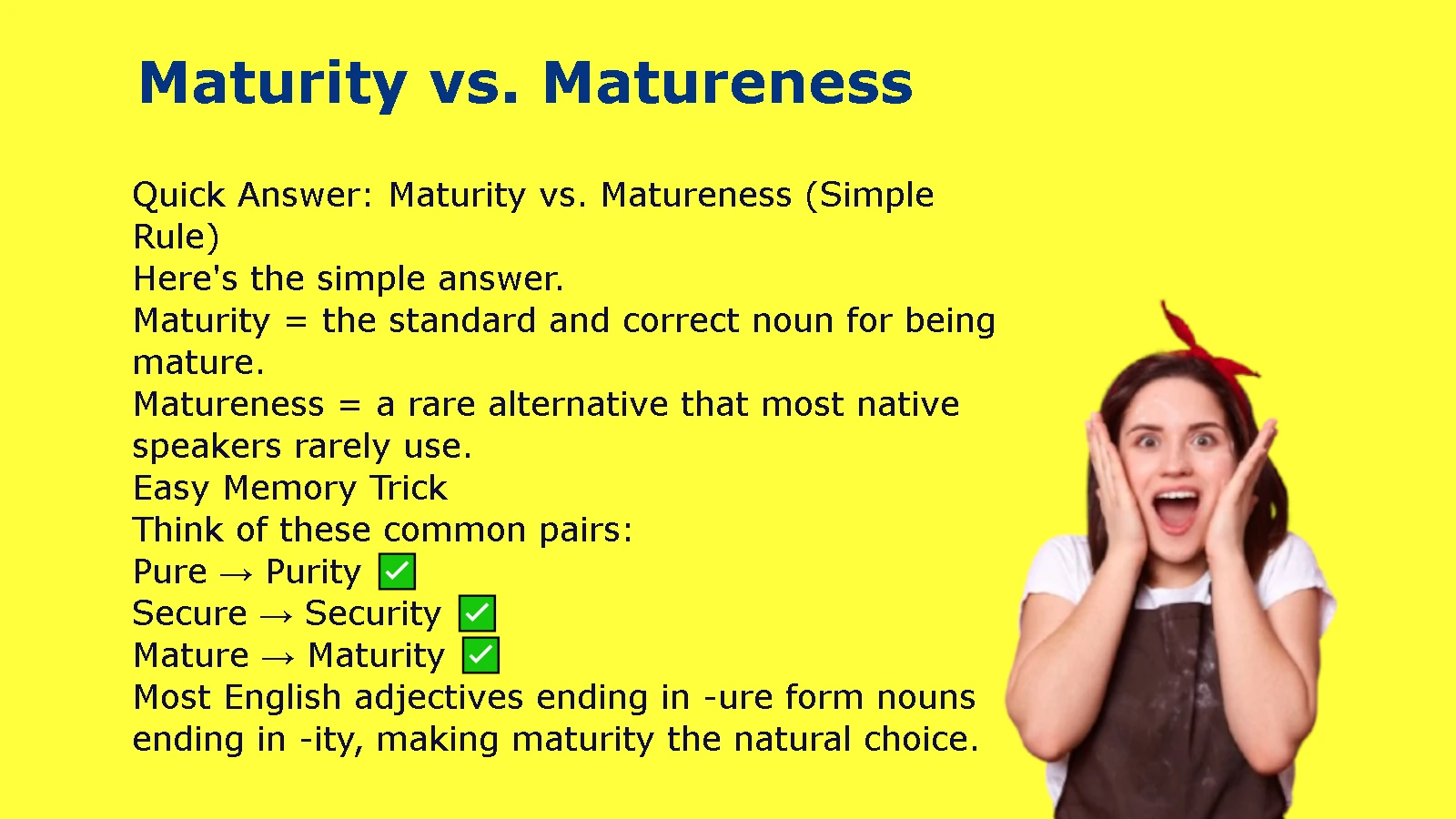
Quick Answer: Maturity vs. Matureness (Simple Rule)
Here’s the simple answer.
Maturity = the standard and correct noun for being mature.
Matureness = a rare alternative that most native speakers rarely use.
Easy Memory Trick
Think of these common pairs:
- Pure → Purity ✅
- Secure → Security ✅
- Mature → Maturity ✅
Most English adjectives ending in -ure form nouns ending in -ity, making maturity the natural choice.
How People Actually Use “Maturity” and “Matureness”
Real-life English doesn’t treat these words equally.
In Everyday Conversations
People almost always say:
- emotional maturity
- physical maturity
- financial maturity
- maturity level
Very few people naturally use matureness.
In Professional Writing
Business, education, psychology, and science overwhelmingly prefer maturity.
For example:
- leadership maturity
- market maturity
- emotional maturity
Why This Happens
English gradually favored maturity because it’s shorter, smoother, and more widely accepted.
As a result, matureness has become uncommon in modern English.
The Meaning Behind “Maturity” vs. “Matureness”
Although both words relate to being mature, their usage differs greatly.
Think in Terms of Common Usage
Mature
↓
Maturity ✅ (standard)
Matureness ⚠️ (rare)
Key Insight
Both words technically describe the state of being mature.
However:
- Maturity is the accepted standard.
- Matureness sounds old-fashioned or unnatural to many native speakers.
“Maturity” Explained Clearly
At its core, maturity refers to the quality or state of being fully developed.
It may describe:
- emotional growth
- physical development
- intellectual wisdom
- business development
- social responsibility
Common Examples
- She showed remarkable maturity during the discussion.
- The child demonstrated emotional maturity beyond his age.
- The fruit has reached full maturity.
- Investors look for market maturity before expanding.
Key Takeaway
If you’re writing, speaking, or taking an English exam, maturity is almost always the correct choice.
“Matureness” Explained Clearly
Now let’s examine the less common word.
Matureness is a legitimate English word, but it’s rarely used in modern speech or writing.
Some dictionaries include it, but many style guides recommend maturity instead.
Examples
- The matureness of the wine was impressive.
- His matureness surprised everyone.
While these sentences are grammatically possible, most native speakers would naturally replace matureness with maturity.
Better Versions
- The maturity of the wine was impressive.
- His maturity surprised everyone.
Key Insight
Using matureness isn’t necessarily wrong, but it often sounds awkward because English strongly favors maturity.
The Biggest Mistake People Make
Here’s the most common misunderstanding.
People assume every adjective can form multiple equally acceptable nouns.
That’s not always true.
What Goes Wrong
Someone writes:
“Your matureness is impressive.”
Although understandable, it sounds unnatural.
A native speaker would almost always say:
“Your maturity is impressive.”
Lesson
Just because a word exists doesn’t mean it’s commonly used.
Frequency matters in natural English.
Side-by-Side Comparison Table
| Word | Standard Meaning | Commonness | Best Use |
| Maturity | State of being mature | Very common | Everyday English, academic writing, business |
| Matureness | State of being mature | Rare | Mostly avoided in modern English |
Real-Life Examples of “Maturity”
Let’s see how native speakers naturally use the word.
Common Situations
- She handled the criticism with maturity.
- Emotional maturity comes with experience.
- The company has reached market maturity.
- Physical maturity varies from person to person.
- His maturity impressed the interview panel.
Mini Scenario
A teacher tells a parent:
“Your daughter shows remarkable maturity for her age.”
This sounds completely natural.
Real-Life Examples of “Matureness”
Now compare.
Less Common Sentences
- His matureness impressed everyone.
- The matureness of the project became clear.
- They admired her matureness.
Although grammatically acceptable, these sentences sound unusual.
Native speakers would typically replace matureness with maturity.
Why “Maturity” Is More Common
English has developed patterns over centuries.
Many adjectives ending in -ure create nouns ending in -ity.
Examples include:
- secure → security
- pure → purity
- mature → maturity
Because of this pattern, maturity feels natural to English speakers.
Meanwhile, matureness has gradually fallen out of everyday use.
Common Expressions Using “Maturity”
These phrases appear frequently in books, news articles, and conversations.
- emotional maturity
- physical maturity
- mental maturity
- intellectual maturity
- financial maturity
- social maturity
- professional maturity
- market maturity
- technological maturity
- maturity level
Notice that matureness almost never appears in these expressions.
How to Avoid Confusion Every Time
Want to choose the correct word without thinking?
Follow these simple rules.
Use “Maturity”
When talking about:
- personal growth
- emotional intelligence
- adulthood
- education
- psychology
- business
- science
Avoid “Matureness”
Unless you’re reading older literature or discussing unusual vocabulary choices.
Why This Works
You’ll sound more natural and write more confidently.
What to Say Instead (Clear Alternatives)
Depending on the context, you can also use:
- wisdom
- adulthood
- development
- growth
- responsibility
- experience
- emotional intelligence
- full development
These alternatives often make your writing even clearer.
Quick Decision Guide (Use This Instantly)
When choosing between the two words:
Need the standard English noun?
→ Maturity
Wondering if matureness works?
→ Technically yes, but avoid it in modern English.
Still unsure?
→ Choose maturity every time.
Simple. Reliable. Done.
FAQ: Maturity vs. Matureness
Is “matureness” a real word?
Yes. It’s a legitimate English word, but it’s uncommon and rarely used in modern English.
Which word is more correct?
Maturity is the standard and preferred word in almost every context.
Can I use “matureness” in formal writing?
It’s better not to. Most editors and native speakers prefer maturity.
Why does “matureness” sound strange?
Because English speakers overwhelmingly use maturity, making matureness feel outdated or unnatural.
Which word should English learners remember?
Focus on maturity. You’ll encounter it far more often in conversations, books, exams, and professional writing.
Case Study: A Small Word Choice That Changed the Impression
A university student submitted an essay that included this sentence:
“The leader showed great matureness during the crisis.”
The professor understood the meaning but suggested changing it to:
“The leader showed great maturity during the crisis.”
What Happened
The revised sentence sounded smoother, more professional, and more natural.
Lesson
Choosing the commonly accepted word makes your writing stronger and more fluent.
Key Facts You Should Remember
- Maturity is the standard English noun.
- Matureness is rare in modern usage.
- Native speakers overwhelmingly prefer maturity.
- Both words share a similar meaning, but one is far more natural.
- When in doubt, choose maturity.
Final Takeaway: The One Rule That Never Fails
The debate over Maturity vs. Matureness is easier than it first appears. While both words exist in English, they are not equally common. Maturity is the established, natural choice that you’ll hear in everyday conversations, academic writing, business communication, and professional settings. In contrast, matureness is rarely used and may sound awkward or outdated to many native speakers.
The simplest rule is this:
- Maturity → Use in almost every situation.
- Matureness → Technically correct but generally avoided.
Think of it this way: speaking fluent English isn’t just about choosing words that are grammatically possible—it’s about choosing the words native speakers actually use. By remembering this distinction, you’ll sound more confident, write more naturally, and avoid one of the most common vocabulary mistakes learners make.
Whenever you’re unsure between Maturity vs. Matureness, the safest and smartest choice is maturity.