Have you ever wondered about the difference between Empathy vs. Compassion? Although these words are often used interchangeably, they have distinct meanings that can influence how you communicate, build relationships, and respond to others in everyday life.
The confusion is understandable. Many people search for empathy meaning, compassion meaning, empathy vs compassion difference, and when to use empathy or compassion because the two concepts seem similar but are not exactly the same. And here’s the kicker: using the wrong term can change the message you want to convey, especially in professional, educational, or personal conversations.
The good news? The distinction is easier to understand than you might think.
In this guide, you’ll learn the key differences between Empathy vs. Compassion, discover the meaning of empathy and compassion, understand when to use empathy vs compassion, and explore practical examples of empathy and compassion in real-life situations. You’ll also learn how these terms are commonly used, making it easier to choose the right word with confidence.
By the end, you’ll clearly understand Empathy vs. Compassion, know which word best fits different contexts, and never second-guess their meaning or usage again.
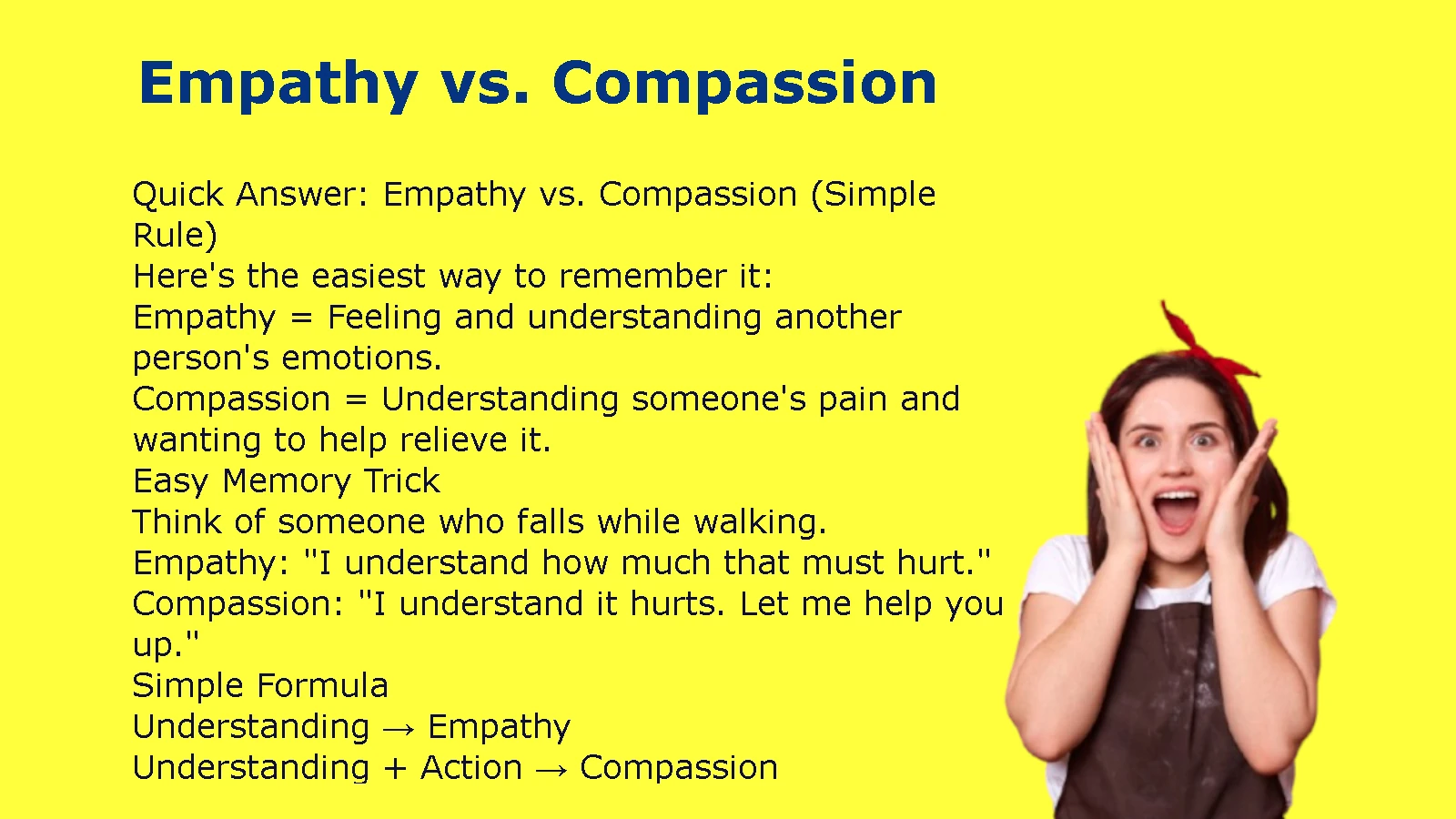
Quick Answer: Empathy vs. Compassion (Simple Rule)
Here’s the easiest way to remember it:
Empathy = Feeling and understanding another person’s emotions.
Compassion = Understanding someone’s pain and wanting to help relieve it.
Easy Memory Trick
Think of someone who falls while walking.
- Empathy: “I understand how much that must hurt.”
- Compassion: “I understand it hurts. Let me help you up.”
Simple Formula
Understanding → Empathy
Understanding + Action → Compassion
How People Actually Use “Empathy” and “Compassion”
This is where confusion begins.
Most people assume both words simply mean “being kind.” But in everyday English, they often describe different responses.
In Everyday Conversations
People often say “show empathy” when they simply mean “be nice.”
Others use “compassion” whenever someone helps another person.
In the Workplace
Managers may encourage empathy to improve communication.
Organizations often encourage compassion by supporting employees during difficult times.
Why This Happens
Both involve caring.
Both relate to emotions.
The biggest difference lies in whether action follows understanding.
The Core Difference Between Empathy and Compassion
A simple way to understand both words is to imagine them as two steps.
Step 1: Feel what another person feels.
↓
Empathy
↓
Step 2: Decide to reduce their suffering.
↓
Compassion
Key Insight
Empathy helps you connect.
Compassion motivates you to care through action.
Empathy Explained Clearly (With Examples)
Empathy means putting yourself in someone else’s shoes.
You try to understand their feelings without necessarily solving their problem.
Standard Meaning
You recognize another person’s emotions.
You emotionally connect with their experience.
Example
Your friend loses a pet.
You say:
“I can’t imagine how difficult this must be for you.”
You’re acknowledging their pain.
That’s empathy.
Another Example
A coworker feels stressed before a presentation.
Instead of judging them, you understand their anxiety because you’ve experienced something similar.
That’s empathy.
Key Takeaway
Empathy is about emotional understanding—not fixing the problem.
Compassion Explained Clearly (With Examples)
Compassion starts with empathy but doesn’t stop there.
It includes a genuine desire to improve someone’s situation.
Standard Meaning
You recognize suffering.
You want to help reduce it.
Example
A homeless person is sitting outside in the cold.
You notice their struggle.
You buy them a warm meal or blanket.
That’s compassion.
Another Example
Your colleague looks overwhelmed with work.
Instead of only saying,
“That must be stressful.”
You offer to help finish part of their project.
That’s compassion.
Key Takeaway
Compassion turns caring into action.
The Biggest Mistake People Make
The most common misunderstanding is believing empathy automatically means helping.
It doesn’t.
Someone can deeply understand another person’s pain without doing anything.
Likewise, a person can act compassionately even if they haven’t experienced the same situation themselves.
Real Scenario (Case Study)
A student fails an important exam.
Teacher A says:
“I know this feels disappointing.”
Teacher B says:
“I know this feels disappointing. Let’s create a study plan together.”
Teacher A demonstrates empathy.
Teacher B demonstrates compassion.
Side-by-Side Comparison Table
| Feature | Empathy | Compassion |
| Main Focus | Understanding feelings | Helping relieve suffering |
| Emotional Connection | Yes | Yes |
| Requires Action | No | Usually yes |
| Purpose | Connect emotionally | Improve someone’s situation |
| Example | “I understand your pain.” | “How can I help?” |
Real-Life Examples of Empathy
Let’s look at situations where empathy is the best response.
Common Situations
“I understand why you’re upset.”
“That must have been really difficult.”
“I’ve felt something similar before.”
“I’m sorry you’re going through this.”
Mini Scenario
A friend didn’t get the job they wanted.
You listen carefully and acknowledge their disappointment.
You don’t interrupt or immediately offer advice.
That’s empathy.
Real-Life Examples of Compassion
Now compare those situations.
Common Situations
“I’ll help you find another opportunity.”
“Can I bring you dinner tonight?”
“Let me take care of that for you.”
“What can I do to support you?”
Mini Scenario
A neighbor becomes sick.
Instead of only expressing concern, you help with groceries.
That’s compassion.
Regional and Cultural Differences
Different cultures place different emphasis on empathy and compassion.
In Western Countries
Empathy is often highlighted in leadership, therapy, and communication.
Compassion is commonly associated with volunteering, healthcare, and community service.
In Eastern Traditions
Compassion is often viewed as a core personal value connected to kindness, generosity, and reducing suffering.
Empathy is appreciated but is sometimes seen as only the first step.
In International Workplaces
Strong communication often combines both:
Understand others.
Then support them when possible.
How to Know Which Word to Use
Ask yourself one question.
Did the person only understand someone’s feelings?
Use empathy.
Did they also try to help?
Use compassion.
Easy Checklist
Understanding emotions → Empathy
Helping reduce suffering → Compassion
Both together → Compassion includes empathy
What to Say Instead (Clear Alternatives)
Sometimes other words fit even better.
Alternatives for Empathy
- Understanding
- Emotional awareness
- Relating to someone’s feelings
- Seeing another person’s perspective
Alternatives for Compassion
- Kindness
- Care
- Support
- Mercy
- Generosity
- Helping others
Quick Tip
If you’re describing feelings, choose empathy.
If you’re describing helpful actions, choose compassion.
Quick Decision Guide (Use This Instantly)
When you’re unsure, remember this:
Feel someone’s emotions → Empathy
Help ease their suffering → Compassion
Both understanding and helping → Compassion
Still unsure?
Think:
Feeling = Empathy
Helping = Compassion
FAQ: Empathy vs. Compassion
Is compassion the same as empathy?
No. Compassion includes empathy but also involves a desire to help or reduce suffering.
Can someone be empathetic without being compassionate?
Yes. A person may understand another’s feelings without taking any action.
Which is better?
Neither is “better.” They serve different purposes. Empathy builds understanding, while compassion encourages support.
Do healthcare workers need both?
Yes. Effective healthcare professionals often combine empathy with compassionate care.
Case Study: A Workplace Example
A team member is struggling after losing a family member.
Manager One
“I’m sorry for your loss.”
The employee feels understood.
Manager Two
“I’m sorry for your loss. Please take the week off, and let us know how we can support you.”
The employee feels understood and supported.
The second manager demonstrates compassion because they pair empathy with meaningful action.
Key Facts You Should Remember
- Empathy means understanding another person’s emotions.
- Compassion means understanding emotions and wanting to help.
- Compassion usually includes action.
- Empathy builds emotional connection.
- Compassion focuses on reducing suffering.
- Both are valuable in healthy relationships.
- Knowing the difference improves communication.
Final Takeaway: The One Rule That Never Fails
The difference between Empathy vs. Compassion is simpler than many people think. Empathy is about connecting with another person’s feelings and seeing the world from their perspective. Compassion builds on that connection by inspiring you to ease their pain or offer meaningful support.
Think of empathy as listening with your heart, while compassion is listening with your heart and extending your hand. One creates understanding, and the other creates positive change.
Whenever you’re unsure, remember this simple rule:
Feel with someone → Empathy.
Feel with someone and help → Compassion.
Whether you’re communicating with friends, family, coworkers, or clients, choosing the right word makes your message clearer and more meaningful. In the end, both qualities matter—but knowing the difference helps you use each one with confidence.