Have you ever paused while writing and wondered whether it should be “Definitely vs. Definately”? This is one of the most common spelling confusions in English, especially among learners who rely on pronunciation while writing. The two words may sound similar when spoken, but only one of them is correct in standard English, while the other is a frequent misspelling that often leads to grammar mistakes in exams, emails, and professional communication.
In simple terms, “Definitely” is the correct word, meaning something that is certain, clear, or without doubt. It is widely used in everyday conversation and formal writing to show strong agreement or confirmation. On the other hand, “Definately” is not a correct English word—it is simply a common spelling error caused by how the word sounds when spoken quickly. Because of this, many learners accidentally replace the correct vowel pattern with an incorrect one.
This confusion is especially common in topics like spelling mistakes in English, commonly confused words, English grammar rules, and vocabulary improvement. Learners often search for phrases like “definitely meaning,” “correct spelling of definitely,” and “how to spell definitely correctly,” showing how widespread this error is in both British and American English usage.
If you’ve ever written a sentence like “I will definitely come” and doubted the spelling, you’re not alone—this small but important word often trips up even confident writers. In this guide, you’ll learn the correct spelling, meaning, usage examples, and simple memory tricks so you never confuse Definitely vs Definately again.
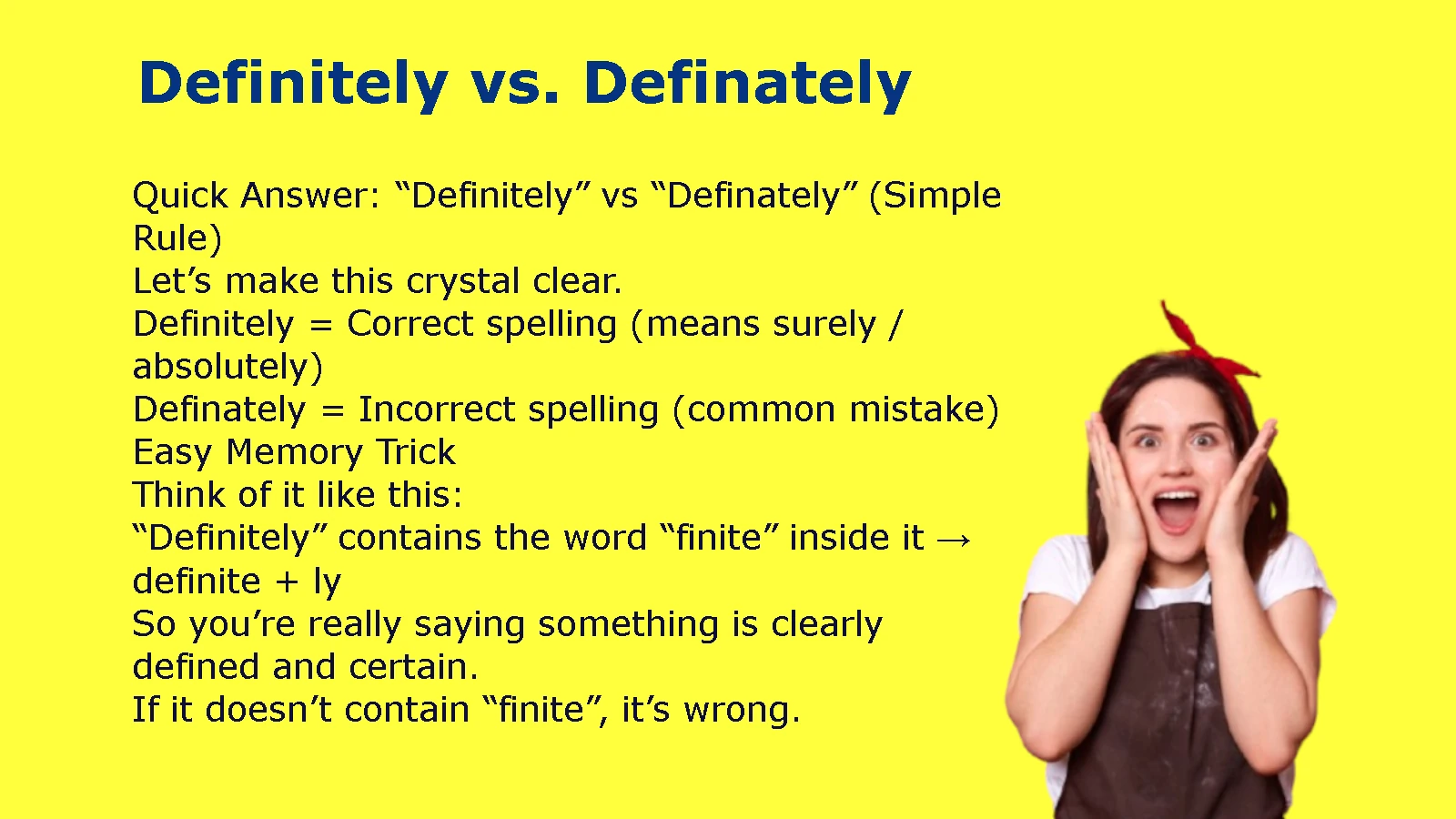
Quick Answer: “Definitely” vs “Definately” (Simple Rule)
Let’s make this crystal clear.
- Definitely = Correct spelling (means surely / absolutely)
- Definately = Incorrect spelling (common mistake)
Easy Memory Trick
Think of it like this:
“Definitely” contains the word “finite” inside it → definite + ly
So you’re really saying something is clearly defined and certain.
If it doesn’t contain “finite”, it’s wrong.
Why “Definately” Feels Right (But Isn’t)
Here’s where most learners get tricked.
When we say “definitely,” it often sounds like:
“defin-it-ly” or “definately”
So your brain naturally adds an “a” sound in the middle. That phonetic illusion is what causes the mistake.
The Real Reason Behind the Error
- English pronunciation doesn’t always match spelling
- The “-ite” syllable gets softened in speech
- People write what they hear, not what is correct
That’s why “definately” spreads so easily online.
“Definitely” Explained Clearly (With Meaning)
The correct word is definitely, and it means:
- Without doubt
- Certainly
- Absolutely
- Clearly and surely
Simple Definition
Definitely = something is 100% sure or confirmed
Real-Life Examples of “Definitely”
Let’s see it in action:
- “I will definitely attend the meeting tomorrow.”
- “She is definitely the best candidate for the job.”
- “This movie is definitely worth watching.”
- “We will definitely finish the project on time.”
Mini Scenario
You ask your friend:
“Are you coming tonight?”
They reply:
“Definitely!”
That means there is no doubt at all.
Common Mistake: “Definately” Explained
Now let’s talk about the incorrect version.
Why People Use It
- It matches pronunciation
- It “looks right” when spoken fast
- It spreads through informal texting and social media
But Here’s the Truth
“Definately” is always wrong in standard English writing.
Even if it’s widely used, it is still considered a spelling error in:
- Exams
- Professional writing
- Emails
- Academic work
Side-by-Side Comparison Table
| Word | Correct? | Meaning | Usage |
| Definitely | ✅ Correct | Surely / Absolutely | Formal & informal |
| Definately | ❌ Incorrect | Misspelling | Avoid completely |
Why This Mistake Is So Common
This is one of the most searched spelling doubts in English—and for good reason.
Main Causes
- Spoken English influence
- Typing quickly on mobile
- Autocorrect mistakes
- Lack of visual memory of spelling
Key Insight
People don’t learn this mistake—they pick it up naturally.
How to Remember the Correct Spelling Forever
Here are simple tricks that actually work:
1. The “Finite” Trick
“Definitely” contains finite, meaning something has a clear limit or certainty.
2. Break It Down
Definite + ly = definitely
3. Say It Slowly While Writing
Say: “definite-ly” not “definately”
Real-World Mistake Example (Case Study)
A student writes in an exam:
“I will definately complete the assignment.”
What Happens
- Teacher marks it wrong
- Even though grammar is correct, spelling reduces score
Lesson
One small spelling error can affect credibility, grades, or professionalism.
Where This Mistake Causes Problems
This confusion isn’t just academic—it shows up everywhere:
- Job applications
- Business emails
- Social media captions
- Freelance writing
Example
A freelancer writes:
“I can definately deliver on time.”
Client perception:
Lack of attention to detail
Quick Fix Guide (Use This Anytime)
If you’re unsure, just remember:
- If you mean “surely” → use definitely
- If you write “definately” → delete and correct it immediately
- When in doubt → check spelling or auto-suggestion
FAQ: “Definitely” vs “Definately”
Is “definately” ever correct?
No. It is always a spelling mistake in standard English.
Why do so many people write it wrong?
Because pronunciation sounds like it has an “a,” even though it doesn’t.
What is the easiest way to remember it?
Remember the word “finite” inside “definitely.”
Is it okay in informal texting?
It is understood, but still incorrect.
Final Takeaway: The One Rule You Should Remember
Here’s the simplest truth:
“Definitely” is always correct. “Definately” is always wrong.
There is no middle ground, no context change, and no exception.
So whenever you feel unsure, just pause and ask yourself:
- Does it contain finite?
- Does it look like a real dictionary word?
If yes → you’re safe.
If not → correct it immediately.
Because in English writing, small spelling details don’t just matter—they define clarity, confidence, and credibility.