Have you ever wondered whether “separate vs seperate” is just a typing mistake or a real confusion in English spelling? This is one of the most common issues learners face in writing, reading, and everyday communication. The word separate is often misspelled as seperate, mainly because of how it sounds when spoken, which leads to confusion in both academic and professional contexts.
In simple terms, separate means to divide, keep apart, or make distinct from something else. It can be used in physical, emotional, or conceptual situations, such as separating objects, ideas, or groups. On the other hand, seperate is not a correct English word—it is simply a common spelling error that appears frequently in informal writing, social media, and even student assignments.
This confusion is closely linked to broader topics like spelling mistakes, commonly confused English words, grammar accuracy, and vocabulary development. Many learners search for terms like separate meaning, how to spell separate correctly, and common spelling errors in English while trying to improve their writing skills.
If you’ve ever paused while writing a sentence like “please separate the files correctly,” you’re not alone—this is a classic example of how a small spelling difference can affect clarity and correctness in English writing.
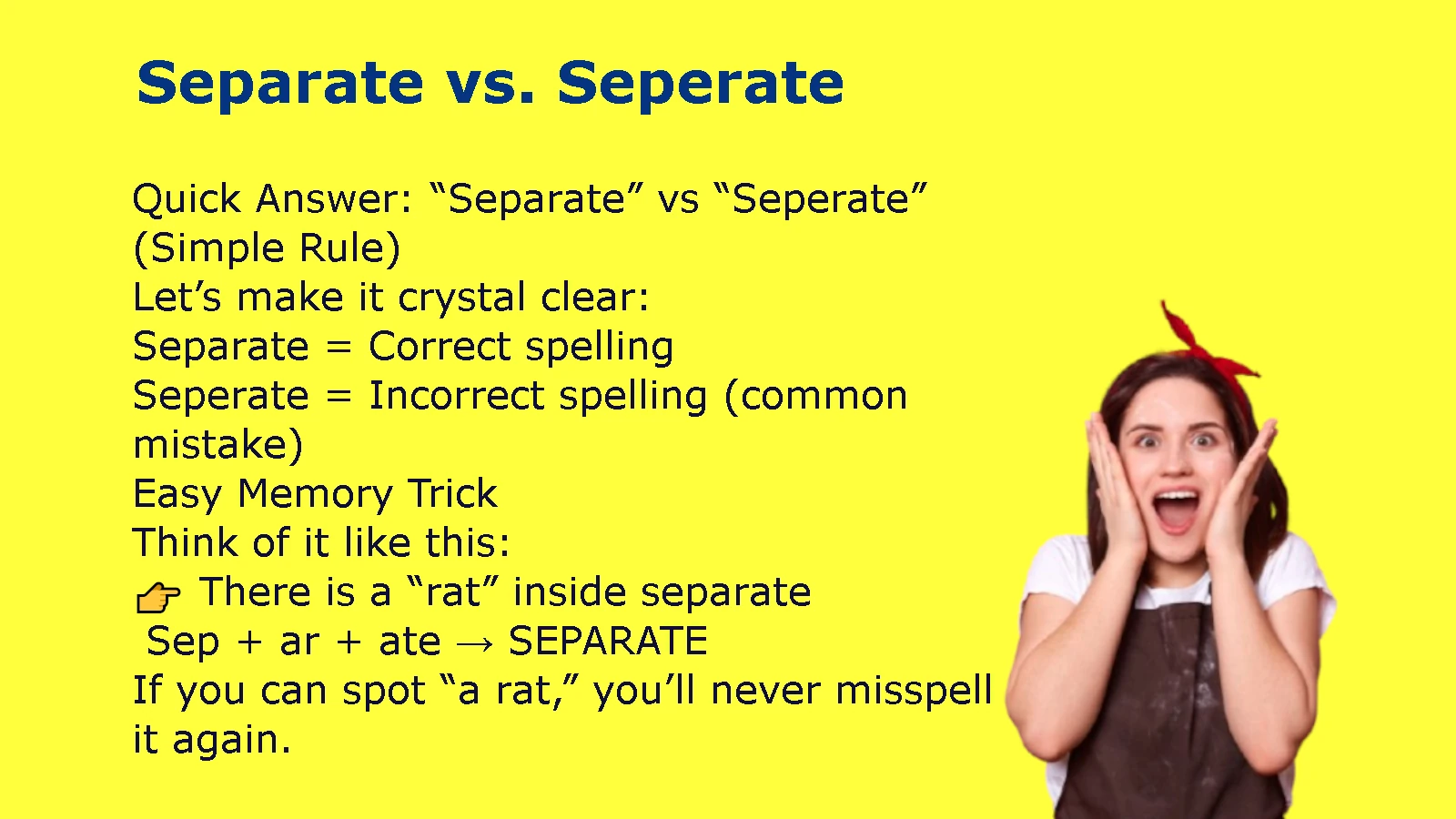
Quick Answer: “Separate” vs “Seperate” (Simple Rule)
Let’s make it crystal clear:
- Separate = Correct spelling
- Seperate = Incorrect spelling (common mistake)
Easy Memory Trick
Think of it like this:
👉 There is a “rat” inside separate
Sep + ar + ate → SEPARATE
If you can spot “a rat,” you’ll never misspell it again.
Why “Seperate” Feels Correct (But Isn’t)
Here’s the tricky part: “Seperate” looks right because English often confuses vowel patterns.
People assume:
- “decorate” → looks similar
- “generate” → similar ending sound
- So “seperate” feels natural
But English doesn’t always follow sound-based spelling logic. It follows historical word roots.
The Real Problem
We spell based on how we hear words, but “separate” is not spelled the way it sounds in casual speech.
That’s why the mistake is so common—even among fluent speakers.
“Separate” Meaning Explained Clearly
Before spelling, let’s understand meaning.
Separate (verb + adjective) means:
- To divide or split something
- To keep things apart
- To be not connected
Examples
- Please separate the papers into two piles.
- They decided to live in separate houses.
- Try to separate fact from opinion.
Why “Seperate” Is Always Wrong
Let’s be direct:
👉 “Seperate” is not a word in standard English.
It appears because:
- People type it the way it sounds
- Auto-correct sometimes fails
- It spreads through informal writing
But in exams, professional emails, and formal writing, it is always marked incorrect.
Spelling Breakdown of “Separate” (The Easiest Way to Remember)
Let’s break it visually:
SE + PAR + ATE
Now read it slowly:
- SE
- PAR (like “part” → to divide)
- ATE
Hidden Meaning Trick
Think:
👉 To “separate” is to make things become apart
That “PAR” in the middle secretly reminds you of “parting ways.”
Common Mistakes People Make
Here’s how people usually mess it up:
❌ Wrong Forms
- seperate ❌
- seperet ❌
- seprate ❌
✅ Correct Form
- separate ✔
Why These Errors Happen
- Fast typing
- Pronunciation influence
- Lack of visual memory of the word
Side-by-Side Comparison Table
| Word | Is It Correct? | Meaning | Usage Level |
| Separate | ✅ Correct | To divide or keep apart | Formal + Informal |
| Seperate | ❌ Incorrect | Not a valid word | Never use |
Real-Life Examples of “Separate”
Let’s see how it’s used naturally:
- We need to separate work and personal life.
- The teacher asked us to separate into groups.
- Please keep the files in separate folders.
- They were seated at separate tables.
👉 In every case, it shows division or distance between things.
How to Never Misspell It Again
Here are simple strategies that actually work:
1. Use the “Rat Rule”
If you see “a rat” inside the word → it’s correct:
sep + ar + ate
2. Break It Into Syllables
Say it slowly:
- Sep
- Ar
- Ate
3. Don’t Trust Sound Alone
Just because it sounds like “seperate” doesn’t mean it’s correct.
4. Visual Memory Trick
Picture two things moving apart → “separate”
Quick Decision Guide
Use this when unsure:
- If you are writing it → always SEPARATE
- If you see “seperate” → it’s wrong
- If confused → break it into “sep + ar + ate”
FAQ: Separate vs Seperate
Is “seperate” ever correct in British or American English?
No. It is incorrect in all forms of English.
Why do so many people write “seperate”?
Because it matches pronunciation and common typing habits.
What is the easiest way to remember “separate”?
Remember the word contains “a rat” → sepARate.
Is “separate” a verb or adjective?
It can be both:
- Verb: to separate items
- Adjective: separate rooms
Common Confusing Pair Examples (Bonus Insight)
“Separate” belongs to a group of words often misspelled due to pronunciation:
- definitely (not definately)
- accommodation (not accomodation)
- necessary (not neccessary)
👉 English is full of these traps.
Final Takeaway: The One Rule That Never Fails
Let’s simplify everything:
👉 If you are writing English correctly, there is only one form: SEPARATE
Not “seperate.”
The confusion happens because English doesn’t always follow sound logic—but spelling always has a fixed rule.
So remember this:
Separate things correctly… and separate the wrong spelling from your memory forever.