Have you ever paused while writing and wondered whether “does not” vs. “do not” is the correct choice? This is one of the most common grammar questions in the English language because both phrases express negation but are used with different subjects. Many English learners and even native speakers occasionally mix them up, leading to grammar mistakes that can affect writing clarity and communication.
In simple terms, do not is used with the pronouns I, you, we, and they, as well as plural nouns, while does not is used with he, she, it, and singular nouns. Although the difference is only one word, choosing the correct form depends entirely on subject-verb agreement, making it an essential part of English grammar and sentence construction.
This confusion often appears in searches such as does not vs. do not, difference between does not and do not, when to use does not, when to use do not, subject-verb agreement, and common English grammar mistakes. Understanding this grammar rule is important for writing emails, academic papers, business documents, social media posts, and everyday conversations with confidence and accuracy.
If you’ve ever hesitated before writing sentences like “She does not like coffee” or “They do not like coffee,” you’re certainly not alone. A simple change in the subject determines which phrase is grammatically correct, making this one of the most frequently confused grammar rules in English.
In this guide, you’ll learn the clear difference between does not and do not, their meanings, grammar rules, sentence examples, common mistakes, and easy memory tricks to help you use both forms correctly in every situation.
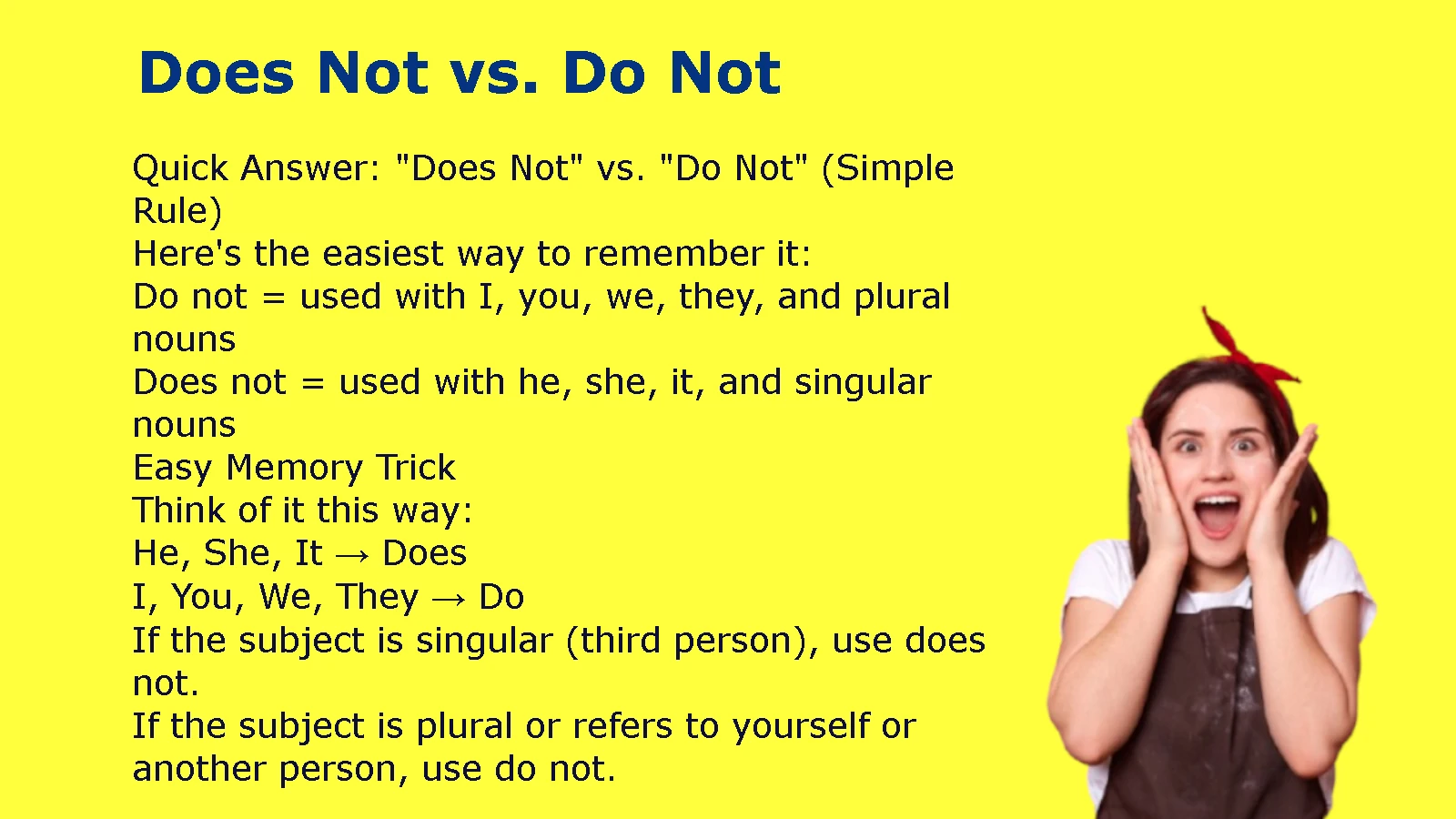
Quick Answer: “Does Not” vs. “Do Not” (Simple Rule)
Here’s the easiest way to remember it:
Do not = used with I, you, we, they, and plural nouns
Does not = used with he, she, it, and singular nouns
Easy Memory Trick
Think of it this way:
- He, She, It → Does
- I, You, We, They → Do
If the subject is singular (third person), use does not.
If the subject is plural or refers to yourself or another person, use do not.
How People Actually Use “Does Not” and “Do Not”
In everyday English, these phrases are usually shortened.
Instead of saying:
- Do not
- Does not
People usually say:
- Don’t
- Doesn’t
In Casual Conversations
People almost always use contractions.
- I don’t know.
- She doesn’t like coffee.
In Formal Writing
The full forms are more common.
- Employees do not have access after 6 p.m.
- The machine does not operate automatically.
Why This Matters
Understanding the full forms helps you use contractions correctly and avoid grammar mistakes.
The Grammar Rule Behind “Does Not” vs. “Do Not”
The difference isn’t about meaning.
It’s about the subject.
Think in Terms of the Subject
| Subject | Correct Form |
| I | Do not |
| You | Do not |
| We | Do not |
| They | Do not |
| He | Does not |
| She | Does not |
| It | Does not |
| Singular noun | Does not |
| Plural noun | Do not |
Key Insight
The helping verb changes—not the main verb.
Correct:
- She does not work.
Not:
- She does not works.
“Do Not” Explained Clearly (With Examples)
“Do not” is used with:
- I
- You
- We
- They
- Plural nouns
Standard Examples
- I do not agree.
- You do not need to hurry.
- We do not work on Sundays.
- They do not live here.
- Cats do not like loud noises.
Common Situations
School assignments
Instructions
Emails
Conversations
Key Takeaway
Whenever the subject isn’t he, she, it, or a singular noun, choose do not.
“Does Not” Explained Clearly (With Examples)
“Does not” is used with:
- He
- She
- It
- Singular nouns
Standard Examples
- He does not drive.
- She does not eat meat.
- It does not matter.
- My brother does not play soccer.
- The computer does not start.
Remember
After does, the main verb always stays in its base form.
Correct:
- She does not like pizza.
Incorrect:
- She does not likes pizza.
Key Insight
The “s” moves from the main verb to does.
The Biggest Mistake People Make
The most common mistake is adding -s to the main verb after does not.
Incorrect
- He does not likes football.
Correct
- He does not like football.
Another common mistake is using do not with singular subjects.
Incorrect:
- She do not understand.
Correct:
- She does not understand.
Lesson
Only one verb carries the grammar change.
Side-by-Side Comparison Table
| Phrase | Used With | Example |
| Do not | I, You, We, They, plural nouns | They do not agree. |
| Does not | He, She, It, singular nouns | She does not agree. |
Real-Life Examples of “Do Not”
Everyday Sentences
- I do not drink coffee.
- We do not open on Mondays.
- They do not speak Spanish.
- You do not have to wait.
- Dogs do not eat chocolate safely.
Mini Scenario
A teacher says:
“We do not allow phones during exams.”
Everyone understands the rule applies to the entire class.
Real-Life Examples of “Does Not”
Everyday Sentences
- He does not like spicy food.
- She does not work here.
- The printer does not respond.
- My father does not watch TV often.
- The train does not stop here.
Mini Scenario
A manager says:
“The system does not save changes automatically.”
Everyone knows the issue is with the system.
Regional and Style Differences
Unlike some grammar topics, “do not” and “does not” follow the same rules in American English, British English, Canadian English, and Australian English.
The only noticeable difference is style.
Formal Writing
Full forms are common.
- Employees do not receive overtime pay.
Informal Speech
Contractions are preferred.
- Employees don’t receive overtime pay.
Key Tip
The grammar rule never changes.
How to Avoid Mistakes Every Time
Use these simple strategies.
Identify the Subject First
Ask yourself:
Who is performing the action?
Match the Subject
- He/She/It → Does not
- Everyone else → Do not
Keep the Main Verb Simple
After do or does, never add -s to the verb.
Read the Sentence Aloud
Incorrect grammar often sounds awkward when spoken.
What to Say Instead (Common Contractions)
Most conversations use contractions.
| Full Form | Contraction |
| Do not | Don’t |
| Does not | Doesn’t |
Examples:
- I don’t know.
- She doesn’t agree.
- They don’t understand.
- It doesn’t work.
Quick Decision Guide (Use This Instantly)
When you’re unsure, follow this:
He, She, It, or one person/thing → Does not
I, You, We, They, or more than one → Do not
Still unsure?
Replace the subject with he or they and see which one sounds correct.
FAQ: “Does Not” vs. “Do Not”
Is “does not” singular?
Yes. It is used with singular third-person subjects.
Is “do not” plural?
Mostly yes, but it is also used with I and you.
Can I say “he don’t”?
Only in certain dialects or informal speech. In standard English, the correct form is he doesn’t or he does not.
Why doesn’t the main verb end with “s”?
Because the helping verb does already carries the singular form.
Case Study: A Common Grammar Error
A student writes:
“She do not enjoy science.”
The teacher corrects it to:
“She does not enjoy science.”
What Went Wrong?
The student matched the wrong helping verb with the singular subject.
The Fix
Identify the subject first.
Since she is singular, use does not.
Problem solved.
Key Facts You Should Remember
- Do not is used with I, you, we, they, and plural nouns.
- Does not is used with he, she, it, and singular nouns.
- After do or does, always use the base form of the main verb.
- Don’t and doesn’t are simply contractions.
- The grammar rule is the same in American and British English.
Final Takeaway: The One Rule That Never Fails
The difference between “Does Not” vs. “Do Not” is easier than it looks.
Just remember one simple rule:
Singular (he, she, it) → Does not
Plural or I, you, we, they → Do not
Whenever you’re writing, identify the subject before choosing the helping verb. Then keep the main verb in its base form.
Master this one rule, and you’ll avoid one of the most common grammar mistakes in English. Whether you’re writing emails, essays, or everyday messages, choosing between “does not” and “do not” will become second nature.