Have you ever come across fiend vs. feen and wondered whether they are simply different spellings of the same word or two completely different terms? This is a common point of confusion for English learners, especially since fiend is a standard English word, while feen is an informal slang term used in certain dialects and online conversations. Knowing the difference helps you choose the right word for the right situation and avoid misunderstandings in both writing and speech.
In simple terms, fiend refers to a cruel, wicked, or evil person, and it can also describe someone with an intense obsession or addiction, such as a coffee fiend or sports fiend. On the other hand, feen is slang that generally means to strongly crave or desire something. In some communities, it is also used as a shortened or alternative spelling of fiend when talking about someone who desperately wants or is addicted to something. Although the words may sound similar in casual speech, they differ in spelling, meaning, formality, and proper usage.
This confusion often appears in searches like fiend meaning, feen meaning, fiend vs. feen, is feen a real word, how to use fiend in a sentence, and commonly confused English words. It also relates to broader topics such as English vocabulary, slang vs. standard English, spelling differences, and grammar usage, making it an important distinction for students, writers, and anyone looking to improve their communication skills.
If you’ve ever hesitated before writing a sentence like “He’s a gaming fiend” or “I’m feening for pizza,” you’re not alone. While these expressions may sound alike, they belong to different contexts and levels of formality.
In this guide, you’ll learn the clear difference between fiend and feen, their definitions, pronunciation, real-life examples, grammar rules, and easy memory tricks so you can use each word confidently in everyday conversations and writing.
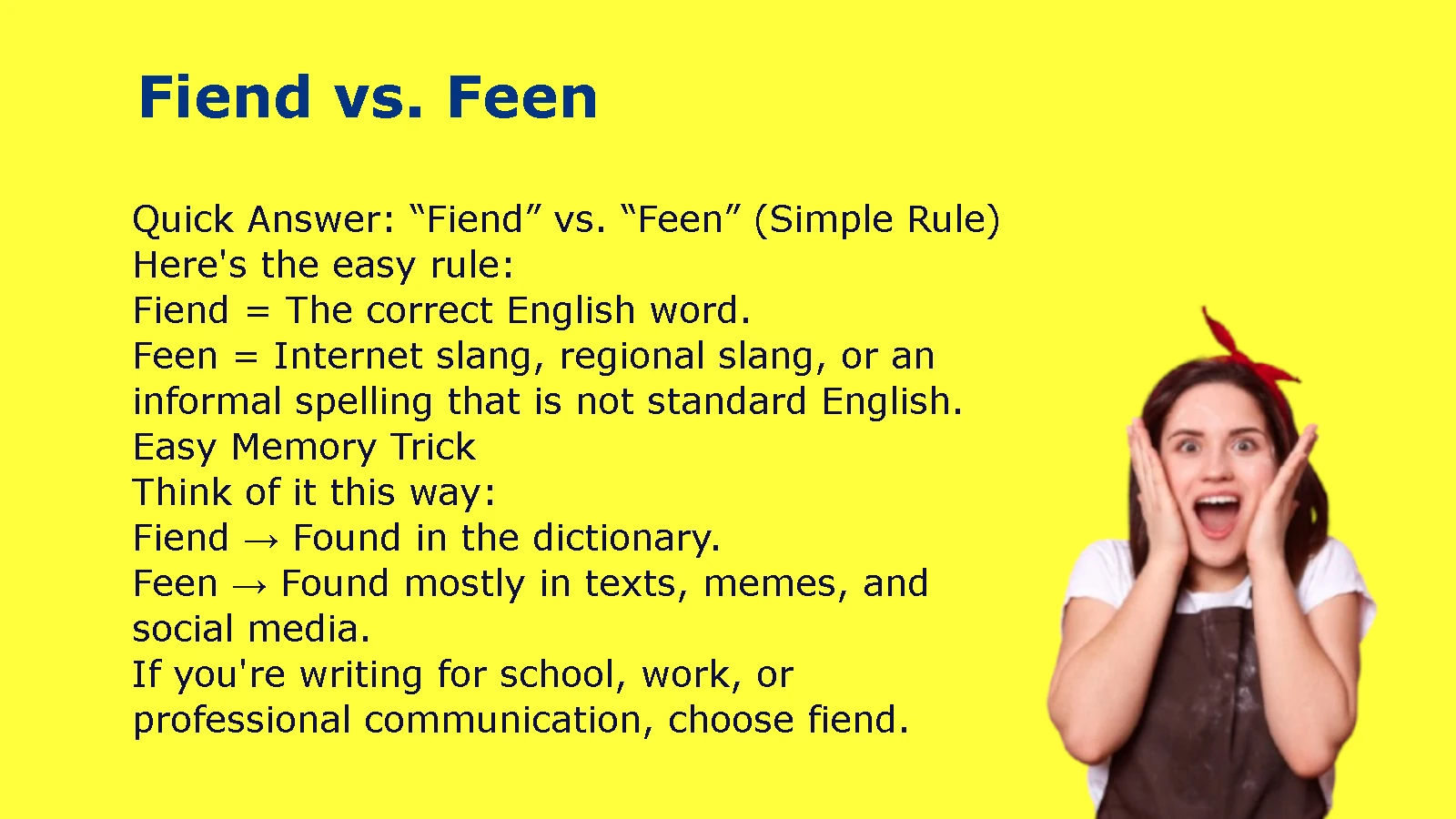
Quick Answer: “Fiend” vs. “Feen” (Simple Rule)
Here’s the easy rule:
Fiend = The correct English word.
Feen = Internet slang, regional slang, or an informal spelling that is not standard English.
Easy Memory Trick
Think of it this way:
Fiend → Found in the dictionary.
Feen → Found mostly in texts, memes, and social media.
If you’re writing for school, work, or professional communication, choose fiend.
What Does “Fiend” Mean?
The word fiend has been part of English for centuries and has several meanings depending on the context.
Common Meanings
- A wicked or evil person
- Someone with an intense obsession or craving
- A person who is extremely enthusiastic about something
Examples
- He’s a coffee fiend and drinks six cups a day.
- She’s a fitness fiend who never skips the gym.
- The villain was portrayed as an evil fiend.
Key Insight
Today, fiend is often used positively to describe someone who loves something intensely.
What Does “Feen” Mean?
Unlike fiend, feen is not recognized as a standard English word.
However, it appears frequently in slang.
Common Uses
People may use feen to mean:
- Craving something
- Wanting something badly
- Acting addicted to something
Examples:
- I’m feening for pizza.
- He’s feening for the new video game.
In these cases, many writers intentionally spell it feen to reflect slang pronunciation.
Key Insight
Outside of informal conversations, feen is generally considered nonstandard.
Why People Confuse “Fiend” and “Feen”
The confusion happens because the words sound very similar.
Main Reasons
- Similar pronunciation
- Social media slang
- Text messaging shortcuts
- Regional dialects
Many younger speakers encounter feen online before they ever learn the correct spelling fiend.
The Grammar Difference
Here’s the important distinction.
| Word | Standard English | Meaning | Appropriate for Formal Writing |
| Fiend | ✅ Yes | Obsessed person, evil person | ✅ Yes |
| Feen | ❌ No | Slang spelling | ❌ No |
“Fiend” Explained Clearly
The standard English word fiend works in many situations.
Someone Obsessed With Something
Examples:
- My brother is a movie fiend.
- She’s a travel fiend.
Someone Evil
Examples:
- The story described a terrifying fiend.
- The villagers feared the evil fiend.
Key Takeaway
In modern English, the “obsessed with something” meaning is much more common than the “evil creature” meaning.
“Feen” Explained Clearly
The slang spelling feen usually appears in casual conversation.
Examples:
- I’m feening for some ice cream.
- He’s been feening for the weekend.
You’ll often see this spelling on:
- Social media
- Song lyrics
- Text messages
- Online forums
Key Takeaway
Avoid using feen in academic papers, business emails, or professional documents.
The Biggest Mistake People Make
Many people assume feen is simply another accepted spelling of fiend.
It isn’t.
What Goes Wrong
Someone writes:
“He’s a soccer feen.”
Readers may think:
- It’s a typo.
- The writer doesn’t know the correct spelling.
- The sentence is intentionally using slang.
Lesson
If you’re unsure, use fiend.
Side-by-Side Comparison Table
| Feature | Fiend | Feen |
| Dictionary word | ✅ Yes | ❌ No |
| Standard English | ✅ Yes | ❌ No |
| Used in professional writing | ✅ Yes | ❌ No |
| Common in slang | Sometimes | ✅ Yes |
| Safe for academic writing | ✅ Yes | ❌ No |
Real-Life Examples of “Fiend”
Here are some everyday examples.
Common Sentences
- She’s a chocolate fiend.
- He’s a basketball fiend.
- Our dog is a treat fiend.
- The novel featured an ancient fiend.
Mini Scenario
A coworker drinks coffee every hour.
You could say:
“He’s a complete coffee fiend.”
This sounds natural and correct.
Real-Life Examples of “Feen”
Now compare.
Common Slang
- I’m feening for tacos.
- They’re feening over the new album.
- She’s feening for summer vacation.
Mini Scenario
A friend texts:
“Bro I’m feening for burgers.”
This is acceptable in casual texting but not in formal writing.
Regional and Cultural Differences
Language changes across communities.
In Standard English
Most dictionaries recognize only fiend.
In Internet Slang
Many users intentionally write feen or feening.
In Music and Pop Culture
Slang spellings often become popular through rap lyrics, TikTok, and online conversations.
Key Tip
Know your audience. Slang works among friends but not in professional settings.
How to Avoid Confusion Every Time
Follow these simple strategies.
Use “Fiend” When
- Writing essays
- Sending emails
- Creating blog posts
- Writing resumes
- Publishing professional content
Use “Feen” Only When
- Texting friends
- Quoting slang
- Writing dialogue
- Mimicking casual speech
Why This Works
Standard spelling makes your writing clear and credible.
What to Say Instead (Clear Alternatives)
Depending on the meaning, you can also use:
Instead of “Fiend”
- Enthusiast
- Fan
- Addict (informal)
- Lover
- Devotee
Instead of “Feening”
- Craving
- Wanting
- Longing for
- Desperate for
- Eager for
Quick Decision Guide (Use This Instantly)
Need the standard English word?
→ Fiend
Writing slang or dialogue?
→ Feen (only if intentional)
Writing for school or work?
→ Always choose fiend.
FAQ: “Fiend” vs. “Feen”
Is “feen” a real word?
Not in standard English. It’s mainly slang or a nonstandard spelling used online.
Is “fiend” always negative?
No. It can describe someone who is passionate about something, such as a “fitness fiend.”
Can I use “feen” in formal writing?
No. Use fiend or another standard word instead.
Why do people spell it “feen”?
The spelling reflects informal pronunciation and internet slang rather than standard English.
Case Study: A Common Writing Mistake
A student wrote:
“My brother is a gaming feen.”
The teacher marked it incorrect because feen isn’t standard English.
The corrected sentence became:
“My brother is a gaming fiend.”
The meaning stayed the same, but the writing became grammatically correct.
Key Facts You Should Remember
- Fiend is the correct dictionary spelling.
- Feen is slang or a nonstandard spelling.
- Use fiend in formal and professional writing.
- Use feen only when intentionally writing slang.
- Knowing your audience helps you choose the right word.
Final Takeaway: The One Rule That Never Fails
The difference between Fiend and Feen is simple once you understand the context. Fiend is the standard English word used in dictionaries and formal writing, while feen belongs mainly to slang and casual online conversations.
Whenever you’re writing for school, work, or a professional audience, choose fiend. If you’re texting friends or quoting slang, feen may fit the informal tone.
When in doubt, remember this simple rule:
Dictionary English → Fiend
Internet slang → Feen
Following this guideline will help your writing stay accurate, clear, and appropriate for every situation.