Have you ever wondered whether “Familiar” vs. “Familar” is just a small spelling mistake or two different forms of the same word? This is a common confusion in English writing, especially among learners who often encounter similar-looking words in reading, exams, and everyday communication.
In simple terms, Familiar is the correct English word that means something well known, recognized, or easy to understand. On the other hand, “Familar” is actually a common misspelling of the word familiar and is not considered correct in standard English usage.
This confusion often appears in searches like familiar meaning, familiar vs familar difference, and commonly misspelled English words, especially among students trying to improve their grammar accuracy and vocabulary skills.
If you’ve ever paused while writing a sentence like “I am familiar with this topic,” you’re not alone—this is one of those tricky spelling cases where a single missing letter can lead to a mistake.
In this guide, you’ll learn the correct spelling, meaning, usage examples, and easy memory tricks to avoid confusing Familiar with its incorrect form “Familar” in writing and communication.
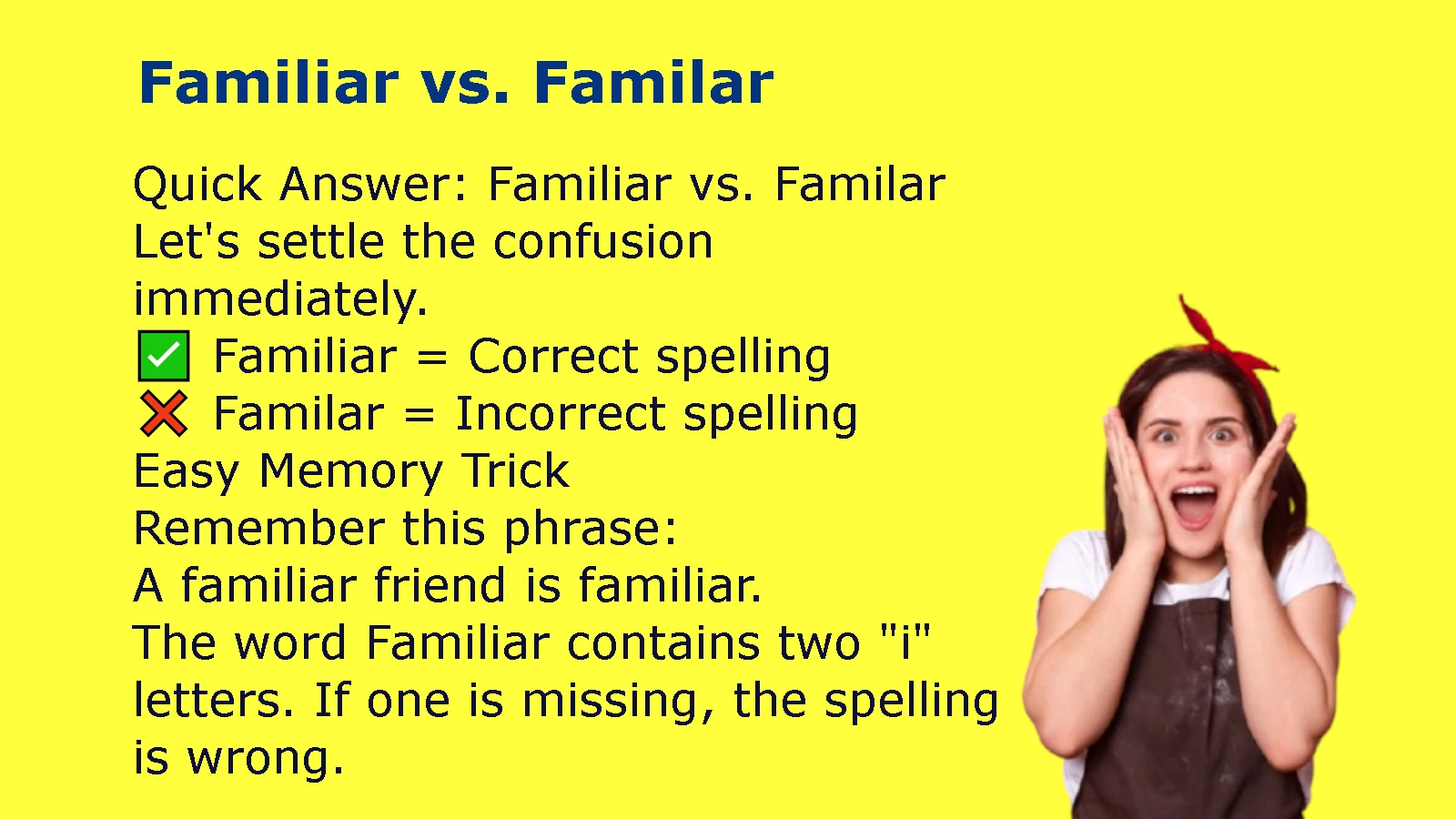
Quick Answer: Familiar vs. Familar
Let’s settle the confusion immediately.
✅ Familiar = Correct spelling
❌ Familar = Incorrect spelling
Easy Memory Trick
Remember this phrase:
A familiar friend is familiar.
The word Familiar contains two “i” letters. If one is missing, the spelling is wrong.
What Does “Familiar” Mean?
The adjective Familiar describes something that is:
- Well known
- Easily recognized
- Previously experienced
- Comfortable because you’ve seen or used it before
It can also describe a person you know well or a situation that feels recognizable.
Examples
- That song sounds familiar.
- I’m familiar with this software.
- Her voice seemed strangely familiar.
- The streets became more familiar as we walked.
Does “Familar” Exist?
No.
Familar is simply a spelling mistake.
Although many people accidentally type it, you’ll never find Familar as a correct English word in dictionaries or grammar guides.
Whenever you write Familar, it should be corrected to Familiar.
Incorrect Examples
❌ This place looks familar.
❌ I’m not familar with the rules.
✅ This place looks familiar.
✅ I’m not familiar with the rules.
Why Do People Confuse “Familiar” and “Familar”?
The mistake happens because English pronunciation can be misleading.
Common Reasons
- People pronounce the word quickly.
- The middle vowel sound is easy to skip.
- Fast typing causes letters to be omitted.
- Spell-check isn’t always enabled.
Since the missing “i” is in the middle of the word, many writers don’t notice the error until someone points it out.
The Spelling Rule Behind “Familiar”
The correct spelling is:
F-a-m-i-l-i-a-r
Notice that it contains:
- Two i letters
- One a after the second i
Many people mistakenly write:
F-a-m-i-l-a-r
That version leaves out an important letter.
Quick Breakdown
Correct:
F A M I L I A R
Incorrect:
F A M I L A R
One missing i changes the spelling completely.
Side-by-Side Comparison
| Word | Correct? | Meaning |
| Familiar | ✅ Yes | Well known or recognized |
| Familar | ❌ No | Incorrect spelling |
Examples of “Familiar” in Sentences
Here are some everyday examples.
At School
- The teacher used a familiar example.
- These vocabulary words should look familiar.
At Work
- I’m familiar with the company’s policies.
- She is familiar with the new project.
In Daily Life
- That restaurant seems familiar.
- His face looked familiar, but I couldn’t remember his name.
- This route is very familiar to me.
- The music sounded instantly familiar.
Common Phrases Using “Familiar”
You’ll often hear these expressions:
- Familiar face
- Familiar voice
- Familiar place
- Familiar feeling
- Familiar name
- Become familiar with
- Look familiar
- Sound familiar
- Be familiar to
- Be familiar with
Examples
- That name sounds familiar.
- You should become familiar with the safety rules.
- The neighborhood feels familiar after living here for years.
The Biggest Mistake People Make
Many writers assume that Familar is simply an alternative spelling.
It isn’t.
Unlike words such as color and colour, there is no accepted variation here.
Only Familiar is correct in:
- American English
- British English
- Canadian English
- Australian English
Real-Life Example
Imagine you’re writing a job application.
You write:
“I am familar with Microsoft Excel.”
Even if your qualifications are excellent, the spelling mistake can make your application appear less polished.
Writing:
“I am familiar with Microsoft Excel.”
creates a stronger first impression.
How to Remember the Correct Spelling
Try these easy tricks.
Think of “Family”
The beginning of Familiar looks similar to Family, but remember that Familiar has another “i” later in the word.
Remember Two “I”s
Ask yourself:
“Am I using both i’s?”
If not, you’ve probably misspelled the word.
Read It Slowly
Say it as:
Fa • mil • i • ar
Breaking it into parts makes the second “i” easier to remember.
Common Mistakes to Avoid
Don’t write:
- ❌ Familar
- ❌ Familliar
- ❌ Familier
- ❌ Famillar
Always write:
- ✅ Familiar
Quick Decision Guide
Before using the word, ask yourself:
Are you referring to something well known or recognized?
Yes?
Then use:
Familiar
Never use:
Familar
FAQ: Familiar vs. Familar
Is “Familar” ever correct?
No. Familar is always a spelling mistake.
Which spelling should I use?
Always write Familiar.
Why do so many people spell it incorrectly?
Because the second “i” is easy to overlook when speaking or typing quickly.
Is “Familar” accepted in British English?
No. Both British and American English use Familiar.
Key Facts to Remember
- Familiar is the correct spelling.
- Familar is incorrect.
- The correct word contains two “i” letters.
- The mistake usually happens because writers accidentally omit one “i.”
- Using the correct spelling makes your writing more professional and credible.
Final Takeaway
The difference between Familiar and Familar is surprisingly simple once you know what to look for. Familiar is the only correct spelling in standard English, while Familar is a common typo caused by leaving out the second “i.” Although the words may look similar, only one belongs in professional writing, academic work, emails, and everyday communication.
Whenever you’re unsure, remember this simple rule: if you’re describing something well known or easily recognized, always write “Familiar.” Taking a second to check the spelling can help you avoid an easy mistake and make your writing appear clearer, more accurate, and more confident.