Have you ever stopped mid-sentence wondering whether it’s “wander” vs. “wonder”—or if they’re just two spellings of the same idea? You’re not alone. These two words look and sound similar, but in the English language, they carry completely different meanings, and mixing them up can easily change the sense of a sentence.
In simple terms, wander (*pronounced: /ˈwɒn.dər/ or /ˈwɑːn.dɚ/) means to move around without a fixed direction or purpose—like walking through streets, forests, or even letting your thoughts drift without control. You might wander through a city, wander off a path, or let your mind wander during a quiet moment. It often connects with ideas of travel, exploration, movement, and mental or physical drifting.
On the other hand, wonder (*pronounced: /ˈwʌn.dər/) is about curiosity, surprise, and deep thinking. It describes the feeling you get when something amazes you or when you start questioning something unknown. You might wonder about the future, wonder how something works, or stand in wonder at something beautiful.
This confusion between wander vs. wonder is common in everyday writing, speech, and even professional communication because just one vowel completely changes both meaning and usage. Understanding this small but important difference can significantly improve your grammar accuracy, vocabulary strength, and overall English fluency.
In this guide, you’ll clearly learn the difference between wander and wonder, with simple definitions, pronunciation help, real-life examples, and easy memory tricks so you never confuse them again.
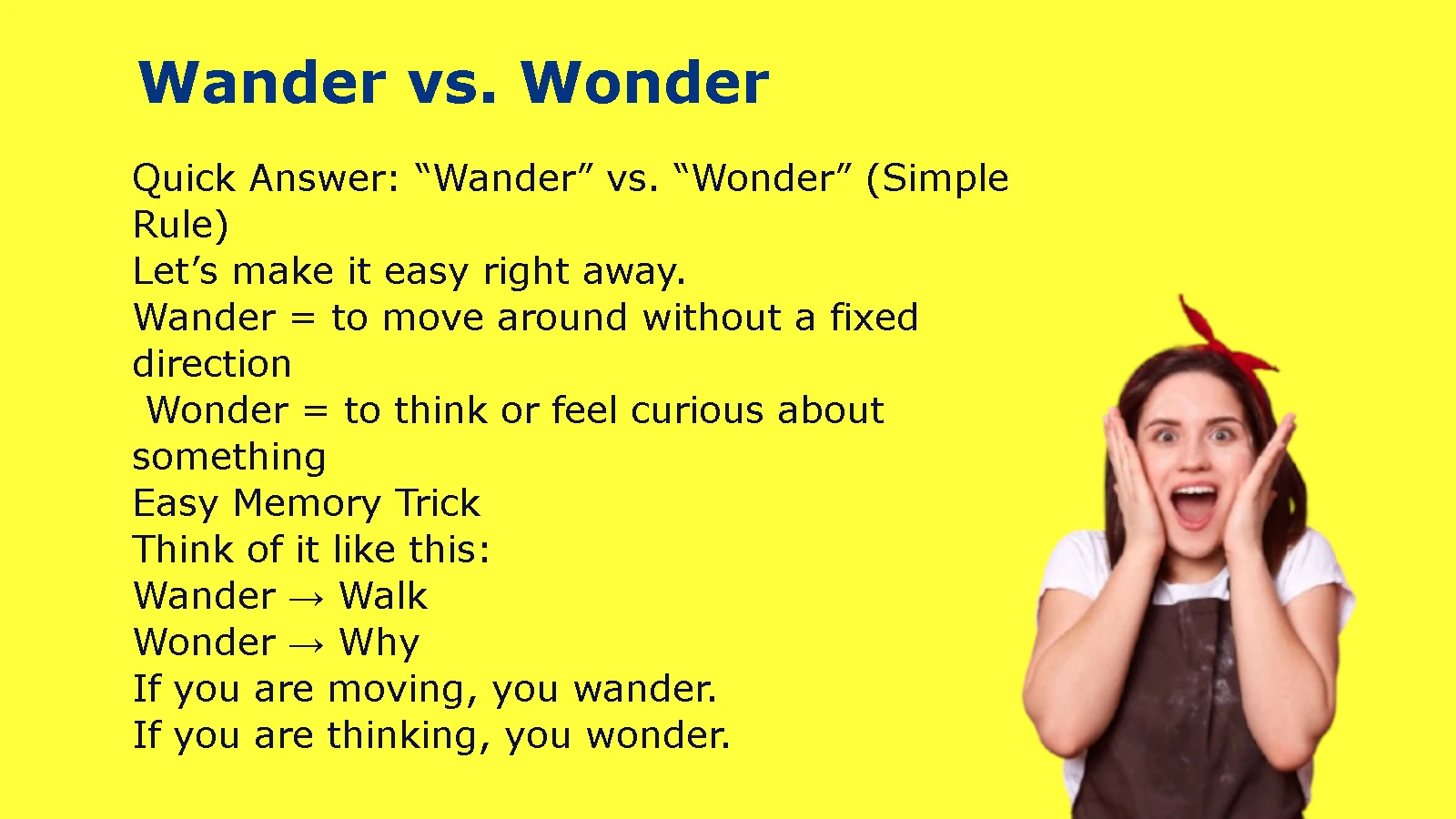
Quick Answer: “Wander” vs. “Wonder” (Simple Rule)
Let’s make it easy right away.
Wander = to move around without a fixed direction
Wonder = to think or feel curious about something
Easy Memory Trick
Think of it like this:
- Wander → Walk
- Wonder → Why
If you are moving, you wander.
If you are thinking, you wonder.
Why “Wander” and “Wonder” Get Confused
Here’s the real issue—they sound almost identical when spoken. That’s why even fluent speakers mix them up in writing.
But their meanings are not even close.
- One is physical
- The other is mental
The confusion usually happens because:
- They are homophones (sound similar in some accents)
- Fast typing leads to mistakes
- People rely on sound instead of meaning
“Wander” Explained Clearly (With Real Meaning)
At its core, wander means moving around without a clear direction or purpose.
Standard Meaning
To walk, travel, or move slowly without a fixed path.
Examples
- “I like to wander through the park on weekends.”
- “The child began to wander away from the group.”
- “We wandered around the city for hours.”
Key Idea
There is movement, but no fixed destination.
Mental Image
Think of:
- A tourist exploring streets without a map
- A person drifting through a forest trail
- A dog roaming freely
“Wonder” Explained Clearly (With Real Meaning)
Now let’s switch to the mental side.
Wonder means to think about something with curiosity, surprise, or uncertainty.
Standard Meaning
To ask yourself questions or feel curious.
Examples
- “I wonder what time it is.”
- “She wondered why he didn’t call.”
- “I often wonder about the future.”
Key Idea
There is no movement, only thought.
Mental Image
Think of:
- Staring out the window thinking deeply
- Asking “why?” or “what if?”
- Feeling curious or confused
The Biggest Difference (Simple Breakdown)
Here’s where everything becomes clear:
| Word | Type of Action | Meaning | Example |
| Wander | Physical | Move without direction | Wander around the city |
| Wonder | Mental | Think with curiosity or doubt | Wonder about the future |
How People Commonly Mistake Them
This is where most errors happen.
Wrong Usage Examples
- “I like to wonder in the park.” ❌
- “I wander what happened.” ❌
Correct Versions
- “I like to wander in the park.” ✔️
- “I wonder what happened.” ✔️
Why This Happens
People match sound instead of meaning:
- “wander” sounds like “wonder”
- typing quickly leads to swapped letters
Real-Life Scenarios
Let’s make it practical.
Scenario 1: Travel
You are in a new city.
- “I love to wander around new places.” ✔️
(You are physically moving)
Scenario 2: Thinking
You are unsure about something.
- “I wonder if it will rain today.” ✔️
(You are thinking, not moving)
Memory Trick That Always Works
Use this simple association:
- Wander = “Walk + Direction”
- Wonder = “Why + Thinking”
Or even simpler:
- If your body moves → wander
- If your brain moves → wonder
Common Situations Where Confusion Happens
In Writing
Students often write:
- “I wander what will happen next”
Correct:
- “I wonder what will happen next”
In Speech-to-Text
AI tools sometimes mishear:
- “wander” instead of “wonder”
In Fast Communication
Text messages and social media posts often mix them up.
Why This Difference Matters
It may seem small, but it changes meaning completely.
- “I wander about you” → sounds like physically roaming ❌
- “I wonder about you” → means thinking about someone ✔️
One letter changes the entire message.
Quick Decision Guide
When you’re stuck, ask yourself:
- Is it about movement? → Wander
- Is it about thinking? → Wonder
- Still unsure? → Replace with “walk” or “think”
Simple test:
If “walk” fits → wander
If “think” fits → wonder
FAQ: Wander vs. Wonder
Is “wander” always physical?
Yes, it usually refers to physical movement without direction.
Can “wonder” mean surprise?
Yes, it can express curiosity or amazement.
Why do they sound similar?
They are homophones in many accents, especially in casual speech.
What is the easiest way to remember?
Wander = walk
Wonder = why
Final Takeaway: The One Rule That Never Fails
Here’s the simplest way to never confuse them again:
If you are moving without direction, you wander.
If you are thinking with curiosity, you wonder.
That’s it.
One belongs to your feet.
The other belongs to your mind.
And once you see that difference, “wander” vs. “wonder” becomes one of the easiest English distinctions you’ll ever learn.