Have you ever wondered about “scent” vs “smell” and why two words that seem so similar are used in such different ways? At first glance, they both relate to what we perceive through the nose, but in English usage, their tone, context, and emotional impact are quite different.
The word scent (pronounced sent) usually refers to a pleasant or noticeable smell, often something delicate, natural, or intentionally created. You might talk about the scent of flowers, the scent of perfume, or the fresh scent of rain in the air. It carries a more refined, sensory, and sometimes poetic feeling, making it common in descriptive writing, branding, and storytelling.
On the other hand, smell (pronounced smel) is a more general term that can refer to any kind of odor—pleasant, unpleasant, or neutral. You can smell food cooking, smell smoke, or smell something strange in a room. Because it is more neutral and direct, smell is widely used in everyday conversation, practical communication, and descriptive explanations.
The confusion between scent vs smell often comes from their overlapping meaning in basic usage, but in reality, they differ in tone and emotional expression. Choosing the right word can make your writing more precise, natural, and expressive.
In this guide, you’ll learn the clear difference between scent and smell, along with pronunciation, real-life examples, and simple usage tips so you can confidently use both words in the right context.
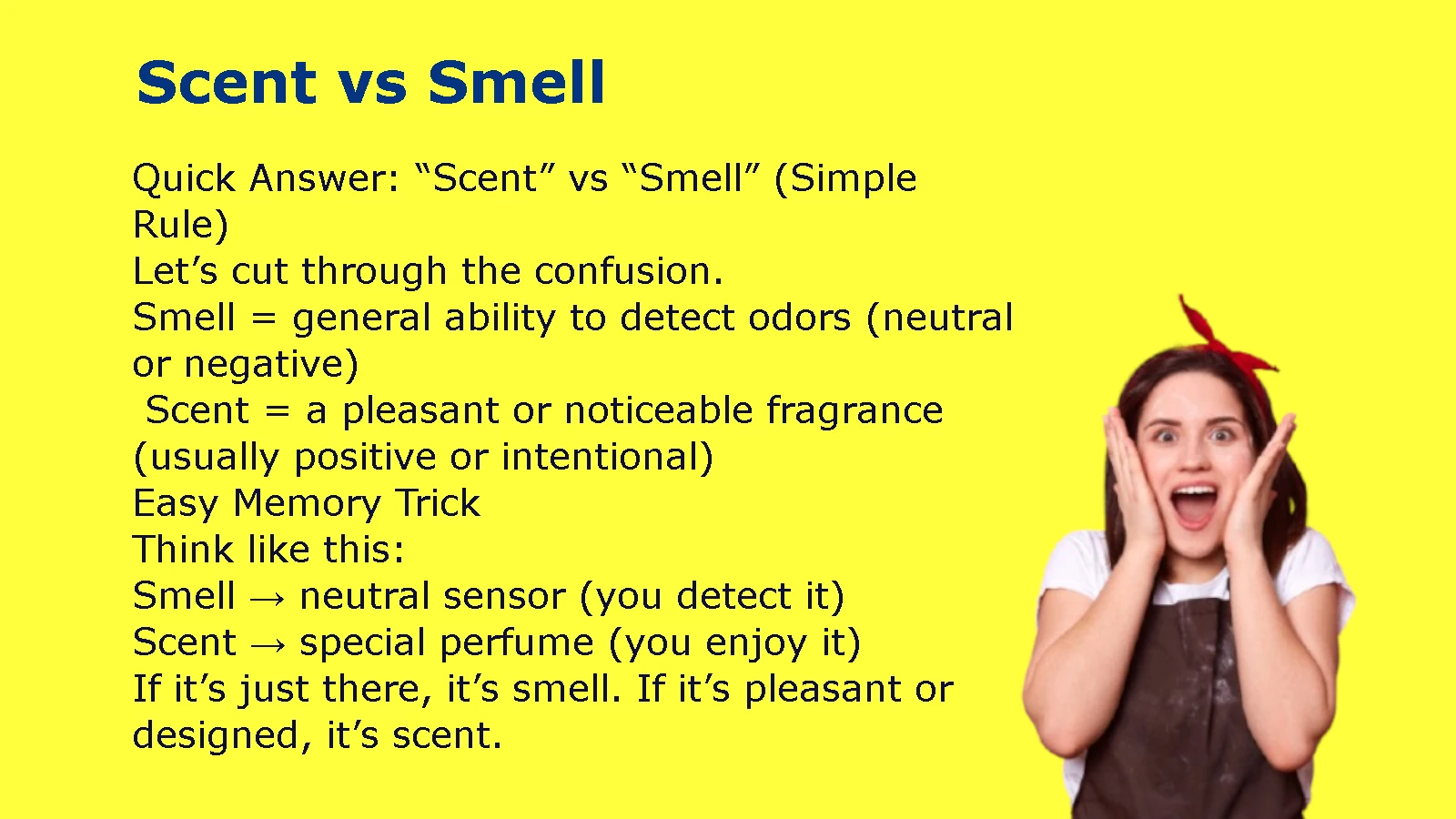
Quick Answer: “Scent” vs “Smell” (Simple Rule)
Let’s cut through the confusion.
Smell = general ability to detect odors (neutral or negative)
Scent = a pleasant or noticeable fragrance (usually positive or intentional)
Easy Memory Trick
Think like this:
- Smell → neutral sensor (you detect it)
- Scent → special perfume (you enjoy it)
If it’s just there, it’s smell. If it’s pleasant or designed, it’s scent.
How People Actually Use “Scent” and “Smell”
Here’s where things get interesting. People don’t always follow strict rules.
In Everyday Speech
- “I smell something burning” (natural detection)
- “Nice scent!” (pleasant fragrance)
- “What’s that smell?” (could be good or bad)
In Marketing and Branding
Brands almost always prefer:
- “fresh scent”
- “signature scent”
- “lavender scent”
Why? Because “smell” sounds too plain or sometimes negative.
In Emotional Context
- “That smell reminds me of home” (neutral/nostalgic)
- “The scent of roses filled the room” (poetic/pleasant)
The Core Meaning Behind “Smell” vs “Scent”
To understand the difference, think of function vs experience.
Smell = Sense or Odor (Broad Meaning)
“Smell” can be:
- A verb: I smell coffee.
- A noun: There is a strange smell.
It doesn’t judge whether it’s good or bad.
Scent = Fragrance or Designed Smell
“Scent” is:
- Usually pleasant
- Often intentional (perfume, flowers, candles)
- More refined or emotional in tone
When to Use “Smell” (With Clear Edge Cases)
At its core, smell is neutral and functional.
Standard Meaning
- I can smell food cooking.
- There is a strong smell in the room.
Edge Case: Negative Bias
Often used for unpleasant odors:
- Bad smell
- Foul smell
- Rotten smell
Edge Case: Positive Use (Less Common)
- The smell of fresh bread (still correct, but plain)
Key Takeaway
“Smell” is about detection—not beauty.
When to Use “Scent” (With Real Context)
Now let’s look at the more refined word.
Standard Meaning
- The scent of perfume filled the air.
- I love the scent of rain.
Edge Case: Emotional or Memory-Based Use
- Childhood scent
- Nostalgic scent of home
Branding Use
- “New scent formula”
- “Signature scent collection”
Key Insight
“Scent” adds emotion, elegance, or intention.
The Biggest Mistake People Make
Here’s the real confusion point.
People assume “smell” and “scent” are interchangeable in every situation.
What Goes Wrong
- Saying “bad scent” (sounds unnatural in most contexts)
- Saying “nice smell” (correct, but less refined)
- Overusing “scent” in technical descriptions
Real-Life Example
A company advertises:
- “Bad scent in your kitchen?”
This sounds awkward. Correct version:
- “Bad smell in your kitchen?”
Side-by-Side Comparison Table
| Word | Meaning | Tone | Best Use Case |
| Smell | General odor / ability to detect | Neutral (can be bad or good) | Everyday speech |
| Scent | Pleasant or intentional fragrance | Positive / refined | Perfume, flowers, marketing |
Real-Life Examples of “Smell”
Let’s make it practical.
Common Situations
- “I smell smoke.”
- “There’s a weird smell in the fridge.”
- “Do you smell that?”
What It Implies
- Detection
- Neutral or negative meaning
- Functional observation
Real-Life Examples of “Scent”
Now compare.
Common Situations
- “The scent of jasmine is beautiful.”
- “This candle has a relaxing scent.”
- “Her signature scent is vanilla.”
What It Implies
- Pleasant experience
- Emotional or sensory enjoyment
- Often intentional or designed
Cultural and Language Differences
English usage can shift slightly depending on context.
In American English
- “Scent” heavily used in marketing and beauty products
- “Smell” used for general description
In British English
- “Smell” is very common in everyday speech
- “Scent” often sounds more formal or poetic
Global English Usage
- Learners often overuse “scent” in neutral situations
- Native speakers rely more on “smell” for everyday talk
How to Avoid Confusion Every Time
Use this simple decision system:
Step 1: Is it neutral or just detection?
→ Use smell
Step 2: Is it pleasant, emotional, or designed?
→ Use scent
Step 3: Still unsure?
→ Use “smell” (safer in general contexts)
What to Say Instead (Clear Alternatives)
If you want natural, fluent English, use these:
Instead of “good smell”
- pleasant scent
- nice fragrance
- fresh aroma
“bad scent”
- bad smell
- foul odor
- unpleasant smell
Instead of overthinking
- “I can smell something” (safe and natural)
Quick Decision Guide
- Neutral detection → smell
- Bad odor → smell
- Pleasant fragrance → scent
- Marketing/perfume → scent
- Still unsure → smell
Simple. Reliable. Done.
FAQ: “Scent” vs “Smell”
Is “scent” always positive?
Mostly yes, but it can be neutral in poetic contexts.
Can “smell” be positive?
Yes, but it sounds plain compared to “scent.”
Why do brands use “scent” instead of “smell”?
Because it sounds premium, emotional, and attractive.
Which is more common in daily English?
“Smell” is more common in everyday conversation.
Final Takeaway: The One Rule That Never Fails
Here’s the truth.
“Smell” is what you detect. “Scent” is what you experience.
One is functional. The other is emotional.
So instead of treating them as equals, think like this:
- If you’re simply noticing something → smell
- If you’re describing something beautiful or intentional → scent
Because when it comes to “Scent vs Smell,” clarity isn’t just grammar—it’s communication.