Have you ever paused while writing and wondered whether it’s “lay vs. lie” or if both words mean the same thing? You’re not alone. These two verbs are among the most confusing pairs in English because they are closely related in form but completely different in usage and grammar.
The word lay is pronounced /leɪ/ (rhymes with “day”) and it is a transitive verb, which means it always needs an object. In simple terms, you “lay something down.” For example, you lay a book on the table, lay a blanket on the bed, or lay a phone aside. It always involves placing or putting something somewhere.
On the other hand, lie is pronounced /laɪ/ (rhymes with “my”) and it is an intransitive verb, meaning it does not take an object. It describes the action of reclining or resting in a flat position. For example, you lie on the bed, lie on the sofa, or lie down to rest. It is about your own position, not something you are placing.
The confusion between lay vs. lie happens so often because their past tense forms overlap and sound even more similar: lay (past of lie) and laid (past of lay), which easily leads to mistakes in everyday writing and speech.
Understanding the difference between lay and lie is essential for improving grammar accuracy, sentence clarity, and overall English fluency. Once you learn the pattern—you lay something, but you lie yourself—it becomes much easier to use correctly in real-life communication.
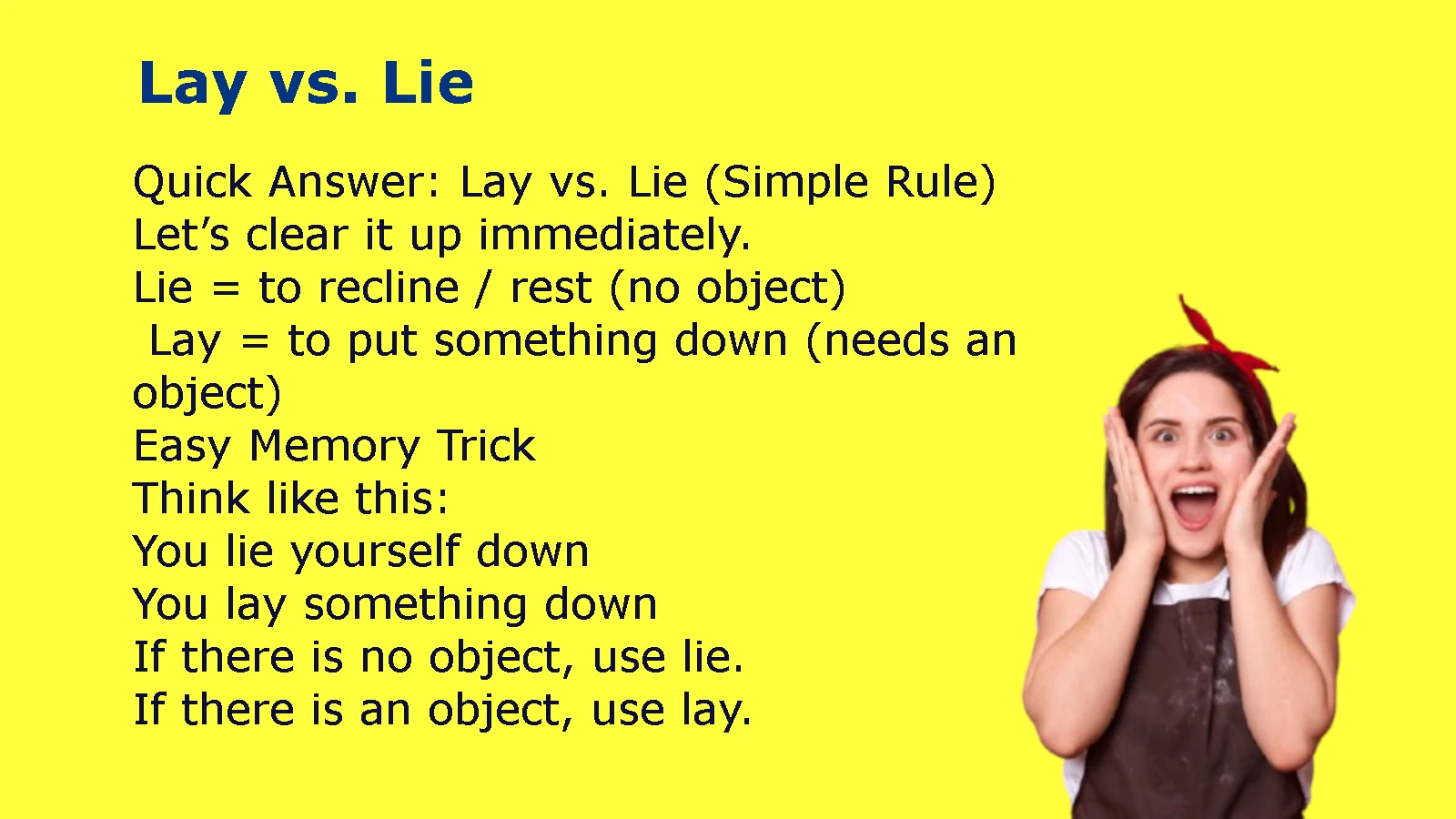
Quick Answer: Lay vs. Lie (Simple Rule)
Let’s clear it up immediately.
Lie = to recline / rest (no object)
Lay = to put something down (needs an object)
Easy Memory Trick
Think like this:
- You lie yourself down
- You lay something down
If there is no object, use lie.
If there is an object, use lay.
Why Lay vs. Lie Is So Confusing
Here’s the real problem: these verbs overlap in real life.
People say:
- “I’m going to lay down” (but they mean lie down)
- “The book is lying on the table” (correct)
- “She laid on the bed” (often incorrect in standard grammar)
It gets worse because “lie” and “lay” change forms in different ways, and that’s where most mistakes happen.
The Core Meaning of “Lie” (Resting / Reclining)
At its simplest, “lie” means to rest or recline yourself.
Present Tense
- I lie on the bed every afternoon.
- He lies on the sofa after work.
Past Tense
- I lay on the bed yesterday. (Yes, “lay” is the past of “lie”)
Past Participle
- I have lain here for hours.
Key Idea
No object is involved. You are doing the action to yourself.
The Core Meaning of “Lay” (To Place Something Down)
Now “lay” always needs an object—something is being placed.
Present Tense
- I lay the book on the table.
- She lays the baby in the crib.
Past Tense
- I laid the book on the table.
Past Participle
- I have laid the documents here.
Key Idea
If something is being placed or positioned, use lay.
The Biggest Mistake People Make
Here’s where most confusion happens:
People mix up “lie” (recline) and “lay” (place) in everyday speech.
Wrong Examples
- ❌ I’m going to lay down for a nap.
- ❌ She was laying on the bed all day.
Correct Versions
- ✅ I’m going to lie down for a nap.
- ✅ She was lying on the bed all day.
Why This Happens
Because “lay” sounds more natural in speech—but grammar doesn’t follow sound, it follows structure.
Lie vs Lay Tense Table (Super Simple View)
| Base Verb | Present | Past | Past Participle | Meaning |
| Lie (recline) | lie | lay | lain | rest / recline |
| Lay (place) | lay | laid | laid | put something down |
This table is where most learners finally “click” the difference.
Real-Life Examples of “Lie”
Let’s make it practical.
- “I lie in bed every morning before work.”
- “He lies on the couch watching TV.”
- “They have lain under the stars all night.”
Simple Idea
If the subject is resting themselves → use lie
Real-Life Examples of “Lay”
Now compare:
- “I lay my phone on the table.”
- “She lays the keys near the door.”
- “He laid the papers on my desk yesterday.”
Simple Idea
If you are placing something → use lay
Why “Lay Down” Feels So Natural (But Is Often Wrong)
Here’s the twist:
People say “lay down” because it feels smooth and common in conversation. But grammatically:
- “Lay down” should only be used when placing something
- “Lie down” is correct for resting
Correct Usage
- “I need to lie down.”
- “Please lay the book down.”
Memory Trick That Actually Works
Forget grammar rules for a second. Use this:
- Lie = recline (you do it yourself)
- Lay = place (you do it to something else)
Or even simpler:
👉 If you can add an object, it’s LAY
👉 If you can’t, it’s LIE
Side-by-Side Comparison
| Situation | Correct Verb |
| Resting in bed | Lie |
| Putting book down | Lay |
| Resting on sofa | Lie |
| Placing keys on table | Lay |
Common Everyday Mistakes
1. “I’m laying down”
❌ Incorrect (if you mean resting)
✅ I’m lying down
2. “She laid on the bed”
❌ Incorrect
✅ She lay on the bed
3. “He is laying on the couch”
❌ Incorrect
✅ He is lying on the couch
Real-Life Scenario (Case Study)
A student writes in an essay:
“After school, I laid on my bed and relaxed.”
The teacher marks it wrong.
Why?
Because:
- “laid” requires an object
- The student is not placing anything
Correct Version:
“After school, I lay on my bed and relaxed.”
One small verb change fixes the entire sentence.
Quick Decision Guide
When in doubt:
- Resting? → Lie
- Placing something? → Lay
- Past of lie? → Lay
- Past of lay? → Laid
FAQ: Lay vs. Lie
Is “lay down” always wrong?
No. It’s correct only when you are placing something down.
Why is “lie” so confusing?
Because its past tense is “lay,” which overlaps with another verb.
What’s the easiest way to remember?
If there’s an object → lay. If not → lie.
Do native speakers get it wrong?
Yes, very often in casual speech.
Final Takeaway: The One Rule That Never Fails
Here’s the simplest truth:
- If you are doing the action to yourself → lie
- If you are doing it to something else → lay
And when it really matters—emails, essays, professional writing—slow down and check. Because in the end, “lay vs. lie” isn’t about memorizing charts—it’s about understanding who is doing what to whom.