
Have you ever wondered whether “Formulas vs. Formulae” is just a spelling variation or two different ways of expressing the same mathematical idea? This is a common point of confusion in English usage, especially among students, writers, and professionals who encounter both forms in academic texts, science papers, and everyday problem-solving contexts. While the words look similar, their usage often depends on regional English preferences and stylistic conventions rather than a difference in meaning.
In simple terms, formulas is the modern, widely accepted plural form used in American English, while formulae is the traditional Latin-based plural commonly used in British English and formal academic writing. Both refer to sets of rules, equations, or methods used to solve mathematical, scientific, or logical problems. You may see them in subjects like algebra, physics, chemistry, and engineering, where precision in language is important for clear communication. Understanding the difference between formulas vs. formulae helps improve grammar accuracy, academic writing quality, and overall vocabulary confidence.
If you’ve ever written something like “mathematical formulas are important” or read “chemical formulae in research papers,” you’ve already encountered both forms in real usage. This guide will break down their meanings, differences, usage rules, and examples so you can use them correctly in any context without confusion.
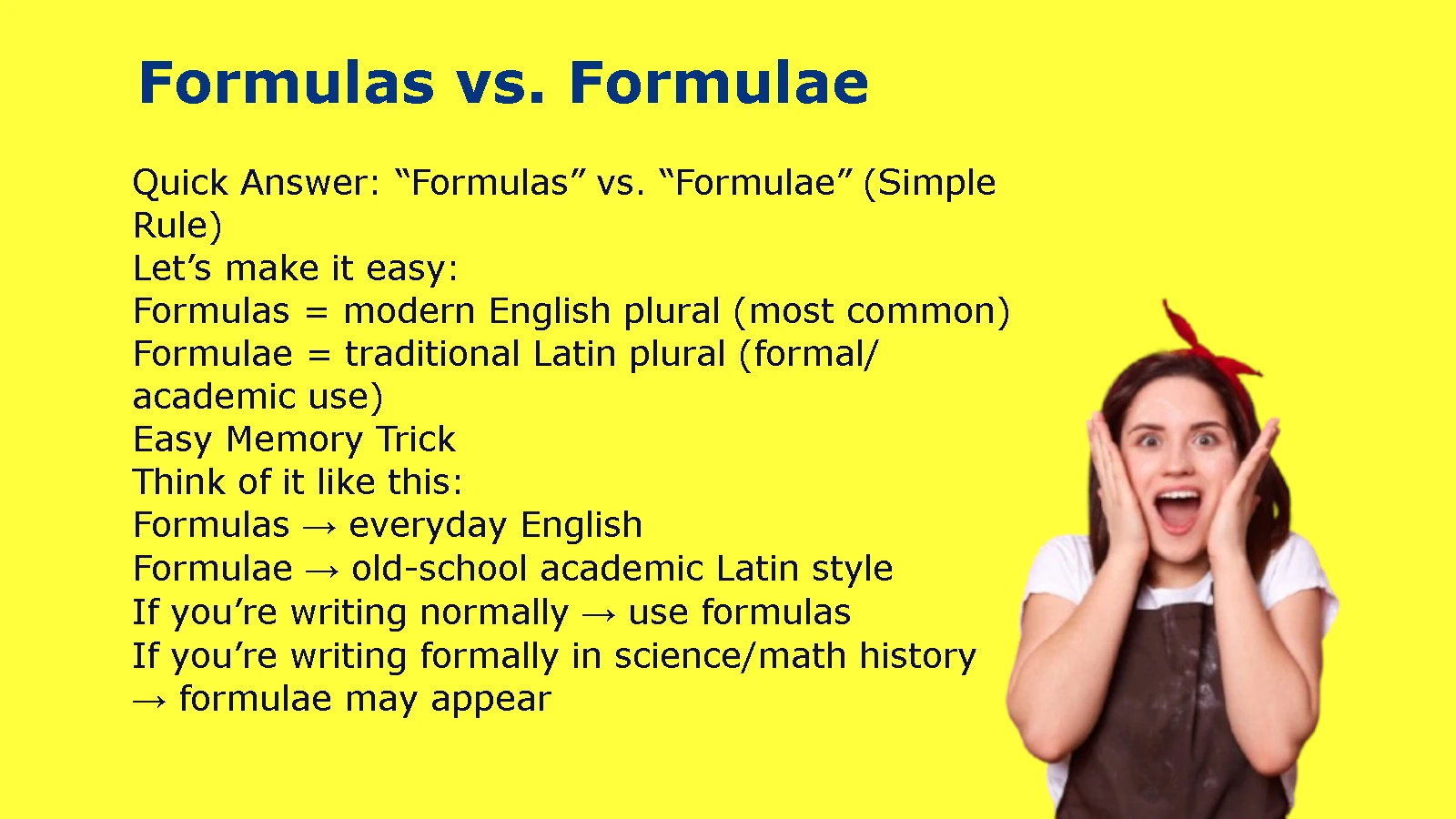
Quick Answer: “Formulas” vs. “Formulae” (Simple Rule)
Let’s make it easy:
Formulas = modern English plural (most common)
Formulae = traditional Latin plural (formal/academic use)
Easy Memory Trick
Think of it like this:
- Formulas → everyday English
- Formulae → old-school academic Latin style
If you’re writing normally → use formulas
If you’re writing formally in science/math history → formulae may appear
Where the Confusion Comes From
The confusion isn’t random—it comes from language history.
English borrows many scientific words from Latin. In Latin:
- “Formula” → plural is “formulae”
But English evolved differently, simplifying most plural forms.
So now we have two correct versions coexisting.
The Key Difference Between “Formulas” and “Formulae”
Let’s break it down simply.
| Word | Usage Style | Context | Modern Usage |
|---|---|---|---|
| Formulas | English plural | General writing, education, exams | Very common |
| Formulae | Latin plural | Academic, scientific, formal texts | Less common |
“Formulas” Explained Clearly (With Examples)
“Formulas” is the standard modern plural used in everyday English.
Common Uses
- Mathematics
- Chemistry
- Physics
- Business models
- General education
Examples
- “We learned different algebra formulas in class.”
- “Chemistry formulas help identify compounds.”
- “These marketing formulas improve sales.”
Key Insight
If you’re unsure, “formulas” is almost always correct.
“Formulae” Explained Clearly (With Examples)
“Formulae” is the Latin plural form. It appears in more formal, traditional, or academic writing.
Common Uses
- Academic papers
- Older textbooks
- Scientific literature
- Formal British English contexts
Examples
- “The researcher analyzed several chemical formulae.”
- “Mathematical formulae were derived in the study.”
- “These classical formulae are still referenced today.”
Key Insight
“Formulae” sounds more formal, but it is not necessary in modern everyday English.
Why Both Forms Exist
This is where language history plays a role.
Latin Influence
Many scientific words entered English from Latin:
- formula → formulae (plural in Latin system)
English Simplification
Over time, English preferred simpler plural forms:
- formulas (easier, more consistent)
Result Today
Both exist, but one is clearly dominant.
The Biggest Mistake People Make
Here’s the real issue:
People assume both words mean slightly different things.
What actually happens
- Some think “formulae” is more correct
- Others think “formulas” is informal or wrong
Reality
Both are correct, but usage depends on style—not meaning.
Real-Life Examples of “Formulas”
Everyday Context
- “I forgot the geometry formulas before the exam.”
- “The teacher explained all the physics formulas clearly.”
- “These skincare formulas are scientifically tested.”
What It Means
Simple, modern plural used in most situations.
Real-Life Examples of “Formulae”
Academic Context
- “The paper compares different mathematical formulae.”
- “Ancient scientific formulae influenced modern chemistry.”
- “Several economic formulae were evaluated.”
What It Means
Formal or traditional academic plural.
Side-by-Side Comparison Table
| Feature | Formulas | Formulae |
|---|---|---|
| Language Style | Modern English | Latin-based formal |
| Usage Frequency | Very common | Less common |
| Context | Schools, daily use | Academic writing |
| Difficulty Level | Simple | Formal/technical |
| Recommendation | Preferred choice | Optional style variant |
Regional Usage Differences
American English
- Strong preference for “formulas”
- “Formulae” is rare
British English
- Both are used
- “Formulae” appears more in academic writing
Global English Today
- “Formulas” dominates in most modern content
Which One Should You Use? (Simple Rule)
Use this decision guide:
- Writing an essay, blog, or exam → formulas
- Writing a scientific journal → either is fine
- Unsure? → formulas always wins
FAQ: Formulas vs. Formulae
Is “formulae” wrong?
No. It is correct but more formal and less common.
Which is used in exams?
Most modern exams prefer “formulas.”
Why do scientists use “formulae”?
Because some academic traditions still prefer Latin plural forms.
Is there a meaning difference?
No. The meaning is exactly the same.
Common Misunderstanding
A lot of learners think:
“Formulae is more advanced English.”
But that’s not true.
It’s just a stylistic choice, not a correctness level.
Quick Recap: What You Should Remember
- Formulas = modern, common, everyday English
- Formulae = traditional, academic, Latin style
- Both are correct, but usage depends on context
- “Formulas” is safer in almost all writing
Final Takeaway: The One Rule That Never Fails
English often gives us multiple correct answers—but only one that feels natural.
So keep it simple:
If you’re writing for school, work, or online content → use “formulas.”
If you’re reading or writing highly formal academic material → you may see “formulae.”
But in real-world usage, clarity always wins over tradition.
Because when it comes to “Formulas” vs. “Formulae,” the smartest choice is not the oldest word—it’s the clearest one.