Have you ever paused before sending a text or email because you weren’t sure whether to write Good Morning or Goodmorning? You’re not alone. This is one of the most common greeting spelling questions, and many people wonder which version is the correct spelling in everyday and professional writing.
The confusion often leads people to search for good morning meaning, good morning definition, good morning pronunciation, and how to spell good morning before hitting send. But here’s the kicker: using goodmorning as a single word is a frequent spelling mistake that can make your message appear less polished.
The good news? The rule is simple once you understand it.
In this guide, you’ll learn the difference between Good Morning or Goodmorning, discover the correct usage of good morning, and see good morning examples in sentences. You’ll also find out when to use good morning in emails, messages, and formal greetings, along with tips to remember the correct spelling every time.
By the end, you’ll know why Good Morning is the standard form, why Goodmorning is incorrect in standard English, and how to avoid this common writing mistake with confidence.
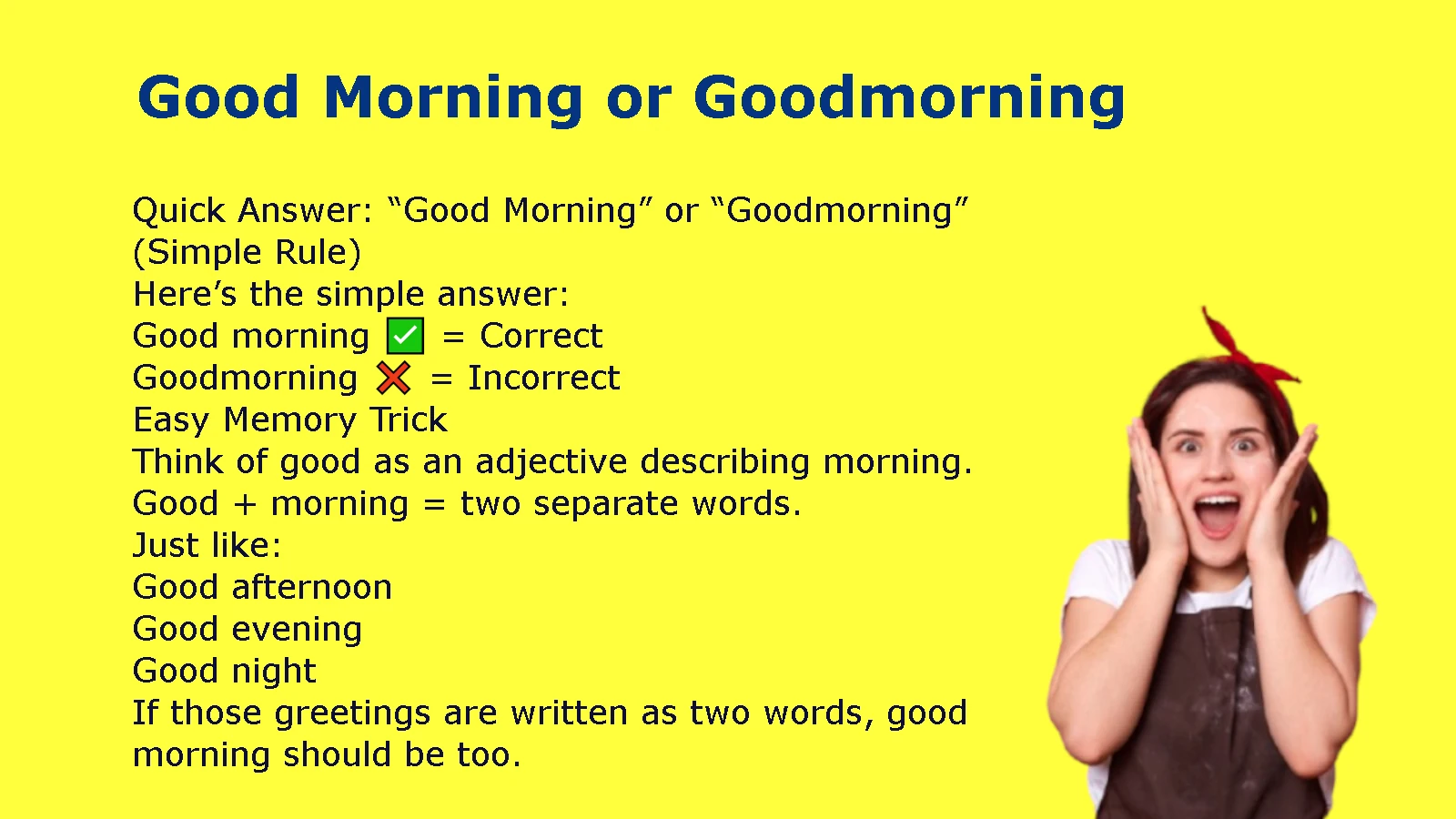
Quick Answer: “Good Morning” or “Goodmorning” (Simple Rule)
Here’s the simple answer:
Good morning ✅ = Correct
Goodmorning ❌ = Incorrect
Easy Memory Trick
Think of good as an adjective describing morning.
- Good + morning = two separate words.
- Just like:
- Good afternoon
- Good evening
- Good night
If those greetings are written as two words, good morning should be too.
Why Do People Write “Goodmorning”?
The mistake usually happens because of pronunciation.
When speaking, the two words blend together, making them sound like one.
Common Reasons
- Fast typing on phones
- Autocorrect doesn’t always catch it
- Social media habits
- Confusing it with compound words like goodbye
The Grammar Behind “Good Morning”
In English grammar, good functions as an adjective, while morning is a noun.
Together, they create a greeting.
Examples:
- Good morning, everyone.
- Good morning, Sarah.
- I wanted to wish you a good morning.
Because good modifies morning, they remain two separate words.
Is “Goodmorning” Ever Correct?
In standard English, no.
Whether you’re writing:
- an email
- a business letter
- a school assignment
- a text message
- a social media caption
the correct spelling is always:
Good morning
You may occasionally see Goodmorning in usernames, business names, hashtags, or creative branding, but those are stylistic choices—not correct grammar.
“Good Morning” Explained Clearly
The phrase good morning is one of the most common greetings in English.
Standard Meaning
It is used to greet someone during the morning hours.
Examples:
- Good morning! How are you?
- Good morning, class.
- Good morning, everyone.
Formal Situations
It is appropriate in:
- Business meetings
- Emails
- Schools
- Interviews
- Customer service
Informal Situations
It’s equally natural among:
- Friends
- Family
- Neighbors
- Text messages
“Goodmorning” Explained Clearly
Although many people type Goodmorning, dictionaries and grammar guides do not recognize it as a standard English word.
Why It Looks Correct
Many English words combine into compounds over time.
Examples:
- Notebook
- Bedroom
- Sunlight
People sometimes assume good morning follows the same pattern.
It doesn’t.
Key Insight
English keeps good morning as two separate words.
The Biggest Mistake People Make
The most common mistake is believing that frequent usage makes Goodmorning acceptable.
What Goes Wrong
Someone writes:
Goodmorning, everyone!
It looks informal and contains a spelling error.
Instead, write:
Good morning, everyone!
Side-by-Side Comparison Table
| Phrase | Correct? | Best Use |
| Good morning | ✅ Yes | All writing and speech |
| Goodmorning | ❌ No | Avoid in standard English |
Real-Life Examples of “Good Morning”
Common Situations
- Good morning, everyone.
- Good morning, Mr. Wilson.
- Good morning! I hope you’re doing well.
- She smiled and said, “Good morning.”
- Good morning, team. Let’s begin today’s meeting.
Mini Scenario
You’re arriving at work.
You say:
Good morning, everyone.
That’s the correct greeting.
Real-Life Examples of “Goodmorning”
Here are examples of incorrect usage.
Incorrect Examples
❌ Goodmorning everyone.
❌ Goodmorning, Mom!
❌ Wishing you a Goodmorning.
Correct Versions
✅ Good morning, everyone.
✅ Good morning, Mom!
✅ Wishing you a good morning.
Why the Confusion Exists
English contains both open compounds and closed compounds.
Examples:
Two words:
- Good morning
- High school
- Living room
One word:
- Goodbye
- Notebook
- Sunflower
Since goodbye is written as one word, many learners mistakenly think goodmorning should be too.
How to Avoid This Mistake Every Time
Follow these simple tips.
Remember the Greeting Family
These are all written as two words:
- Good morning
- Good afternoon
- Good evening
- Good night
Read Before Sending
Take one extra second before sending emails or messages.
Let Spell Check Help
Most writing apps recognize Goodmorning as incorrect.
Better Alternatives
Depending on the situation, you can also say:
- Morning!
- Good day.
- Hello!
- Hi there!
- Have a wonderful morning!
- Wishing you a pleasant morning.
Quick Decision Guide
Use this simple rule:
Need a morning greeting?
↓
Write:
Good morning
Never:
Goodmorning
Simple. Easy. Correct.
FAQ: “Good Morning” or “Goodmorning”
Is “Goodmorning” one word?
No. Standard English always writes good morning as two separate words.
Can I write “Goodmorning” in a text?
You can, but it is considered a spelling mistake. Good morning is the correct form.
Why does “Goodbye” become one word but “Good morning” doesn’t?
English developed these expressions differently over time. Goodbye became a compound word, while good morning remained two separate words.
Is “Good morning” formal?
Yes. It’s suitable for both formal and informal situations.
Case Study: A Professional First Impression
A job applicant emailed a hiring manager and began the message with:
Goodmorning Sir,
Although the email was polite, the greeting contained a spelling mistake.
The corrected version was:
Good morning, Sir.
Using the proper spelling helped create a more polished and professional first impression.
Key Facts You Should Remember
- Good morning is the correct spelling.
- Goodmorning is not standard English.
- Good is an adjective describing morning.
- Always write the greeting as two separate words.
- The rule applies to emails, messages, schoolwork, and professional writing.
Final Takeaway: The One Rule That Never Fails
When deciding between “Good Morning” and “Goodmorning,” the answer is straightforward.
Always write good morning as two separate words. Although people often pronounce it quickly and some mistakenly type it as one word, standard English grammar keeps the words separate. This rule applies whether you’re sending a text, writing an email, greeting coworkers, or posting on social media.
If you’re ever unsure, remember this simple trick: good morning follows the same pattern as good afternoon and good evening—all are written as two words.
When in doubt, choose Good morning. It’s clear, correct, and appropriate in every situation.