
Have you ever come across Remanent vs Remnant and wondered which word is actually correct? You’re not alone. These two words look remarkably similar, but only one is commonly used in modern English, making this a frequent source of spelling confusion.
The confusion often begins when people search for the remanent spelling, remnant meaning, or the difference between remanent and remnant. And here’s the kicker: using the wrong word can change the meaning of your sentence or make your writing appear inaccurate.
But don’t worry—the answer is simpler than you might think.
In this guide, you’ll learn the difference between Remanent vs Remnant, discover the correct spelling, understand the remnant definition, and find out whether remanent is a real English word or simply a common misspelling. You’ll also explore remnant pronunciation, remnant examples, and see remnant in a sentence so you can use the word with confidence.
By the end, you’ll know exactly when to use remnant, why remanent is often mistaken for it, and how to avoid this common spelling error in your everyday writing.
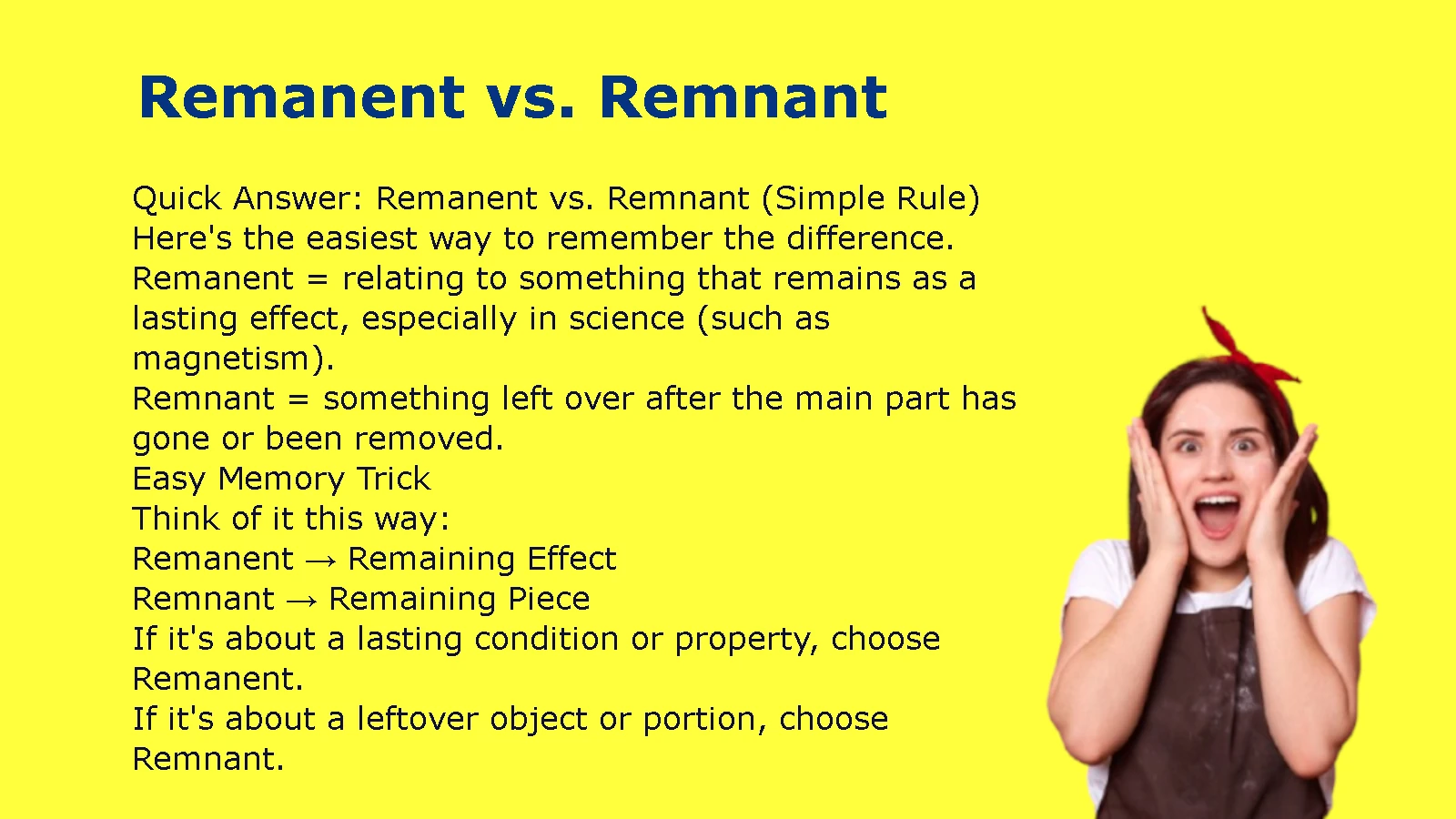
Quick Answer: Remanent vs. Remnant (Simple Rule)
Here’s the easiest way to remember the difference.
Remanent = relating to something that remains as a lasting effect, especially in science (such as magnetism).
Remnant = something left over after the main part has gone or been removed.
Easy Memory Trick
Think of it this way:
- Remanent → Remaining Effect
- Remnant → Remaining Piece
If it’s about a lasting condition or property, choose Remanent.
If it’s about a leftover object or portion, choose Remnant.
How People Actually Use “Remanent” and “Remnant”
Although the words look similar, they appear in very different situations.
In Everyday English
People almost always use Remnant.
Examples include:
- A remnant of cloth
- The remnant of an old building
- Cultural remnants
In Science and Engineering
Professionals may use Remanent when discussing:
- Magnetism
- Physics
- Electrical engineering
- Material science
Why the Confusion Happens
The words:
- differ by only one letter
- sound somewhat alike
- both relate to the idea of “remaining”
However, their meanings are completely different.
The Meaning Behind “Remanent” vs. “Remnant”
A simple way to understand them is to focus on what remains.
| Word | What Remains? |
| Remanent | A lasting property or effect |
| Remnant | A physical or figurative leftover |
Key Insight
A Remanent quality cannot usually be picked up or seen as an object.
A Remnant is something that is left behind after the rest is gone.
“Remanent” Explained Clearly (With Examples)
Remanent is an adjective.
It describes something that continues to exist after the original cause has been removed.
It is most common in scientific writing.
Standard Meaning
A lasting effect that remains.
Examples
- The material showed remanent magnetization after the magnetic field was removed.
- Scientists measured the remanent magnetic field of the sample.
- The alloy retained a remanent property during testing.
Where You’ll See It
- Physics textbooks
- Engineering papers
- Scientific journals
- Academic research
Key Takeaway
Outside technical fields, Remanent is rarely used.
“Remnant” Explained Clearly (With Examples)
Remnant is both a noun and, less commonly, an adjective.
It refers to something left over after the larger part has disappeared.
Standard Meaning
A remaining piece, portion, or trace.
Examples
- Only a remnant of the castle remains.
- She bought a fabric remnant at the store.
- The crew is the last remnant of an ancient civilization.
- Snow remained only in scattered remnants.
Common Uses
- History
- Literature
- Shopping
- Everyday conversation
- News articles
Key Takeaway
Whenever you’re talking about something left behind, Remnant is usually the correct choice.
The Biggest Mistake People Make
The biggest mistake is assuming both words simply mean “something remaining.”
They don’t.
What Goes Wrong
Someone writes:
“The remanent of the building.”
Unfortunately, that’s incorrect.
The correct sentence is:
“The remnant of the building.”
Likewise:
“The remnant magnetization…”
is incorrect in scientific writing.
The correct term is:
“Remanent magnetization.”
Lesson
Choose Remanent for scientific properties.
Choose Remnant for leftover objects or traces.
Side-by-Side Comparison Table
| Feature | Remanent | Remnant |
| Part of Speech | Adjective | Noun (mainly) |
| Meaning | Lasting effect or property | Remaining piece or leftover |
| Common Usage | Science and engineering | Everyday English |
| Frequency | Rare | Very common |
| Example | Remanent magnetization | Fabric remnant |
Real-Life Examples of “Remanent”
Here are some common scientific examples.
Examples
- Engineers measured the remanent magnetic field.
- The mineral exhibited remanent magnetization.
- Researchers analyzed the material’s remanent properties.
- The sample retained remanent polarization after testing.
What They Mean
Each sentence refers to a property that continues after the original force is removed.
Real-Life Examples of “Remnant”
Now compare them with everyday English.
Examples
- A remnant of the old bridge still stands.
- We bought a fabric remnant for quilting.
- The storm left only a small remnant of the fence.
- Ancient traditions survive as cultural remnants.
What They Mean
Every example refers to something physically or figuratively left behind.
Regional and Contextual Differences
Unlike many confusing English words, these don’t vary much by region.
Around the World
English speakers everywhere use Remnant the same way.
Scientific Communities
Researchers worldwide use Remanent in technical discussions.
Key Tip
The difference depends more on subject matter than location.
How to Avoid Confusion Every Time
Here are three easy strategies.
Ask Yourself This Question
Is it describing:
- a lasting scientific property?
- a leftover object or trace?
Remember the Context
Science → Remanent
Everyday English → Remnant
Read the Whole Sentence
The surrounding words usually reveal the intended meaning.
What to Say Instead (Clear Alternatives)
Sometimes another word fits better.
Alternatives for “Remnant”
- Leftover
- Remainder
- Trace
- Fragment
- Piece
- Survivor
Alternatives for “Remanent”
Depending on context:
- Residual
- Persistent
- Lasting
- Remaining
Choose the alternative that best matches your sentence.
Quick Decision Guide (Use This Instantly)
If you’re unsure, remember this:
- Scientific property → Remanent
- Leftover piece → Remnant
- Talking about everyday objects → Remnant
- Talking about magnetism or engineering → Remanent
Simple. Reliable. Done.
FAQ: Remanent vs. Remnant
Is “Remanent” a real English word?
Yes. It is a legitimate English word, but it is mainly used in scientific and technical fields.
Is “Remnant” more common?
Yes. Remnant appears frequently in everyday speech, books, and news articles.
Can I use “Remanent” instead of “Remnant”?
No. Their meanings are different, and they are not interchangeable.
Why do people confuse them?
Because they are spelled similarly and both involve the idea of something “remaining.”
Case Study: A Technical Writing Mistake
A university student was writing a report on magnetic materials.
They wrote:
“The remnant magnetization was measured.”
The professor corrected it to:
“The remanent magnetization was measured.”
Why?
Because remanent magnetization is the correct scientific term describing the magnetization that remains after an external magnetic field is removed.
Later in the report, the student wrote:
“A remnant of the original sample was preserved.”
This time, remnant was correct because it referred to a leftover piece of the sample.
Key Facts You Should Remember
- Remanent describes a lasting scientific property or effect.
- Remnant refers to something left over after the rest is gone.
- Remnant is far more common in everyday English.
- Remanent is mainly used in physics, engineering, and material science.
- The two words are not interchangeable despite their similar spelling.
Final Takeaway: The One Rule That Never Fails
Here’s the simplest rule to remember.
If you’re talking about a lasting scientific effect, use Remanent.
If you’re talking about a remaining piece, fragment, or trace, use Remnant.
Think of it this way:
Effect remains → Remanent.
Piece remains → Remnant.
Once you connect each word to its purpose, choosing between “Remanent” vs. “Remnant” becomes simple, accurate, and confusion-free.