Have you ever come across the terms Exigence vs Context and wondered whether they mean the same thing? Although these words are closely connected in rhetoric, writing, and communication, they describe two different concepts. Many students, writers, and English learners confuse Exigence vs. Context because both influence how a message is created, understood, and delivered. Understanding the difference is essential for improving academic writing, rhetorical analysis, communication skills, and critical thinking.
In simple terms, exigence is the reason or urgency that motivates someone to communicate or write, while context refers to the surrounding circumstances, background, or situation in which that communication takes place. For example, a natural disaster may create the exigence for a public safety announcement, whereas the location, audience, time, and social conditions surrounding that announcement make up its context. Although the two concepts work together, they serve different roles in effective communication.
This distinction often appears in searches like exigence meaning, context meaning, difference between exigence and context, exigence vs. context in rhetoric, rhetorical situation examples, and commonly confused academic terms. It is also an important topic in English composition, public speaking, literary analysis, and communication studies, where understanding rhetorical concepts helps writers develop stronger, more persuasive arguments.
If you’ve ever struggled to determine whether you’re identifying the reason for a message or the circumstances surrounding it, you’re not alone. Exigence and context are frequently confused because they often appear together, yet they answer different questions: Why is this communication happening? and What situation surrounds it?
In this guide, you’ll learn the clear difference between Exigence and Context, their definitions, key distinctions, real-world examples, usage in rhetorical analysis, and simple memory tricks to help you use both terms accurately in writing, speaking, and academic discussions.
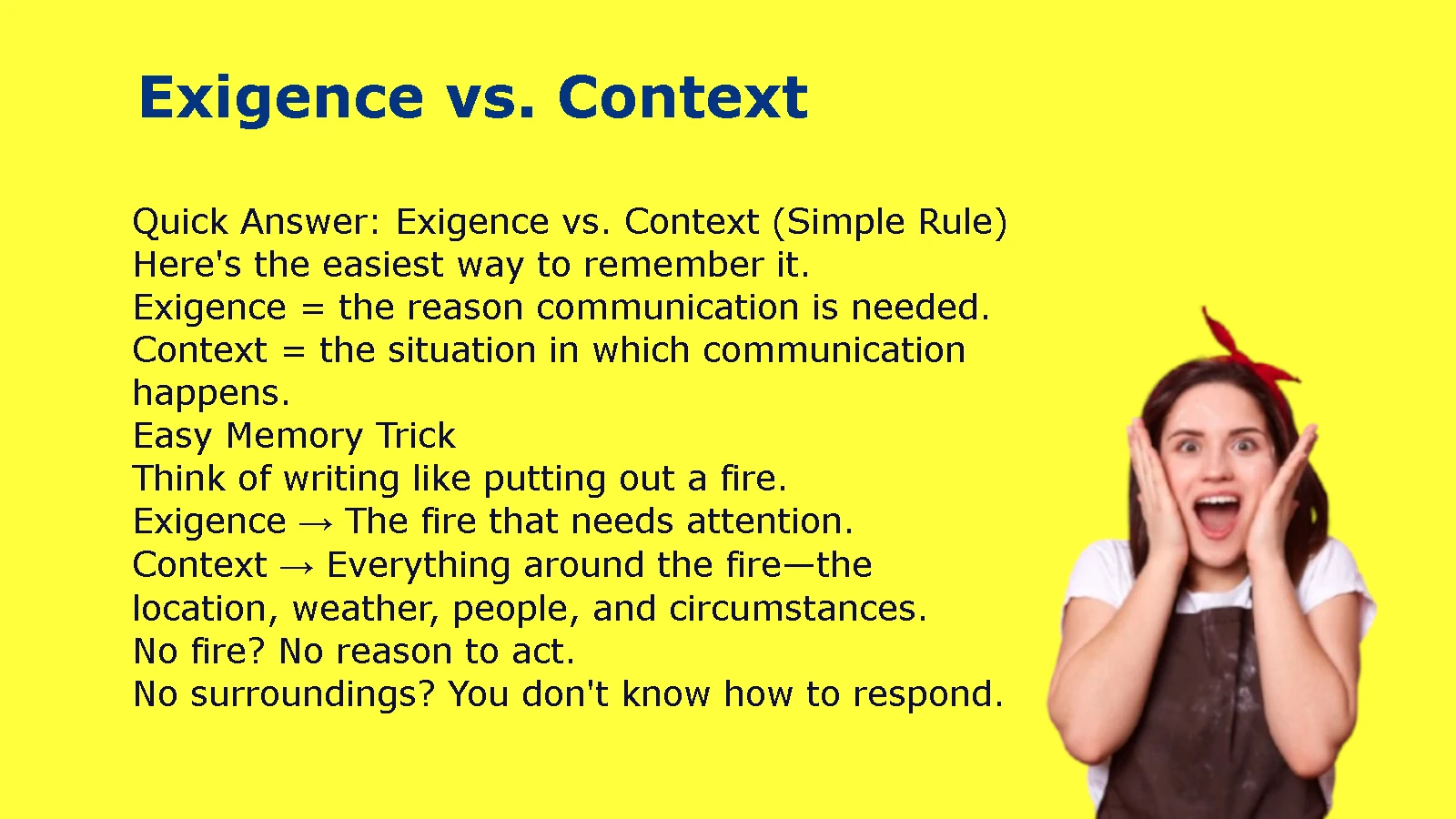
Quick Answer: Exigence vs. Context (Simple Rule)
Here’s the easiest way to remember it.
Exigence = the reason communication is needed.
Context = the situation in which communication happens.
Easy Memory Trick
Think of writing like putting out a fire.
- Exigence → The fire that needs attention.
- Context → Everything around the fire—the location, weather, people, and circumstances.
How People Actually Use Exigence and Context
This is where many students become confused.
Although these terms are related, they answer different questions.
In Academic Writing
Teachers often ask students to identify both.
- Exigence explains why the author wrote.
- Context explains when, where, and under what conditions they wrote.
In Public Speaking
A speaker usually responds to an issue.
The issue is the exigence.
The audience, location, culture, and timing make up the context.
Why People Confuse Them
Both deal with communication.
Both influence a message.
They often appear together in rhetorical analysis.
Because of this, many people accidentally use one term when they actually mean the other.
The Logic Behind Exigence vs. Context
Understanding these concepts becomes much easier when you think about communication as a response.
Think in Terms of Cause and Surroundings
Someone notices a problem.
↓
They decide to communicate.
↓
They communicate in a specific situation.
- Problem → Exigence
- Situation → Context
Key Insight
Exigence answers:
“Why is this message necessary?”
Context answers:
“What circumstances shape this message?”
Exigence Explained Clearly (With Examples)
At its core, exigence is the issue, need, or problem that motivates communication.
Without an exigence, there is usually no reason to write or speak.
Standard Meaning
Exigence is the driving force behind a message.
Examples include:
- A natural disaster requiring emergency information
- A company announcing a policy change
- A student responding to an assignment
- A politician addressing public concerns
Example
A city experiences severe flooding.
The mayor gives a speech about emergency safety.
- Flooding = exigence
- Speech = response
Edge Case: Positive Events
Exigence isn’t always negative.
Sometimes communication responds to opportunities.
For example:
A company launches a new product.
The launch itself creates the need for announcements and marketing.
That’s also an exigence.
Key Takeaway
Exigence is the reason communication happens in the first place.
Context Explained Clearly (With Examples)
Now let’s look at context.
Context includes every surrounding factor that influences communication.
Standard Meaning
Context may include:
- Time
- Place
- Audience
- Culture
- Historical events
- Social conditions
Example
The mayor gives the flood speech:
- During heavy rainfall
- On local television
- To affected residents
These circumstances make up the context.
Edge Case: Same Message, Different Context
Imagine giving the exact same speech:
- During the flood
- One year later
The words may stay the same.
The context completely changes.
Key Takeaway
Context shapes how a message is understood.
The Biggest Mistake People Make
The most common mistake is treating exigence and context as interchangeable.
What Goes Wrong
People say:
“The context is the reason the author wrote.”
Actually:
The reason is the exigence.
The surrounding circumstances are the context.
Real Scenario (Case Study)
A student analyzes a famous speech.
They write:
“The context was racial inequality.”
Their teacher responds:
“That’s actually the exigence.”
The context also includes:
- The historical period
- The audience
- The political climate
- The location
Lesson
Ask yourself:
“What created the need for this communication?”
If it answers that question, it’s probably exigence.
Side-by-Side Comparison Table
| Feature | Exigence | Context |
| Definition | The reason communication is needed | The circumstances surrounding communication |
| Answers | Why? | When, where, who, and under what conditions? |
| Focus | Problem or opportunity | Environment and situation |
| Changes the Message? | Creates it | Shapes it |
| Common Use | Rhetorical analysis | Writing, literature, communication |
Real-Life Examples of Exigence
Let’s look at everyday situations.
Common Situations
“The company released a safety notice.”
Exigence:
A product defect.
“The school sent an emergency email.”
Exigence:
Severe weather.
“The doctor explains a new treatment.”
Exigence:
A patient’s diagnosis.
Mini Scenario
A water pipe bursts in an apartment building.
Management emails residents.
The burst pipe is the exigence.
Real-Life Examples of Context
Now compare.
Common Situations
The emergency email is sent:
- At midnight
- To all residents
- During a winter storm
Those details are the context.
A graduation speech is delivered:
- At a university
- Before graduating seniors
- During commencement
Again, these surrounding circumstances form the context.
Mini Scenario
The same speech would sound very different if delivered:
- In a classroom
- At a business conference
- During a crisis
The context changes how people interpret it.
How Exigence and Context Work Together
These two ideas are connected but not identical.
Think of them as partners.
Exigence starts the conversation.
Context shapes the conversation.
Without exigence, communication lacks purpose.
Without context, communication lacks meaning.
Example
A company recalls a defective product.
Exigence:
The defect.
Context:
- Current consumer concerns
- News coverage
- Customer expectations
- Government regulations
Both influence the company’s announcement.
How to Avoid Confusing Them Every Time
Use these simple strategies.
Ask the Right Question
If you’re asking:
“Why was this written?”
You’re looking for the exigence.
If you’re asking:
“What circumstances influenced this?”
You’re looking for the context.
Identify the Trigger
Find the event, issue, or opportunity.
That’s usually the exigence.
Look at the Surroundings
Consider:
- Audience
- Time
- Place
- Culture
- Historical events
That’s the context.
Why This Works
Separating the reason from the situation makes rhetorical analysis much easier.
What to Say Instead (Clear Alternatives)
If you’re explaining these concepts in class or writing an essay, these phrases can help.
Better Ways to Describe Exigence
- The motivating issue
- The driving problem
- The communication trigger
- The reason for the message
Better Ways to Describe Context
- The surrounding circumstances
- The communication environment
- The background conditions
- The rhetorical situation
Quick Tip
Remember:
Reason = Exigence
Surroundings = Context
Quick Decision Guide (Use This Instantly)
When you’re unsure, ask yourself:
Does it explain why someone communicated?
→ Exigence
Does it describe the circumstances around that communication?
→ Context
Still unsure?
Think:
Problem → Exigence
Situation → Context
FAQ: Exigence vs. Context
Is exigence the same as context?
No. Exigence is the reason communication happens, while context is the situation surrounding that communication.
Can communication have context without exigence?
Every communication has context, but meaningful communication usually begins with some form of exigence—a reason or purpose.
Why are these terms important in rhetoric?
They help explain both why a message exists and how circumstances influence its meaning.
Which comes first?
Typically, exigence comes first because it creates the need to communicate. Context influences how that communication is delivered and interpreted.
Case Study: Understanding a Historic Speech
Imagine a president giving a national address after a major natural disaster.
Exigence
The disaster created an urgent need to inform and reassure the public.
Context
- National television broadcast
- Millions of viewers
- Ongoing rescue efforts
- Public anxiety
- Current political climate
Result
Understanding both the exigence and the context helps explain why the speech was delivered and why it was presented in that particular way.
Key Facts You Should Remember
- Exigence is the reason communication is necessary.
- Context is the situation surrounding communication.
- Exigence answers why.
- Context answers when, where, who, and under what conditions.
- Both are essential parts of rhetorical analysis.
- Separating the reason from the circumstances prevents confusion.
Final Takeaway: The One Rule That Never Fails
Understanding Exigence vs. Context doesn’t have to be difficult. Once you know what each term answers, the difference becomes clear.
Keep this simple rule in mind:
- Exigence = Why the communication is happening.
- Context = The circumstances in which it happens.
Whenever you’re analyzing an article, speech, advertisement, or essay, first identify the issue that prompted the message. Then examine the surrounding conditions that shaped it.
Think of it this way: exigence starts the conversation, while context gives it meaning. Master that distinction, and you’ll never confuse these two important rhetorical concepts again.