Have you ever paused while describing a smell and wondered whether you should use Musty vs. Musky? Although these two words look and sound similar, they describe completely different types of odors in the English language. This confusion is common among English learners, writers, and even native speakers because both words are often used when talking about scents, yet they carry very different meanings and emotional associations.
In simple terms, musty refers to a stale, damp, moldy, or old smell that is usually unpleasant, while musky describes a rich, earthy, warm, and often pleasant scent that is commonly associated with perfumes, natural body fragrance, or certain animals. Despite their similar spelling and pronunciation, these words belong in different contexts and should never be used interchangeably.
Many people search for phrases like musty meaning, musky meaning, musty vs. musky, difference between musty and musky, how to use musty in a sentence, and commonly confused English words when trying to improve their vocabulary and avoid common writing mistakes. Understanding the distinction also strengthens your grammar, word choice, and overall communication skills in both everyday and professional English.
For example, you might describe an old basement as musty, but a luxury fragrance or cologne is often described as musky. Choosing the wrong word can completely change the meaning of your sentence and create confusion for your readers or listeners.
In this guide, you’ll learn the clear difference between musty and musky, their definitions, pronunciation, real-life examples, grammar tips, and simple memory tricks so you can use each word confidently in writing and conversation.
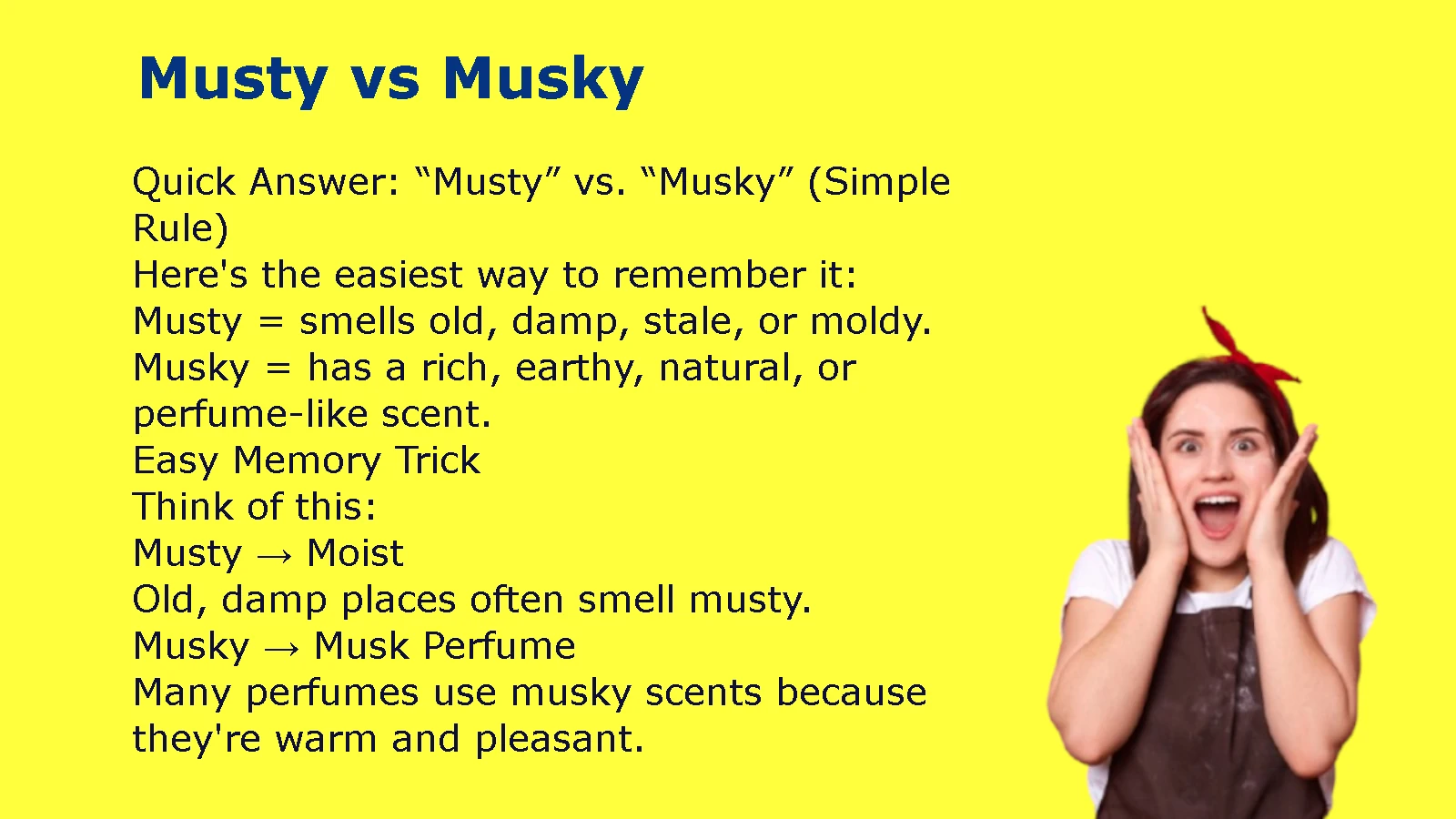
Quick Answer: “Musty” vs. “Musky” (Simple Rule)
Here’s the easiest way to remember it:
- Musty = smells old, damp, stale, or moldy.
- Musky = has a rich, earthy, natural, or perfume-like scent.
Easy Memory Trick
Think of this:
Musty → Moist
Old, damp places often smell musty.
Musky → Musk Perfume
Many perfumes use musky scents because they’re warm and pleasant.
What Do “Musty” and “Musky” Actually Mean?
Although both words describe smells, they create very different impressions.
Musty
A musty smell is usually caused by:
- Damp air
- Mold or mildew
- Poor ventilation
- Old books or furniture
- Stored clothing
It’s generally considered unpleasant.
Example
“The attic had a musty smell after years of being closed.”
Musky
A musky smell is:
- Earthy
- Warm
- Rich
- Animal-like
- Often used in perfumes
It can be pleasant or strong depending on the context.
Example
“The perfume had a soft musky fragrance.”
The Main Difference Between “Musty” and “Musky”
The easiest way to separate them is by thinking about where the smell comes from.
| Word | Meaning | Usually Pleasant? | Common Sources |
| Musty | Damp, stale, moldy smell | Usually No | Basements, books, closets, old furniture |
| Musky | Earthy, warm natural scent | Usually Yes | Perfumes, flowers, animals, fragrances |
Key Insight
- Musty suggests something old or damp.
- Musky suggests a rich natural aroma.
“Musty” Explained Clearly (With Common Uses)
The word musty almost always has a negative meaning.
It describes places or objects that haven’t been cleaned, aired out, or used for a long time.
Common Situations
You might describe these as musty:
- Basements
- Old houses
- Libraries
- Closets
- Storage rooms
- Vintage clothing
Examples
- “These towels smell musty.”
- “The old cabin felt musty inside.”
- “The books had a musty odor.”
Why Things Become Musty
A musty smell often develops because of:
- Moisture
- Humidity
- Mold growth
- Poor airflow
- Long-term storage
Key Takeaway
If something smells old and damp, musty is almost always the right word.
“Musky” Explained Clearly (With Common Uses)
Unlike musty, musky often has a positive or neutral meaning.
It describes a deep, earthy scent that appears naturally or in fragrances.
Common Situations
You may hear musky used for:
- Perfumes
- Cologne
- Flowers
- Forest scents
- Certain animals
- Essential oils
Examples
- “The candle has a musky aroma.”
- “His cologne smelled musky.”
- “The forest carried a musky scent after the rain.”
Can Musky Be Negative?
Sometimes.
If the scent is extremely strong, people may describe it as overpowering.
Still, musky doesn’t usually imply mold or dampness.
Key Takeaway
If the smell is warm, earthy, or perfume-like, choose musky.
The Biggest Mistake People Make
Many people assume both words simply mean “a strong smell.”
They don’t.
What Goes Wrong
Someone writes:
“She wore a musty perfume.”
That sounds like the perfume smells old or moldy.
They probably meant:
“She wore a musky perfume.”
One small spelling difference completely changes the meaning.
Side-by-Side Comparison Table
Here’s a quick comparison you can scan anytime.
| Feature | Musty | Musky |
| Meaning | Damp, stale smell | Warm, earthy scent |
| Usually Positive? | No | Usually Yes |
| Used for Perfume? | No | Yes |
| Associated With | Mold, moisture | Fragrance, nature |
| Emotional Tone | Negative | Positive or Neutral |
Real-Life Examples of “Musty”
Let’s see it in everyday situations.
Common Sentences
- “The basement smelled musty after the flood.”
- “These old clothes have a musty odor.”
- “The unused guest room feels musty.”
- “The antique books smelled musty.”
Mini Scenario
You open a storage box that hasn’t been touched in years.
Immediately, you notice a damp, stale smell.
That smell is musty.
Real-Life Examples of “Musky”
Now compare.
Common Sentences
- “The perfume has a musky finish.”
- “The forest smelled musky after sunset.”
- “He prefers musky colognes over floral ones.”
- “The candle gives off a soft musky fragrance.”
Mini Scenario
You’re shopping for perfume.
The salesperson recommends one with warm, earthy notes.
That’s a musky fragrance.
Common Expressions Using “Musty” and “Musky”
These words often appear in different contexts.
Musty Expressions
- Musty basement
- Musty books
- Musty smell
- Musty closet
- Musty towels
Musky Expressions
- Musky perfume
- Musky fragrance
- Musky cologne
- Musky scent
- Musky aroma
Notice that perfume almost always pairs with musky, not musty.
How to Avoid Confusion Every Time
Want an easy way to remember the difference?
Use these simple strategies.
Think About the Source
If it’s:
- Mold
- Moisture
- Old storage
Use musty.
If it’s:
- Perfume
- Cologne
- Nature
- Earthy fragrance
Use musky.
Use the Memory Trick
- Musty → Moist
- Musky → Musk perfume
Simple and reliable.
What to Say Instead (Clear Alternatives)
Sometimes another word fits even better.
Instead of “Musty”
Try:
- Moldy
- Damp-smelling
- Stale
- Mildewed
- Old-smelling
Instead of “Musky”
Try:
- Earthy
- Woody
- Rich
- Warm
- Aromatic
Choose the word that best matches the smell you’re describing.
Quick Decision Guide (Use This Instantly)
When you’re unsure, ask yourself:
Is the smell caused by dampness?
→ Musty
Is it a perfume-like or earthy fragrance?
→ Musky
Still unsure?
Think:
- Old basement = Musty
- Luxury perfume = Musky
FAQ: “Musty” vs. “Musky”
Is musty always a bad smell?
Usually, yes. It often refers to odors caused by moisture, mold, or stale air.
Is musky always pleasant?
Not always. Some people enjoy musky fragrances, while others find them too strong, but the word itself doesn’t suggest mold or decay.
Can perfume smell musty?
Only if it has gone bad or been stored improperly. Normally, perfumes are described as musky, not musty.
Why do people confuse these words?
Because they sound very similar and differ by only one letter, even though their meanings are completely different.
Case Study: A Small Word, A Big Difference
A customer visited a perfume store and wanted to compliment a fragrance.
She said:
“I love this musty perfume.”
The salesperson looked confused.
She quickly corrected herself:
“I mean musky.”
Everyone laughed, but the correction mattered.
Musty suggests an unpleasant, moldy smell.
Musky describes the warm, earthy fragrance she actually liked.
One letter changed the entire meaning.
Key Facts You Should Remember
- Musty means damp, stale, or moldy.
- Musky means warm, earthy, or perfume-like.
- Musty usually has a negative meaning.
- Musky is often used to describe fragrances.
- Remember: Musty = Moist, Musky = Musk.
Final Takeaway: The One Rule That Never Fails
Although Musty and Musky sound almost identical, they describe very different scents.
Keep this simple rule in mind:
- Musty → old, damp, stale smell.
- Musky → rich, earthy, natural fragrance.
Whenever you’re describing a smell, think about its source. If it reminds you of a damp basement or an old closet, it’s musty. If it reminds you of a warm perfume, forest, or natural aroma, it’s musky.
With that one distinction, you’ll avoid one of the most common vocabulary mix-ups and use “Musty” vs. “Musky” with confidence every time.