Have you ever paused while writing because you couldn’t decide whether to use Grey vs. Gray? You’re not alone. These two spellings look almost identical, sound exactly the same, and mean the same thing. Yet choosing the wrong version can make your writing seem inconsistent, especially in academic papers, business emails, or content aimed at an international audience.
The good news is that there’s no complicated grammar rule to memorize. The difference between Grey vs. Gray comes down mainly to regional spelling preferences. Once you understand where each spelling is commonly used, you’ll never have to second-guess yourself again.
In this guide, you’ll discover the simple rule, easy memory tricks, regional differences, real-life examples, common mistakes, and practical tips to help you use Grey and Gray with confidence.
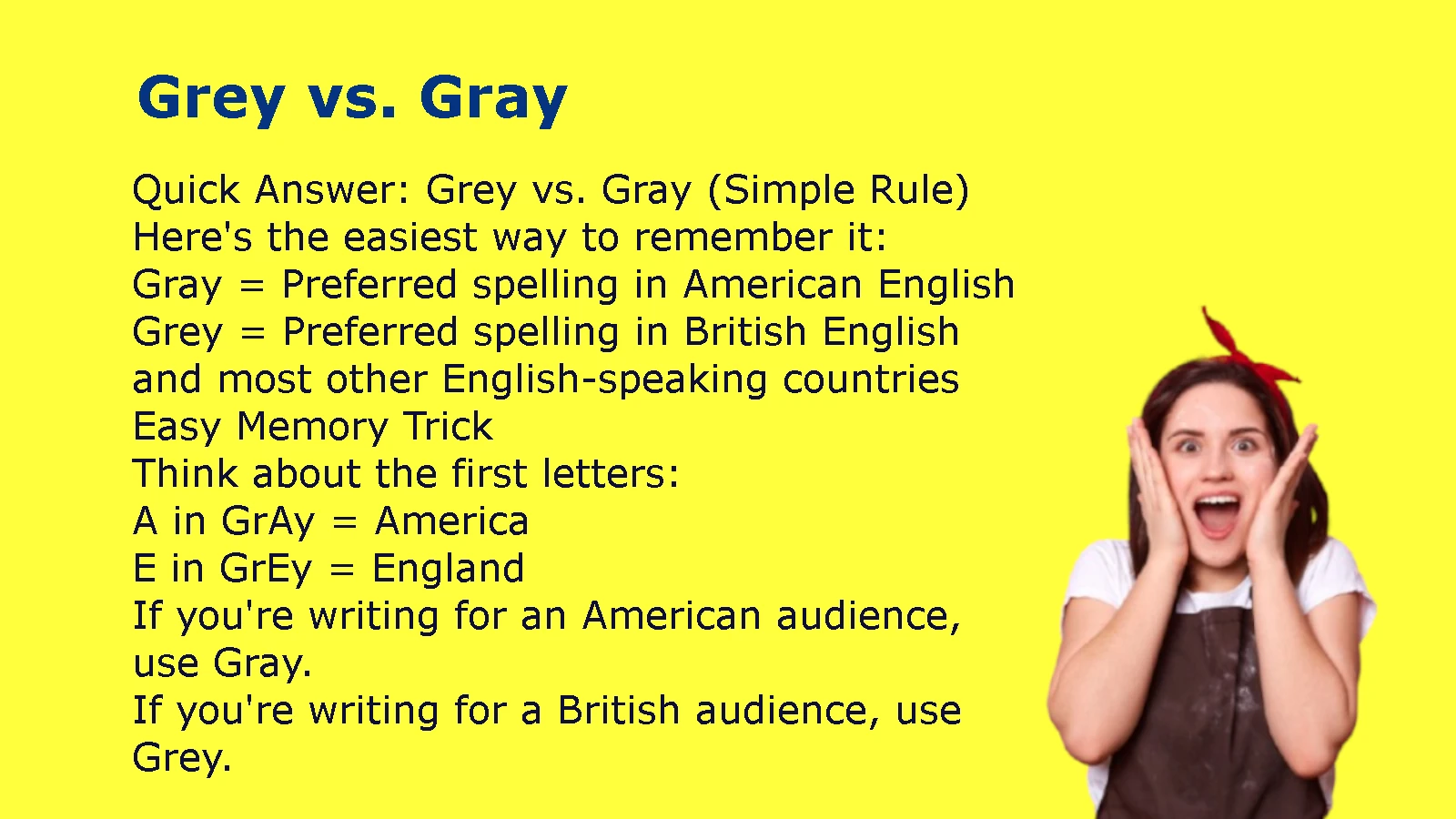
Quick Answer: Grey vs. Gray (Simple Rule)
Here’s the easiest way to remember it:
- Gray = Preferred spelling in American English
- Grey = Preferred spelling in British English and most other English-speaking countries
Easy Memory Trick
Think about the first letters:
- A in GrAy = America
- E in GrEy = England
If you’re writing for an American audience, use Gray.
If you’re writing for a British audience, use Grey.
Do “Grey” and “Gray” Mean the Same Thing?
Yes.
Both words describe the same color, which falls between black and white.
There is no difference in meaning, pronunciation, or grammar.
Examples:
- The sky turned gray before the storm.
- The sky turned grey before the storm.
Both sentences are correct. Only the regional spelling changes.
How People Actually Use “Grey” and “Gray”
Although the meanings are identical, usage depends on where the writer or reader is from.
In American English
Most books, newspapers, schools, and businesses use Gray.
Examples:
- Gray hair
- Gray clouds
- Gray sweater
Using Grey isn’t technically wrong, but it looks unusual to many American readers.
In British English
British writers almost always use Grey.
Examples:
- Grey skies
- Grey trousers
- Grey paint
This spelling is also common in Australia, New Zealand, Ireland, and much of Canada.
The Regional Difference Behind “Grey” vs. “Gray”
Here’s the simplest way to understand it.
| Region | Preferred Spelling |
| United States | Gray |
| United Kingdom | Grey |
| Australia | Grey |
| New Zealand | Grey |
| Ireland | Grey |
| Canada | Usually Grey (Gray also appears) |
Key Insight
Neither spelling is more correct.
The best choice depends on which version of English you’re using.
“Gray” Explained Clearly
Gray is the standard American spelling.
You’ll see it in:
- American newspapers
- School textbooks
- Government documents
- Business writing
- Most U.S. websites
Examples
- My grandfather has gray hair.
- The kitten has gray fur.
- We painted the room gray.
When to Use It
Choose Gray whenever you’re writing in American English.
“Grey” Explained Clearly
Grey is the standard British spelling.
It’s commonly used in:
- British books
- UK newspapers
- Academic writing in Britain
- Australian publications
Examples
- The morning was cold and grey.
- She bought a grey jacket.
- Dark grey clouds filled the sky.
When to Use It
Use Grey when writing in British English or for audiences outside the United States.
The Biggest Mistake People Make
Many writers think one spelling is correct and the other is wrong.
That’s not true.
What Goes Wrong
Someone edits every instance of Grey into Gray, believing they’re fixing mistakes.
Or they switch between both spellings in the same article.
Why It Matters
Inconsistent spelling makes writing appear unprofessional.
Lesson
Pick one spelling based on your audience—and use it consistently throughout your writing.
Side-by-Side Comparison Table
Here’s a quick comparison you can save for future reference.
| Feature | Grey | Gray |
| Meaning | Color between black and white | Color between black and white |
| Pronunciation | Same | Same |
| British English | ✅ Preferred | Less common |
| American English | Less common | ✅ Preferred |
| Correct? | Yes | Yes |
Real-Life Examples of “Gray”
Here are some common American English examples.
Everyday Sentences
- My dog has gray eyes.
- We chose a light gray sofa.
- The sky looked gray all afternoon.
- His beard is turning gray.
- She wore a gray scarf.
Mini Scenario
A designer working for a U.S. company writes:
“Please use a dark gray background.”
This matches American spelling conventions.
Real-Life Examples of “Grey”
Now let’s look at British English.
Everyday Sentences
- The weather stayed grey all day.
- He bought a grey suit.
- Her cat has grey fur.
- The walls are painted grey.
- The sea looked dark grey.
Mini Scenario
A London-based interior designer writes:
“We recommend a soft grey finish.”
This follows British spelling standards.
Common Expressions That Use Both Spellings
The spelling changes with the variety of English.
Examples include:
American English:
- Gray hair
- Gray matter
- Gray skies
- Gray wolf
British English:
- Grey hair
- Grey matter
- Grey skies
- Grey seal
The expressions stay the same—the spelling simply matches the region.
Common Mistakes to Avoid
Avoid these common errors.
Mixing Spellings
❌ The walls are grey, but the carpet is gray.
Unless you’re intentionally quoting different sources, stick to one spelling.
Ignoring Your Audience
If your readers are American, Gray usually feels more natural.
If your readers are British, Grey is the better choice.
Assuming One Is Incorrect
Both spellings are accepted English.
The only difference is regional preference.
How to Avoid Confusion Every Time
Want to choose the right spelling instantly?
Know Your Audience
American readers → Gray
British readers → Grey
Stay Consistent
Once you choose a spelling, don’t switch halfway through your article.
Use Spell Check
Set your document language to either American English or British English.
Your writing software will help keep spelling consistent.
What to Use Instead? (If You’re Unsure)
If you aren’t sure which audience you’re writing for:
- Follow your organization’s style guide.
- Match the spelling used throughout the rest of the document.
- Copy the regional spelling used by your client or publication.
Consistency is more important than the specific spelling you choose.
Quick Decision Guide (Use This Instantly)
Use this simple checklist:
- Writing for Americans? → Gray
- Writing for British readers? → Grey
- Unsure? → Match the rest of your document.
- Already chose one spelling? → Stay consistent.
Simple. Reliable. Done.
FAQ: Grey vs. Gray
Is “Grey” correct?
Yes. It’s the standard spelling in British English and many other English-speaking countries.
Is “Gray” correct?
Yes. It’s the preferred spelling in American English.
Do they have different meanings?
No. Both refer to the same color.
Which spelling should I use?
Use the version that matches your audience or the style guide you’re following.
Can I use both in the same article?
It’s best not to. Choose one spelling and use it consistently.
Case Study: A Branding Mistake
A clothing company launched a website for customers in both the United States and the United Kingdom.
What Happened:
The homepage advertised a “Gray Collection.”
However, many product descriptions used “Grey.”
Result
The inconsistent spelling made the website look poorly edited and confused some customers about whether the products were different.
Fix
The company created separate versions of the website:
- U.S. website → Gray
- UK website → Grey
The branding became more consistent, and the customer experience improved.
Key Facts You Should Remember
- Gray is the preferred American spelling.
- Grey is the preferred British spelling.
- Both words have the same meaning.
- Both are pronounced exactly the same.
- Neither spelling is more correct than the other.
- Choose the spelling that matches your audience.
- Stay consistent throughout your writing.
Final Takeaway: The One Rule That Never Fails
The debate over Grey vs. Gray isn’t about right or wrong—it’s about regional spelling. Both words describe the exact same color, and both are accepted in standard English.
To keep your writing clear and professional, remember this simple rule:
- Gray → American English
- Grey → British English
If you’re ever unsure, look at your audience, follow the style guide you’re using, and stay consistent from beginning to end. A single spelling choice may seem small, but consistency helps your writing appear polished, trustworthy, and easy to read.