Have you ever wondered whether Pretence vs. Pretense is just a spelling variation or if the two words have different meanings? This common spelling question confuses many writers because both words mean the same thing, yet only one is preferred depending on the type of English you use.
The confusion often leads people to search for the correct spelling of pretence, pretence vs pretense difference, pretence meaning, or pretense meaning before using the word in emails, essays, or professional writing. But here’s the kicker: choosing the wrong version for your audience can make your writing seem inconsistent.
The good news? The answer is surprisingly simple.
In this guide, you’ll learn the difference between Pretence vs. Pretense, discover the pretence definition and pretense definition, understand British vs American English usage, and see pretence examples and pretense examples in real sentences. You’ll also learn the correct pronunciation of pretence and pretense, when each spelling is appropriate, and how to avoid this common writing mistake.
By the end, you’ll know exactly which spelling to use, why both are correct in different regions, and how to choose the right one with confidence.
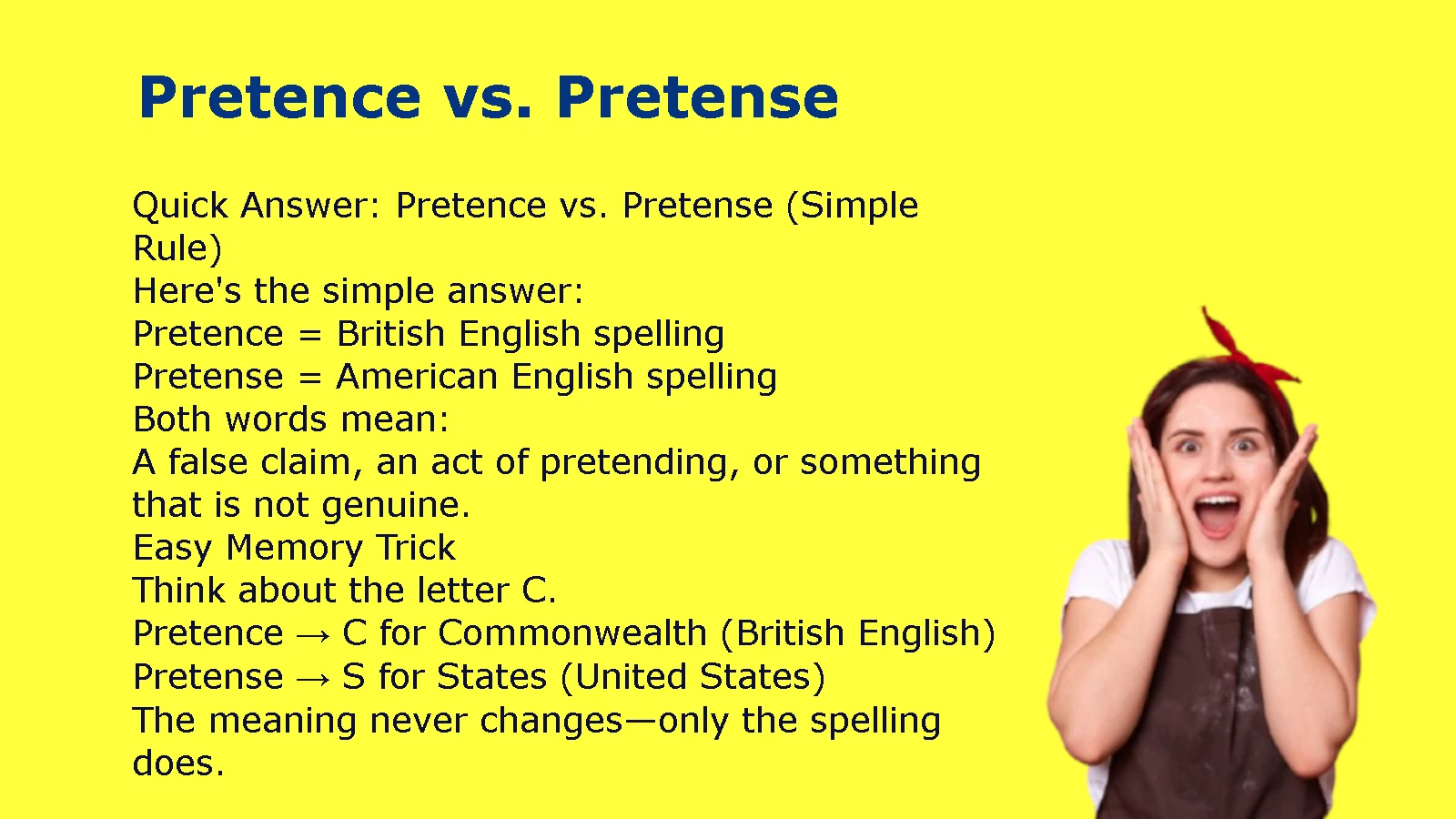
Quick Answer: Pretence vs. Pretense (Simple Rule)
Here’s the simple answer:
- Pretence = British English spelling
- Pretense = American English spelling
Both words mean:
A false claim, an act of pretending, or something that is not genuine.
Easy Memory Trick
Think about the letter C.
- Pretence → C for Commonwealth (British English)
- Pretense → S for States (United States)
The meaning never changes—only the spelling does.
What Do Pretence and Pretense Mean?
Both words describe:
- pretending something is true
- a false appearance
- an excuse used to hide the real reason
- behavior that isn’t genuine
Examples
- He smiled under the pretence of being happy.
- She left on the pretense that she had another meeting.
- Their friendship was only a pretence.
- His confidence was merely a pretense.
No matter which spelling you choose, the meaning remains identical.
How People Actually Use Pretence and Pretense
Most confusion doesn’t come from grammar.
It comes from regional spelling.
In British English
You’ll almost always see:
- pretence
- defence
- licence (noun)
These spellings follow traditional British conventions.
In American English
You’ll usually see:
- pretense
- defense
- license
American English prefers -se in many words where British English uses -ce.
Why This Happens
English evolved differently in Britain and America. Over time, spelling conventions changed, even though pronunciation and meaning stayed the same.
The Real Difference Between Pretence and Pretense
Here’s the entire difference.
| Word | English Variety | Meaning |
| Pretence | British English | False claim or act of pretending |
| Pretense | American English | False claim or act of pretending |
Key Insight
There is no difference in definition.
Only the spelling changes based on the audience you’re writing for.
Pretence Explained Clearly
Pretence is the standard spelling in British English.
You’ll commonly find it in:
- UK newspapers
- British novels
- Australian publications
- New Zealand writing
- Many international English style guides
Examples
- She made no pretence of understanding the rules.
- His kindness was only a pretence.
- They continued the conversation under the pretence of politeness.
When to Use It
Use pretence if you’re writing for readers who expect British English spelling.
Pretense Explained Clearly
Pretense is the preferred American spelling.
It’s commonly used in:
- American books
- U.S. newspapers
- Business writing in the United States
- Academic writing following American style guides
Examples
- He left under the pretense of being sick.
- Her confidence was just a pretense.
- The company operated under the pretense of helping customers.
When to Use It
Choose pretense when writing for an American audience.
The Biggest Mistake People Make
Many writers believe one spelling is incorrect.
It isn’t.
The real mistake is mixing British and American spellings in the same document.
What Goes Wrong
A report contains:
- pretence
- defense
- color
Now the writing looks inconsistent.
Better Approach
Pick one English style and stick with it throughout your writing.
Side-by-Side Comparison Table
| Feature | Pretence | Pretense |
| Meaning | Act of pretending | Act of pretending |
| British English | ✅ Standard | Rare |
| American English | Rare | ✅ Standard |
| Pronunciation | Same | Same |
| Grammar | Noun | Noun |
Real-Life Examples of Pretence
Here are some everyday examples.
Common Sentences
- She dropped the pretence of being interested.
- His apology was merely a pretence.
- They welcomed us with a pretence of warmth.
Mini Scenario
A colleague pretends to enjoy every meeting.
You might say:
“His enthusiasm is just a pretence.”
Real-Life Examples of Pretense
Now compare the American spelling.
Common Sentences
- She smiled under the pretense that everything was fine.
- He visited under the pretense of borrowing a book.
- Their agreement was only a pretense.
Mini Scenario
Someone invents an excuse to leave work early.
You could say:
“He left under the pretense of a doctor’s appointment.”
Common Expressions Using Pretence or Pretense
You’ll often hear these phrases:
- under the pretence/pretense of
- without pretence/pretense
- maintain the pretence/pretense
- abandon the pretence/pretense
- false pretence/pretense
Examples
- She entered under the pretence of helping.
- He acted without any pretense.
- They maintained the pretence for years.
Regional Differences
English spelling varies around the world.
United Kingdom
- Pretence ✅
United States
- Pretense ✅
Canada
Both spellings appear, although British forms are often more common in official writing.
Australia and New Zealand
Pretence is generally preferred.
Key Tip
Match the spelling to your audience rather than switching between both versions.
How to Avoid Confusion Every Time
Use these simple strategies.
Know Your Audience
Writing for the UK?
Use pretence.
Writing for the U.S.?
Use pretense.
Stay Consistent
Never alternate between spellings in one article.
Use Spell Check
Most writing software follows either British or American English settings.
Choose the correct language before you begin writing.
What to Say Instead
If you want to avoid either spelling, these alternatives work well.
Similar Words
- pretending
- deception
- disguise
- false appearance
- sham
- façade
- act
- excuse
Examples
Instead of:
It was only a pretense.
You could write:
It was only a deception.
Or:
It was merely an act.
Quick Decision Guide
Use this whenever you’re unsure.
Writing in British English?
→ Pretence
Writing in American English?
→ Pretense
Still unsure?
→ Match the spelling style used throughout the rest of your document.
Simple. Reliable. Done.
FAQ: Pretence vs. Pretense
Is “pretence” correct?
Yes. It’s the standard British English spelling.
Is “pretense” correct?
Yes. It’s the standard American English spelling.
Do they have different meanings?
No. Both words mean exactly the same thing.
Which spelling should I use?
Use pretence for British English and pretense for American English.
Can I use both in the same article?
It’s best not to. Choose one spelling style and remain consistent.
Case Study: A Style Guide Mix-Up
A content writer was creating articles for an international company.
The first half of the article used pretence.
The second half switched to pretense after copying information from an American source.
What Happened
The editor flagged the article for inconsistent spelling.
Readers questioned whether it had been proofread.
Fix
The writer selected British English for the entire document and changed every instance to pretence.
The article became consistent, professional, and easier to read.
Key Facts You Should Remember
- Pretence is the British spelling.
- Pretense is the American spelling.
- Both words have exactly the same meaning.
- Pronunciation does not change.
- Consistency matters more than the spelling you choose.
- Match your audience’s preferred English style.
Final Takeaway: The One Rule That Never Fails
The difference between Pretence vs. Pretense isn’t about grammar or meaning—it’s simply a matter of British versus American spelling.
Remember this easy rule:
- British English → Pretence
- American English → Pretense
Once you know your audience, the choice becomes effortless. And if you’re writing professionally, always stick to one spelling style from beginning to end. Clear, consistent writing leaves a better impression than switching between language conventions.