Have you ever come across both “Skeptic vs Sceptic” and wondered if they mean different things or if it’s just a spelling variation? This is a common point of confusion in English, especially for learners who notice different spellings in American and British writing.
In simple terms, a skeptic/sceptic is someone who doubts, questions, or does not easily believe something without strong evidence. The only real difference between the two forms is regional spelling: “skeptic” is commonly used in American English, while “sceptic” is preferred in British English. Despite the spelling variation, both words carry the same meaning, usage, and grammatical function.
This difference often appears in searches like skeptic meaning, sceptic meaning, difference between skeptic and sceptic, and American vs British English spelling, as learners try to understand how English changes across regions. It also connects with broader topics such as critical thinking, language variation, and commonly confused English words.
If you’ve ever paused while writing a sentence like “She is a skeptic about new technology” or “He remains a sceptic of the theory,” you’re already encountering this subtle spelling difference in real use.
In this guide, you’ll learn the exact difference between skeptic and sceptic, their usage in sentences, regional spelling rules, and easy memory tricks to help you never confuse them again.
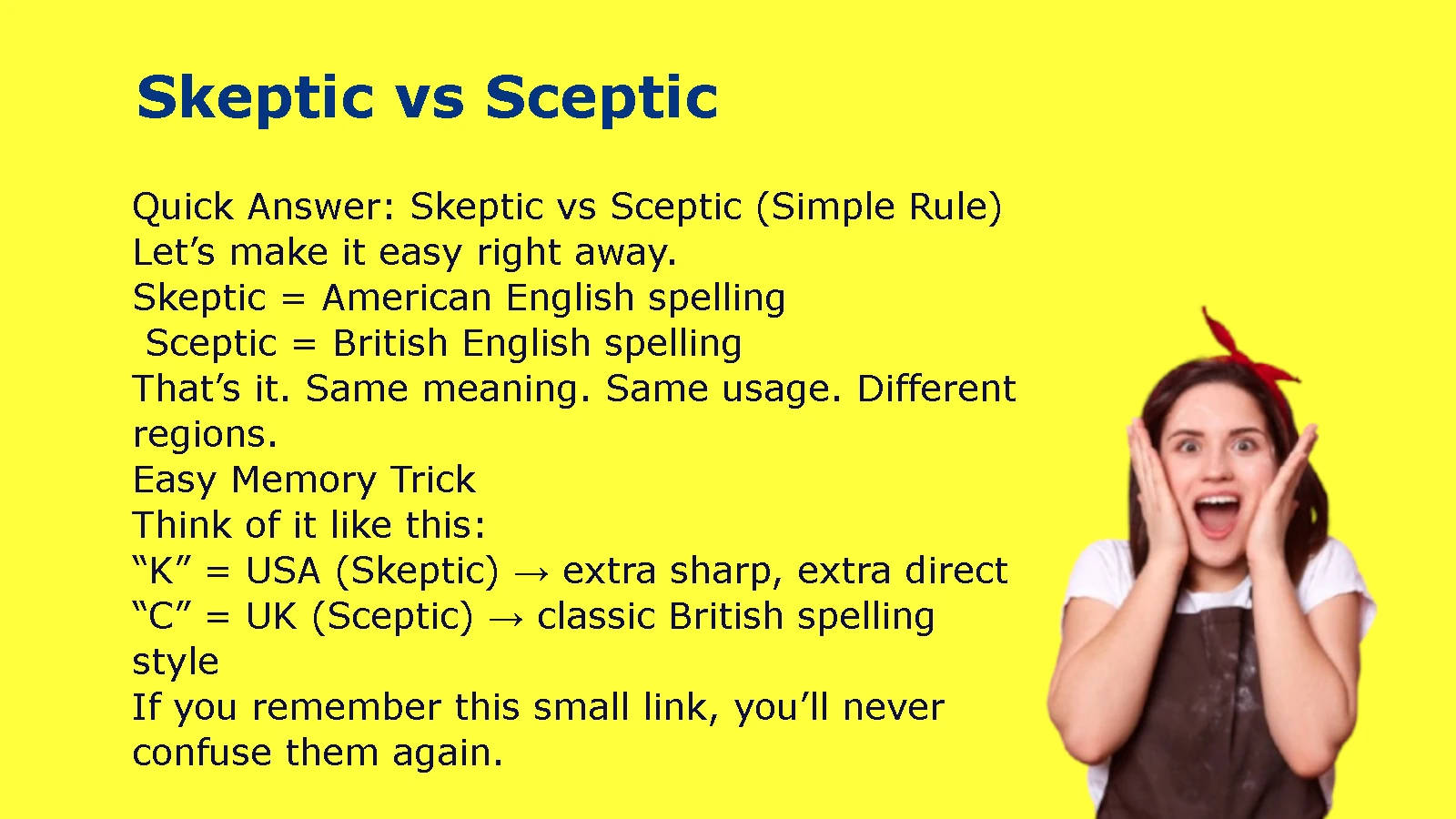
Quick Answer: Skeptic vs Sceptic (Simple Rule)
Let’s make it easy right away.
Skeptic = American English spelling
Sceptic = British English spelling
That’s it. Same meaning. Same usage. Different regions.
Easy Memory Trick
Think of it like this:
- “K” = USA (Skeptic) → extra sharp, extra direct
- “C” = UK (Sceptic) → classic British spelling style
If you remember this small link, you’ll never confuse them again.
What Does Skeptic / Sceptic Actually Mean?
Before spelling, let’s understand meaning.
Both words describe a person who:
- Doubts claims until there is evidence
- Questions information instead of blindly believing it
- Thinks critically before accepting something as true
Simple Definition
A skeptic/sceptic is someone who doesn’t easily accept ideas without proof.
Example
- “He is a skeptic about online news.”
- “She is a sceptic when it comes to miracle products.”
Same meaning. idea. usage.
Why Are There Two Spellings?
This is where English gets interesting.
English evolved differently in different regions:
- American English simplified many spellings
- British English kept traditional forms influenced by Latin and French
So:
- Skeptic → simplified American version
- Sceptic → traditional British version
Key Insight
Neither spelling is wrong. It depends entirely on which version of English you’re using.
Skeptic Explained (American English Usage)
In American English, “skeptic” is the standard form.
Common Usage
You’ll see it in:
- US newspapers
- Academic writing in the US
- Online blogs and tech content
Example Sentences
- “The scientist remained a skeptic about the new theory.”
- “Don’t be a skeptic without checking the facts.”
- “She approached the claim like a skeptic.”
Tone
In American usage, “skeptic” often feels:
- Neutral
- Analytical
- Practical
Sceptic Explained (British English Usage)
In British English, “sceptic” is the standard spelling.
Common Usage
You’ll find it in:
- UK newspapers
- British academic writing
- Commonwealth countries like Pakistan, India, Australia
Example Sentences
- “He is a sceptic about government promises.”
- “The doctor was a sceptic of alternative treatments.”
- “She responded like a sceptic, asking for evidence.”
Tone
In British usage, “sceptic” feels:
- Formal
- Traditional
- Academic
Side-by-Side Comparison Table
Here’s a quick snapshot:
| Word | Region | Meaning | Usage Risk |
| Skeptic | American English | Doubtful person | Low in US, High in UK writing |
| Sceptic | British English | Doubtful person | Low in UK, High in US writing |
The Biggest Mistake People Make
Here’s where confusion actually happens.
People mix spellings in the same document.
What Goes Wrong
- Writing “skeptic” in British English essay
- Using “sceptic” in American academic paper
- Switching back and forth randomly
Result
Your writing looks inconsistent and unprofessional.
Real Scenario
A student writes:
“The sceptic approach is important in science.”
But the assignment requires American English.
The corrected version:
“The skeptic approach is important in science.”
Small change. Big impact.
Real-Life Examples of Skeptic
Let’s see it in action.
Everyday Usage
- “I’m a skeptic when it comes to online deals.”
- “He’s a skeptic about social media trends.”
- “Don’t be a skeptic, just try it first.”
Meaning in Context
Always shows doubt or critical thinking.
Real-Life Examples of Sceptic
Now the British version.
Everyday Usage
- “She is a sceptic of political promises.”
- “The scientist remained a sceptic despite new evidence.”
- “He spoke like a sceptic during the debate.”
Meaning in Context
Same idea—questioning and requiring proof.
When to Use Which One
Here’s the simple decision system:
Use Skeptic if:
- You are writing for American audience
- Your teacher uses US English
- Your website targets global/US readers
Use Sceptic if:
- You are writing UK English
- Your school follows British curriculum
- You’re targeting Commonwealth readers
If unsure:
Stick to one version consistently throughout your writing.
Quick Fix Tip (Never Get It Wrong Again)
Ask yourself:
👉 “Am I writing American or British English?”
Then:
- America → Skeptic
- Britain → Sceptic
That’s the only rule you need.
Common Confusion Variants
People often confuse these too:
- Skeptic vs Cynic
- Skeptic vs Doubter
- Sceptic vs Suspicious person
Key Difference:
- Skeptic = questions ideas
- Cynic = expects bad intentions
FAQ: Skeptic vs Sceptic
Are skeptic and sceptic different meanings?
No. They have the same meaning. Only spelling differs.
Which spelling is correct?
Both are correct depending on English variant.
Is skeptic American or British?
“Skeptic” is American English.
Is sceptic wrong in American English?
Not wrong, but not standard in US writing.
Key Facts You Should Remember
- Skeptic = American English
- Sceptic = British English
- Same meaning, different spelling
- Don’t mix both in one document
- Consistency matters more than choice
Final Takeaway: The One Rule That Never Fails
At the end of the day, this isn’t a vocabulary problem—it’s a regional spelling choice.
So remember this simple rule:
Skeptic = USA
Sceptic = UK
And if you’re ever unsure, just pick one style and stay consistent.
Because in English writing, clarity and consistency matter far more than which spelling you choose.