Have you ever come across the words Objectivity vs. Objectiveness and wondered whether they mean the same thing or if there is a subtle difference between them? This is a common point of confusion in English usage, especially for learners who are trying to build strong grammar accuracy and vocabulary precision in both writing and speaking.
In simple terms, Objectivity refers to the quality of being unbiased, neutral, and based on facts rather than personal feelings or opinions. It is widely used in academic writing, journalism, research, and professional communication where fairness and factual accuracy are important. On the other hand, Objectiveness carries a very similar meaning and is often used as a noun form to describe the state or condition of being objective, though it is less commonly used in modern English compared to “objectivity.”
Because both words are closely related in spelling and meaning, they often appear interchangeable, leading to confusion in usage, grammar choices, and formal writing contexts. Understanding the difference between objectivity vs. objectiveness helps improve clarity, strengthens language control, and ensures more natural and accurate English expression in real-life communication.
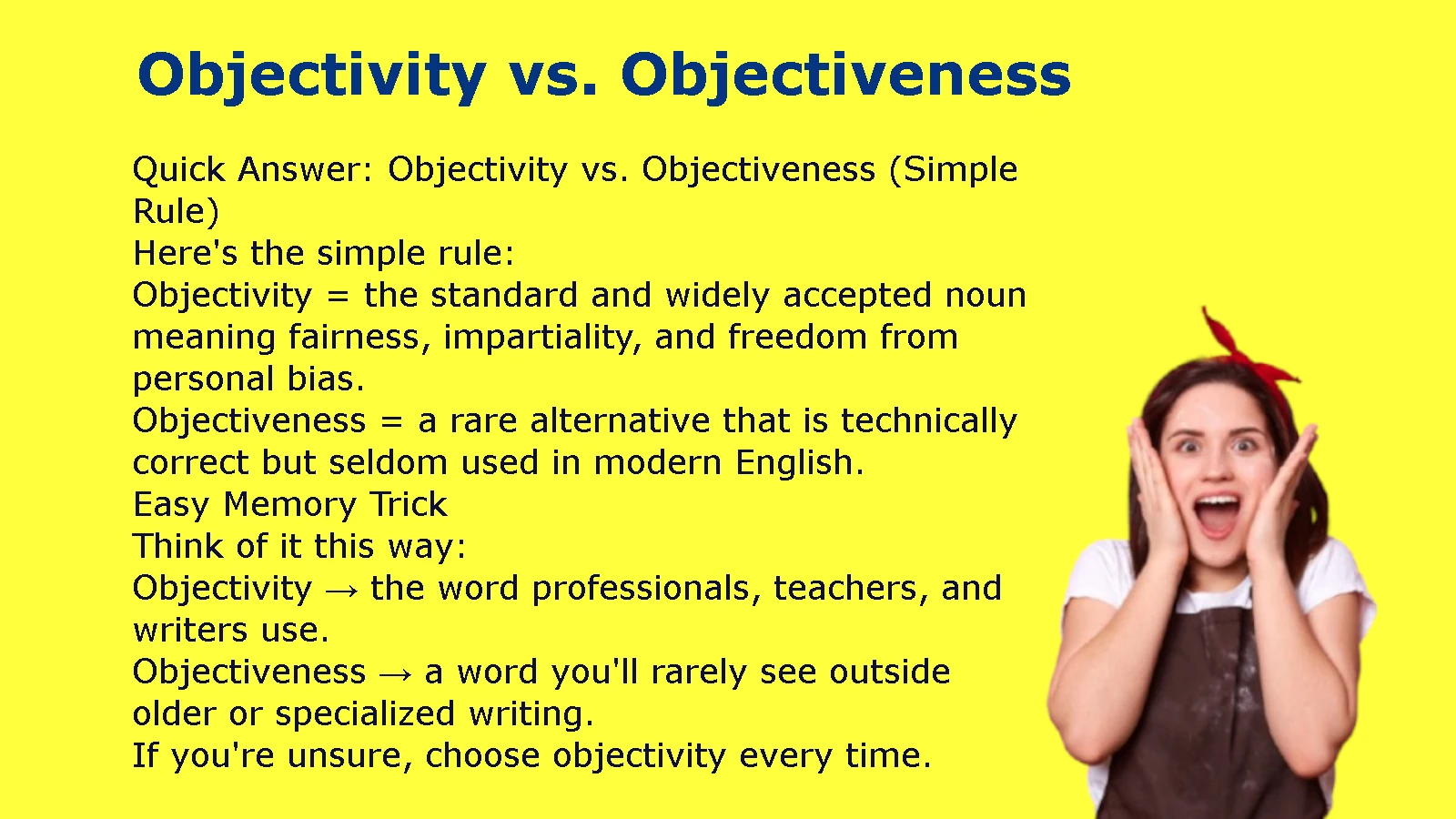
Quick Answer: Objectivity vs. Objectiveness (Simple Rule)
Here’s the simple rule:
Objectivity = the standard and widely accepted noun meaning fairness, impartiality, and freedom from personal bias.
Objectiveness = a rare alternative that is technically correct but seldom used in modern English.
Easy Memory Trick
Think of it this way:
- Objectivity → the word professionals, teachers, and writers use.
- Objectiveness → a word you’ll rarely see outside older or specialized writing.
If you’re unsure, choose objectivity every time.
What Do “Objectivity” and “Objectiveness” Mean?
Both words describe the quality of being objective, but they differ in popularity and acceptance.
Objectivity
Objectivity means making judgments based on facts rather than personal feelings, opinions, or emotions.
Examples:
- Good journalism requires objectivity.
- Scientists strive for objectivity in their research.
- The judge maintained complete objectivity throughout the trial.
This is the preferred word in nearly every context.
Objectiveness
Objectiveness also refers to being objective or unbiased.
Examples:
- The report’s objectiveness was questioned.
- She admired his objectiveness during negotiations.
Although grammatically acceptable, it sounds unusual to most native speakers.
Why Is “Objectivity” More Common?
There’s a simple reason.
English often forms abstract nouns using -ity, especially when describing qualities.
Examples include:
| Adjective | Preferred Noun |
| active | activity |
| creative | creativity |
| objective | objectivity |
| sensitive | sensitivity |
Because of this pattern, objectivity became the standard word.
Meanwhile, objectiveness follows another noun-forming pattern using -ness, but English speakers rarely use it for objective.
The Meaning Behind Objectivity
At its core, objectivity means evaluating something based on evidence rather than emotions.
People demonstrate objectivity when they:
- consider facts first
- avoid personal bias
- examine multiple viewpoints
- make balanced decisions
Examples:
- A researcher must maintain objectivity while analyzing data.
- Reporters should value objectivity over personal opinion.
- Effective leaders balance empathy with objectivity.
The Meaning Behind Objectiveness
Although the meaning is nearly identical, objectiveness appears much less often.
You might encounter it in:
- older books
- philosophical discussions
- occasional academic writing
Examples:
- The philosopher debated the objectiveness of moral values.
- Critics questioned the objectiveness of the evaluation process.
Most modern style guides still recommend replacing it with objectivity.
The Biggest Mistake People Make
The most common mistake is believing both words are equally natural.
What usually happens:
Someone writes:
“The report demonstrates excellent objectiveness.”
While this isn’t technically wrong, many readers find it awkward.
A better version is:
“The report demonstrates excellent objectivity.”
The meaning stays the same, but the sentence sounds much more natural.
Side-by-Side Comparison Table
| Word | Meaning | Common Usage | Best Choice |
| Objectivity | Fairness and freedom from bias | Very common | ✅ Yes |
| Objectiveness | Being objective | Rare | Only in limited contexts |
Real-Life Examples of “Objectivity”
Here are some examples you’ll commonly hear.
Journalism
“The newspaper is respected for its objectivity.”
Science
“Researchers must maintain objectivity during experiments.”
Business
“The hiring committee valued objectivity when reviewing candidates.”
Education
“Teachers should grade assignments with objectivity.”
Notice how natural the word sounds in each sentence.
Real-Life Examples of “Objectiveness”
Although less common, the word still appears occasionally.
Philosophy
“The discussion focused on the objectiveness of ethical standards.”
Formal Writing
“The committee’s objectiveness was praised by several observers.”
Academic Discussion
“The author examined the objectiveness of historical records.”
Most editors would still replace these with objectivity unless there is a specific reason not to.
Why Writers Prefer “Objectivity”
Professional writers usually choose objectivity because it:
- sounds more natural
- is recognized by dictionaries and style guides
- appears more often in published writing
- avoids distracting readers
Using familiar vocabulary improves readability.
How to Choose the Right Word Every Time
Whenever you’re writing, ask yourself one simple question.
Are you describing fairness or impartial judgment?
If yes, use:
Objectivity
Avoid using objectiveness unless you’re quoting an older source or matching specialized terminology.
What to Say Instead (Clear Alternatives)
Depending on the sentence, you can also use:
- impartiality
- neutrality
- fairness
- unbiased judgment
- independence
- balanced perspective
Examples:
Instead of:
“The editor lacked objectivity.”
You could write:
- “The editor lacked impartiality.”
- “The editor showed personal bias.”
- “The editor failed to remain neutral.”
Quick Decision Guide (Use This Instantly)
If you’re unsure, remember this:
Need the standard noun? → Objectivity
Writing an essay or report? → Objectivity
Professional communication? → Objectivity
Quoting older or specialized texts? → Objectiveness may appear.
FAQ: Objectivity vs. Objectiveness
Is “objectiveness” a real word?
Yes. It is a legitimate English word, but it is much less common than objectivity.
Which word is more correct?
Both are grammatically correct, but objectivity is the standard choice in modern English.
Can I use them interchangeably?
Technically yes, but objectivity is preferred in almost every situation.
Which word sounds more natural?
Native speakers overwhelmingly use objectivity.
Case Study: A Better Editing Choice
A university student submitted an essay that included this sentence:
“The journalist demonstrated remarkable objectiveness.”
The professor suggested a small revision:
“The journalist demonstrated remarkable objectivity.”
The meaning didn’t change, but the revised version sounded smoother and aligned with standard academic English.
This tiny adjustment made the writing appear more polished and professional.
Key Facts You Should Remember
- Objectivity is the standard English noun.
- Objectiveness is a valid but uncommon alternative.
- Both describe freedom from personal bias.
- Professional, academic, and everyday writing almost always use objectivity.
- When in doubt, choose objectivity.
Final Takeaway: The One Rule That Never Fails
The distinction between objectivity and objectiveness is less about meaning and more about usage. While both words refer to being objective and unbiased, objectivity has become the accepted standard in modern English.
So keep this simple rule in mind:
- Objectivity = the preferred and widely used term.
- Objectiveness = a rare alternative you’ll occasionally encounter.
If you’re writing an email, report, article, essay, or research paper, objectivity is almost always the right choice. It sounds natural, meets professional standards, and ensures your writing is clear and credible.
When precision matters, choosing the common and accepted form is the easiest way to communicate with confidence.