Have you ever wondered whether “Purity vs. Pureness” is just a subtle spelling variation or two different ways of expressing the same idea? This is a common point of confusion in English vocabulary, especially for learners who often encounter abstract words that seem interchangeable but carry slightly different tones and usage.
In simple terms, purity refers to the state of being clean, unmixed, or free from any contamination, whether physical, moral, or abstract. It is widely used in scientific, emotional, and formal contexts such as water purity, purity of heart, or purity of gold. On the other hand, pureness carries a similar meaning but is far less commonly used in modern English. It is often found in literary or poetic writing, where a softer, more expressive tone is needed.
Although both words share the same root idea of being “pure,” their usage differs in style, frequency, and context. Understanding the distinction between purity and pureness helps improve vocabulary accuracy, writing clarity, and overall communication skills. In this guide, you’ll learn their meanings, differences, real-life examples, and when to use each word correctly.
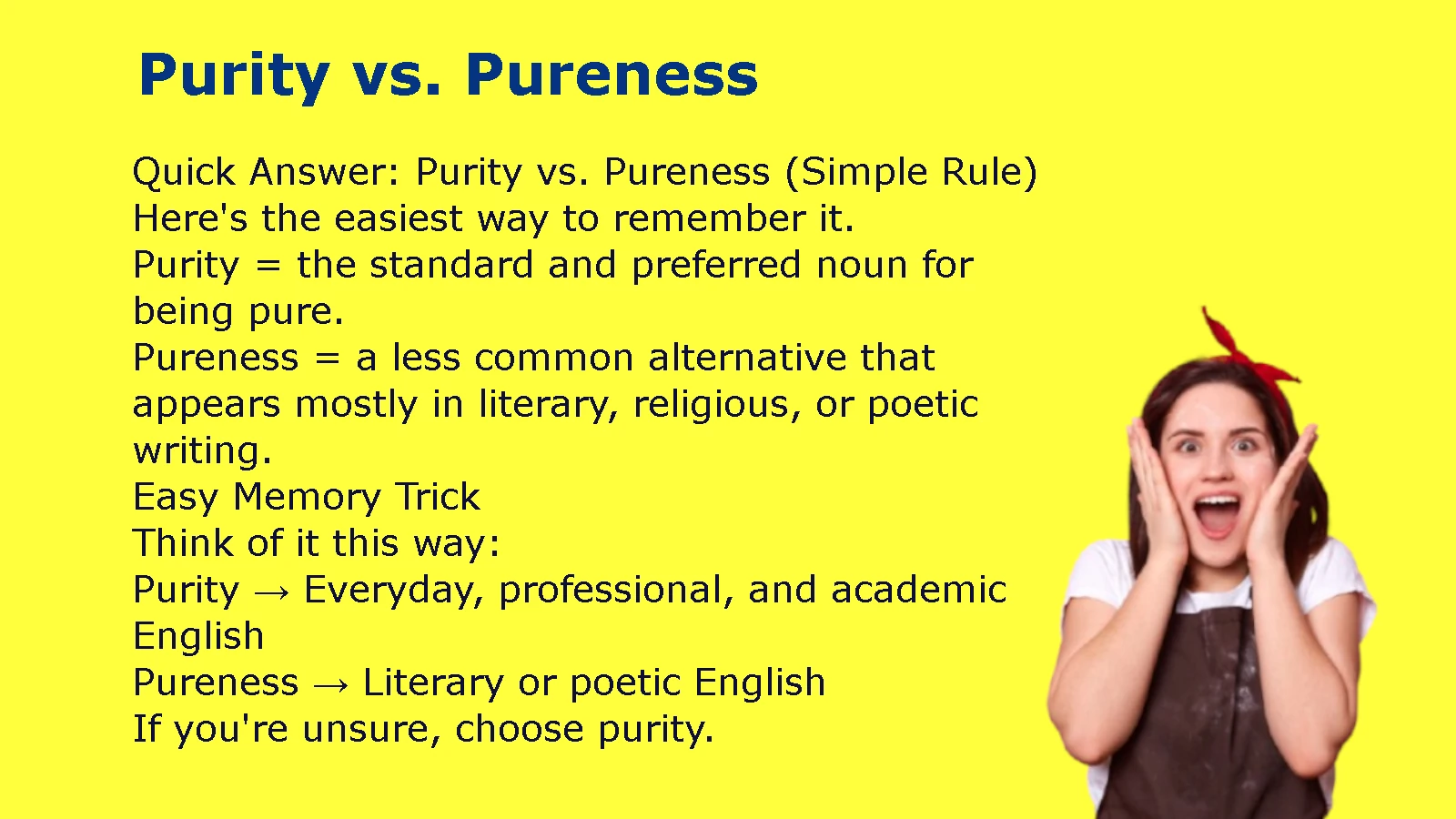
Quick Answer: Purity vs. Pureness (Simple Rule)
Here’s the easiest way to remember it.
Purity = the standard and preferred noun for being pure.
Pureness = a less common alternative that appears mostly in literary, religious, or poetic writing.
Easy Memory Trick
Think of it this way:
- Purity → Everyday, professional, and academic English
- Pureness → Literary or poetic English
If you’re unsure, choose purity.
How People Actually Use Purity and Pureness
Although dictionaries recognize both words, native speakers overwhelmingly prefer purity.
In Everyday Conversations
People naturally say:
- “The purity of the water.”
- “The purity of gold.”
- “Her purity of heart.”
They rarely say:
- “The pureness of the water.”
It isn’t technically wrong—it just sounds unusual.
In Writing
Professional writing almost always favors purity because it’s concise and familiar.
In Literature
Authors sometimes choose pureness because it creates a softer or more poetic rhythm.
The Difference Between Purity and Pureness
Both words describe the state of being pure, but they differ in frequency and style.
| Word | Meaning | Common Usage | Sounds |
| Purity | State of being pure | Very common | Natural and modern |
| Pureness | State of being pure | Rare | Literary or old-fashioned |
Key Insight
The meaning stays nearly the same.
The difference is mainly how natural the word sounds.
Purity Explained Clearly
Purity is the noun that English speakers normally use.
It works in nearly every context.
Common Uses
Science
- Water purity
- Air purity
- Chemical purity
Religion
- Spiritual purity
- Purity of soul
Morality
- Purity of intention
- Purity of heart
Everyday Language
- Food purity
- Purity of ingredients
Example Sentences
- The laboratory tested the purity of the sample.
- The jeweler guaranteed the purity of the silver.
- Parents admired the child’s purity and honesty.
- The company is known for the purity of its natural oils.
Key Takeaway
If you’re writing emails, essays, articles, or reports, purity is almost always the correct choice.
Pureness Explained Clearly
Now let’s look at the less common word.
Pureness also means “the quality of being pure.”
The difference is that modern English rarely uses it.
Where It Appears
- Poetry
- Religious writings
- Classic literature
- Creative storytelling
Example Sentences
- The mountain snow reflected its untouched pureness.
- The poem celebrated the pureness of childhood.
- They admired the pureness of her spirit.
These sentences are grammatically correct, but replacing pureness with purity would sound more natural in everyday English.
Key Insight
Use pureness only when you’re intentionally aiming for a poetic or literary tone.
The Biggest Mistake People Make
Many learners believe purity and pureness are used equally often.
They’re not.
What Goes Wrong
Someone writes:
“The pureness of the water was tested.”
Although correct, native readers expect:
“The purity of the water was tested.”
Lesson
Knowing what’s technically correct isn’t enough.
Knowing what’s natural matters just as much.
Side-by-Side Comparison Table
| Feature | Purity | Pureness |
| Meaning | State of being pure | State of being pure |
| Modern usage | Very common | Rare |
| Academic writing | Excellent choice | Rarely used |
| Business writing | Preferred | Avoid |
| Creative writing | Common | Sometimes effective |
| Poetry | Works well | Often preferred for style |
| Sounds natural | Yes | Less natural |
Real-Life Examples of Purity
Here are some examples you’ll hear regularly.
Science
“The scientist measured the purity of the chemical.”
Food
“We guarantee the purity of every ingredient.”
Jewelry
“The certificate confirms the purity of the gold.”
Character
“Everyone admired her purity of heart.”
Mini Scenario
You’re shopping for bottled water.
The label says:
“Tested for purity.”
This sounds completely natural.
Real-Life Examples of Pureness
Now compare these.
Poetry
“The river flowed with remarkable pureness.”
Literature
“The novel praised the pureness of first love.”
Religion
“They prayed for pureness of heart.”
Mini Scenario
You’re reading an old novel.
The author writes:
“The pureness of the morning light filled the valley.”
Here, pureness fits the artistic style.
Why Purity Is More Common
English often has two nouns formed from the same adjective.
Over time, one becomes the standard choice.
That’s exactly what happened here.
Purity became the preferred word because it sounds smoother and appears more often in education, science, journalism, and everyday conversation.
Pureness survived mostly in poetic and literary contexts.
How to Choose the Right Word Every Time
Want a simple rule?
Follow these tips.
Choose Purity For
- School essays
- Work emails
- Scientific writing
- Business documents
- Everyday conversation
- News articles
- Professional communication
Choose Pureness For
- Poems
- Religious writing
- Creative fiction
- Classic or traditional style
Why This Works
You’ll sound more natural while still matching the tone of your writing.
Better Alternatives
Depending on the context, these words may work even better.
For Quality
- Cleanliness
- Quality
- Authenticity
Character
- Innocence
- Integrity
- Virtue
Science
- Refinement
- Concentration
- Composition
Choose the word that best matches your meaning instead of automatically using purity or pureness.
Quick Decision Guide
Need a fast answer?
Use this checklist.
Writing for school or work? → Purity
Talking with friends? → Purity
Writing poetry? → Pureness can work.
Still unsure? → Choose purity.
FAQ: Purity vs. Pureness
Is pureness a real word?
Yes. It is a correct English word, but it’s much less common than purity.
Which word is more common?
Purity is far more common in both spoken and written English.
Can I use pureness in an essay?
You can, but purity will almost always sound more natural and professional.
Do they have different meanings?
Not really. They share the same basic meaning. The main difference is style and frequency of use.
Which word should English learners use?
Choose purity in almost every situation unless you’re writing poetry or aiming for a literary effect.
Case Study: A Small Writing Improvement
A student submitted an essay that included this sentence:
“The pureness of the drinking water was carefully checked.”
The teacher suggested changing it to:
“The purity of the drinking water was carefully checked.”
Why?
The second sentence sounds more natural and matches modern academic English.
Result
The essay became clearer and more professional without changing the meaning.
Key Facts You Should Remember
- Purity is the standard modern noun.
- Pureness is correct but uncommon.
- Both words mean the quality of being pure.
- Scientific and professional writing almost always uses purity.
- Pureness appears mainly in poetry, literature, and religious texts.
- When in doubt, choose purity.
Final Takeaway: The One Rule That Never Fails
Here’s the simplest way to remember the difference.
Purity is the word you’ll encounter in everyday English, academic writing, business communication, and scientific discussions. It’s the natural choice in nearly every situation.
Pureness, while perfectly correct, has a more literary and poetic flavor. It appears far less often and is usually chosen for stylistic effect rather than necessity.
So keep it simple:
- Modern, everyday English → Purity
- Poetic or literary writing → Pureness
- Not sure? → Use “purity.”
Choosing the right word isn’t just about being grammatically correct—it’s about sounding natural. And in the case of “Purity vs. Pureness,” that small difference can make your writing clearer, smoother, and more professional.