Have you ever wondered whether Responsibility vs. Responsibleness are interchangeable or if one is actually more appropriate than the other? This common English vocabulary question confuses many students, writers, professionals, and English learners because both words relate to being accountable, dependable, and trustworthy. However, their meanings, usage, and frequency differ significantly in modern English.
If you’ve ever paused while writing an email, academic paper, job application, or business document, you’re not alone. The confusion often comes from the fact that both terms stem from the adjective responsible, yet only one is commonly used in everyday communication. Choosing the wrong word can make your writing sound awkward, outdated, or unnatural to native speakers.
The good news? Understanding the difference is easier than it seems.
In this guide, you’ll learn the meaning of Responsibility vs. Responsibleness, how each word is used in English grammar, professional writing, and everyday conversation, along with the key differences between these commonly confused words. You’ll also discover practical examples, common mistakes to avoid, pronunciation tips, regional usage, and simple ways to improve your English vocabulary, word choice, and writing confidence. We’ll also compare related terms like accountability, duty, obligation, reliability, dependability, and trustworthiness so you know exactly which word fits each context.
So, if you’re ready to master the difference between Responsibility and Responsibleness and communicate more clearly in both formal and informal English, let’s dive in.
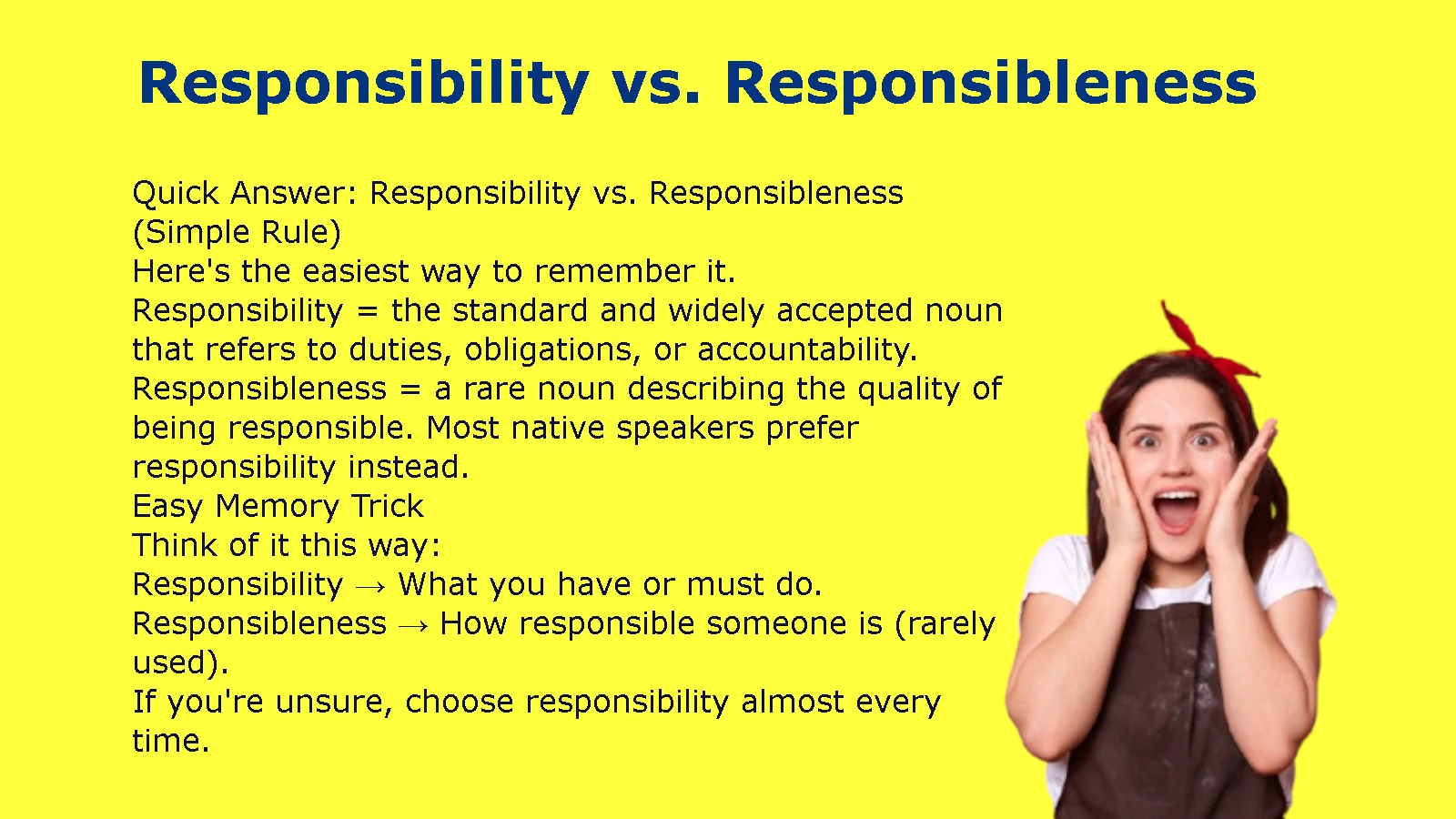
Quick Answer: Responsibility vs. Responsibleness (Simple Rule)
Here’s the easiest way to remember it.
Responsibility = the standard and widely accepted noun that refers to duties, obligations, or accountability.
Responsibleness = a rare noun describing the quality of being responsible. Most native speakers prefer responsibility instead.
Easy Memory Trick
Think of it this way:
- Responsibility → What you have or must do.
- Responsibleness → How responsible someone is (rarely used).
If you’re unsure, choose responsibility almost every time.
What Does “Responsibility” Mean?
Responsibility is one of the most common nouns in English. It refers to a duty, obligation, or accountability for something.
Common Meanings
- A task you’re expected to complete
- Accountability for actions
- A role or duty assigned to someone
- Moral or legal obligation
Examples
- Taking care of children is a responsibility.
- It is your responsibility to submit the report.
- Parents have the responsibility to protect their children.
- The manager accepted responsibility for the mistake.
Key Insight
Whenever you’re talking about duties, obligations, or accountability, responsibility is almost always the correct choice.
What Does “Responsibleness” Mean?
Responsibleness refers to the quality or trait of being responsible.
Although it is a real English word, it is rarely used in everyday conversation or professional writing.
Instead, native speakers usually express the same idea using:
- responsibility
- sense of responsibility
- reliability
- maturity
- accountability
Examples
Rare:
- Her responsibleness impressed the teachers.
More natural:
- Her responsibility impressed the teachers.
- She showed a strong sense of responsibility.
Key Insight
Most dictionaries recognize responsibleness, but it’s considered uncommon and often sounds old-fashioned.
Why “Responsibility” Is Much More Common
Modern English naturally favors responsibility because it’s more flexible.
It can describe:
- duties
- accountability
- character
- ownership
- moral obligation
Meanwhile, responsibleness only refers to a personality trait.
As a result, native speakers rarely need it.
Responsibility vs. Responsibleness: The Main Difference
The easiest way to understand the distinction is to focus on what each word emphasizes.
Responsibility
Focuses on:
- duties
- obligations
- accountability
- ownership
Example:
Completing the project is my responsibility.
Responsibleness
Focuses on:
- personal character
- reliability
- responsible behavior
Example:
His responsibleness earned everyone’s trust.
Even here, most people would naturally say:
His sense of responsibility earned everyone’s trust.
Grammar Difference
Although both are nouns, they aren’t equally useful.
| Word | Part of Speech | Common? | Best Used For |
| Responsibility | Noun | Very common | Duties, accountability, obligations |
| Responsibleness | Noun | Rare | Quality of being responsible |
Key Insight
In almost every situation, responsibility is the better choice.
Real-Life Examples of “Responsibility”
Let’s see how native speakers actually use it.
At Work
- Managing the budget is her responsibility.
- Every employee has certain responsibilities.
School
- Students should take responsibility for their homework.
- Learning is everyone’s responsibility.
Home
- Feeding the dog is your responsibility.
- Parents teach children about responsibility.
Notice how natural the word sounds in every situation.
Real-Life Examples of “Responsibleness”
Now compare.
Examples:
- The teacher praised his responsibleness.
- Her responsibleness was obvious.
Although these sentences are grammatically correct, many native speakers would rewrite them.
More natural versions:
- The teacher praised his sense of responsibility.
- She demonstrated great responsibility.
Why People Confuse These Words
The confusion is understandable.
Many English adjectives form nouns using -ness.
Examples:
- kind → kindness
- happy → happiness
- polite → politeness
So learners naturally assume:
responsible → responsibleness
While this is technically correct, English developed another noun—responsibility—which became the preferred form.
Common Mistakes
Here are the errors people make most often.
Mistake 1
❌ His responsibleness at work is excellent.
✅ His responsibility at work is excellent.
Mistake 2
❌ Responsibleness is important in leadership.
✅ Responsibility is important in leadership.
Mistake 3
❌ Children should learn responsibleness.
✅ Children should learn responsibility.
Side-by-Side Comparison Table
| Feature | Responsibility | Responsibleness |
| Common in English | ✅ Yes | ❌ Rare |
| Used by native speakers | Very often | Seldom |
| Refers to duties | ✅ Yes | ❌ No |
| Refers to personal quality | Sometimes | ✅ Yes |
| Best for professional writing | ✅ Yes | ❌ No |
When Should You Use “Responsibility”?
Choose responsibility when talking about:
- work duties
- school assignments
- family obligations
- accountability
- leadership
- ownership
- moral obligations
Examples
- It’s my responsibility.
- She accepted full responsibility.
- Everyone has responsibilities at work.
When Can You Use “Responsibleness”?
Use it only if you’re intentionally discussing someone’s character trait and don’t mind sounding formal or old-fashioned.
Even then, these alternatives usually sound better:
- responsibility
- sense of responsibility
- reliability
- dependability
- accountability
Professional Writing Tips
If you’re writing:
- business emails
- academic papers
- resumes
- reports
- blog posts
Always choose responsibility.
It is the standard word that readers expect.
Quick Decision Guide (Use This Instantly)
Need to describe duties or obligations?
→ Responsibility
Talking about someone’s reliable character?
→ Usually responsibility or sense of responsibility
Thinking of using responsibleness?
→ Consider replacing it with responsibility unless you have a specific stylistic reason.
FAQ: Responsibility vs. Responsibleness
Is “responsibleness” a real word?
Yes. It appears in dictionaries, but it’s rarely used in modern English.
Which word do native speakers use?
Almost always responsibility.
Can I use “responsibleness” in formal writing?
You can, but responsibility is much more natural and widely accepted.
Why isn’t “responsibleness” common?
English gradually adopted responsibility as the preferred noun because it’s more versatile and sounds more natural.
Case Study: Choosing the Right Word in a Job Application
Imagine you’re writing a cover letter.
Version A:
I developed my responsibleness through years of project management.
Version B:
I developed a strong sense of responsibility through years of project management.
Most hiring managers would find Version B more polished and professional. It uses the expression that native speakers naturally expect, making the writing clearer and more effective.
Key Facts You Should Remember
- Responsibility is the standard English noun.
- Responsibleness is correct but uncommon.
- Native speakers almost always prefer responsibility.
- Responsibility refers to duties, accountability, and obligations.
- Responsibleness mainly describes a personal quality.
- In professional and academic writing, responsibility is the safer and more natural choice.
Final Takeaway: The One Rule That Never Fails
The difference between Responsibility vs. Responsibleness is simpler than it first appears. Although both words exist, they are not equally common. Responsibility is the everyday choice for talking about duties, accountability, and even a person’s dependable character. Responsibleness, on the other hand, survives mostly as a rare alternative that many native speakers seldom use.
When in doubt, remember this simple rule:
Need to talk about obligations, accountability, or dependable behavior? Choose “responsibility.”
You’ll sound more natural, your writing will be clearer, and your message will match modern English usage. Like many English word pairs, the safest option is often the one that people use every day—and in this case, that’s responsibility.