Have you ever paused while writing and wondered whether it should be principal or principle? You’re not alone—this is one of the most searched English confusions, often seen in queries like principal vs principle meaning, principal vs principle definition, and principal vs principle difference. The confusion happens because both words sound the same but belong to completely different areas of English usage.
In simple terms, principal usually refers to a person in authority or a main/primary amount in finance. For example, a school principal vs principle comparison clearly shows the difference: a school principal is the head of a school, while “principle” has nothing to do with a person. In finance, principal vs principle money and principal vs principle finance refer to the original amount of a loan or investment before interest is added. That’s why we often hear loan principal vs principle as a common mistake—because “principle” is incorrectly used instead of “principal.”
On the other hand, principle refers to a rule, belief, or moral guideline. It explains why someone follows certain standards in life, ethics, or decision-making.
Understanding this distinction helps you avoid common grammar errors and improves clarity in both academic and professional writing. Once you master principal vs principle meaning, you’ll never confuse authority, money, and rules again.
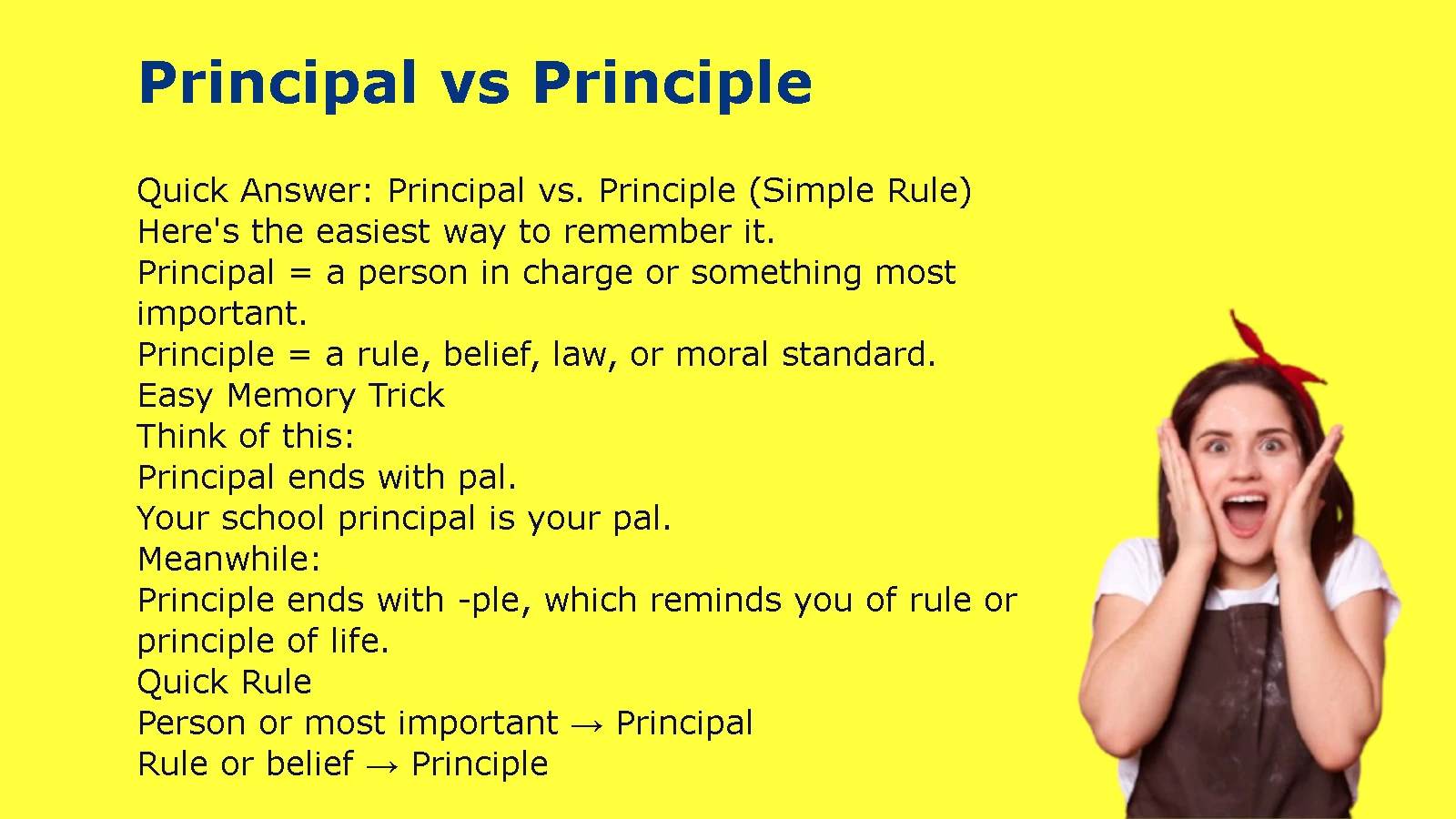
Quick Answer: Principal vs. Principle (Simple Rule)
Here’s the easiest way to remember it.
Principal = a person in charge or something most important.
Principle = a rule, belief, law, or moral standard.
Easy Memory Trick
Think of this:
- Principal ends with pal.
- Your school principal is your pal.
Meanwhile:
- Principle ends with -ple, which reminds you of rule or principle of life.
Quick Rule
- Person or most important → Principal
- Rule or belief → Principle
Pronunciation: Principal vs. Principle
Although principal and principle have different meanings, they’re pronounced exactly the same in modern English.
Principal
principal (PRIN-suh-puhl)
Principle
principle (PRIN-suh-puhl)
Pronunciation: Both words are pronounced PRIN-suh-puhl.
Why This Causes Confusion
Because principal and principle are homophones (words that sound the same but have different meanings and spellings), you can’t tell which one someone means just by listening. The correct word depends entirely on the context.
Examples:
- “The principal gave a speech.” (school administrator)
- “Honesty is an important principle.” (moral belief)
Quick Tip: If you’re writing instead of speaking, pause and ask yourself whether you’re referring to a person or something primary (principal) or a rule or belief (principle). That one question will help you choose the correct spelling every time.
Why People Confuse “Principal” and “Principle”
The confusion is understandable.
Both words:
- Sound exactly the same.
- Have nearly identical spelling.
- Often appear in education, business, and finance.
Many people rely on pronunciation instead of spelling, leading to mistakes.
Why This Happens
English contains many homophones—words that sound alike but have different meanings.
Just because two words sound the same doesn’t mean they mean the same thing.
The Core Difference Between Principal and Principle
Here’s the biggest distinction.
| Word | Meaning | Part of Speech |
| Principal | A person in charge or the main/most important thing | Noun or adjective |
| Principle | A rule, belief, doctrine, or fundamental truth | Noun |
Key Insight
Ask yourself:
Am I talking about a person or importance?
→ Use principal
Am I talking about a rule, value, or belief?
→ Use principle
“Principal” Explained Clearly
The word principal has two common meanings.
Meaning 1: Head of a School
This is the meaning most people learn first.
Examples:
- The principal announced a new school policy.
- Our principal welcomed the new students.
- The principal met with parents yesterday.
Meaning 2: Most Important
As an adjective, principal means “main” or “primary.”
Examples:
- The principal reason for the delay was bad weather.
- Water is the principal ingredient.
- His principal concern was safety.
Meaning 3: Money in Finance
In banking and loans, principal means the original amount of money borrowed or invested.
Example:
- She paid off the principal before the interest accumulated.
- The investment’s principal remains protected.
“Principle” Explained Clearly
A principle is never a person.
Instead, it’s an idea, rule, or belief.
Moral Rule
Examples:
- Honesty is an important principle.
- She lives by strong moral principles.
- Respect is one of our guiding principles.
Scientific Principle
Many scientific laws are called principles.
Examples:
- The principle of gravity explains falling objects.
- Engineers follow basic design principles.
General Rule
Examples:
- The company follows clear business principles.
- Fairness is an essential principle of justice.
The Biggest Mistake People Make
Many writers assume:
“If it’s about school, it must be principle.”
That’s incorrect.
Correct
✅ School principal
Incorrect
❌ School principle
Remember:
The principal is the person.
The principles are the rules the school follows.
Side-by-Side Comparison Table
| Feature | Principal | Principle |
| Meaning | Person in charge; most important; original loan amount | Rule, belief, or law |
| Part of Speech | Noun or adjective | Noun |
| Used for People | Yes | No |
| Used for Ideas | Sometimes (importance) | Yes |
| Common Contexts | Schools, finance, leadership | Ethics, science, philosophy |
Real-Life Examples of “Principal”
Let’s see it in everyday language.
School
“The principal called an assembly.”
Business
“Our principal objective is customer satisfaction.”
Finance
“The loan principal is $20,000.”
Mini Scenario
A student says,
“I have a meeting with the principal.”
Everyone immediately knows they’re talking about the school administrator.
Real-Life Examples of “Principle”
Now compare.
Ethics
“He refused because of his principles.”
Science
“The machine works on a simple principle.”
Personal Values
“She believes honesty is the most important principle.”
Mini Scenario
An employee says,
“I won’t do that because it violates my principles.”
Here, they’re talking about personal beliefs—not a person.
Common Expressions Using “Principal”
You’ll often hear:
- Principal office
- Principal investigator
- Principal actor
- Principal amount
- Principal objective
- School principal
Notice they all involve leadership, importance, or finance.
Common Expressions Using “Principle”
These are equally common.
- Basic principles
- Guiding principles
- Moral principles
- Scientific principles
- Legal principles
- Fundamental principle
These always refer to ideas or rules.
Memory Tricks That Actually Work
Here are two easy ways to remember.
Trick #1: The PAL Trick
Principal has “pal.”
Your school principal is your pal.
Trick #2: Rules vs. People
If you can replace the word with:
- rule
- belief
- value
Use principle.
If you can replace it with:
- leader
- boss
- main
- primary
Use principal.
How to Avoid Confusion Every Time
Want to get it right instantly?
Ask yourself these questions.
Is it a person?
Use principal.
Is it the most important thing?
Use principal.
Is it a belief or rule?
Use principle.
Simple.
What to Say Instead (If You’re Unsure)
Sometimes you can avoid confusion entirely.
Instead of:
“Our principal goal…”
You could say:
“Our main goal…”
Instead of:
“My guiding principle…”
You could say:
“My core belief…”
These alternatives work well in formal writing.
Quick Decision Guide (Use This Instantly)
If you’re unsure, remember this:
Person in charge → Principal
Main or primary → Principal
Original loan amount → Principal
Rule or belief → Principle
Scientific law → Principle
Moral value → Principle
FAQ: Principal vs. Principle
Is a school leader called a principal or principle?
A school leader is always the principal.
Which word means a moral belief?
Principle refers to a moral belief or value.
Can principal mean “main”?
Yes. As an adjective, principal means primary or most important.
Can principle refer to a person?
No. Principle never refers to a person.
Why do these words sound the same?
They’re homophones—words with different meanings but identical pronunciation.
Case Study: An Embarrassing Workplace Mistake
A company handbook included this sentence:
“Our guiding principal is honesty.”
Employees noticed the mistake immediately.
Why?
The company wasn’t talking about a person.
It meant:
“Our guiding principle is honesty.”
One letter completely changed the meaning.
After proofreading the document, the company corrected every instance before publishing the final version.
Key Facts You Should Remember
- Principal refers to a person in charge, the most important thing, or the original loan amount.
- Principle means a rule, belief, value, or fundamental truth.
- Both words sound identical.
- Principal can be both a noun and an adjective.
- Principle is always a noun.
- The “principal is your pal” trick helps many people remember the difference.
Final Takeaway: The One Rule That Never Fails
At first glance, principal and principle look almost identical, but their meanings couldn’t be more different. One refers to a person in charge, something primary, or the original amount of money, while the other represents a belief, rule, or guiding truth.
Whenever you’re unsure, ask one simple question:
- Is it a person or something most important? Choose principal.
- Is it a rule, belief, or moral value? Choose principle.
And if you ever forget, remember the classic memory trick:
The principal is your pal.
With that simple reminder, you’ll avoid one of the most common English spelling mistakes and write with confidence every time.