Have you ever paused while writing and wondered whether it’s “weird” vs “wierd”—or even if both spellings are correct? This is one of the most common spelling confusions in English, especially because the word “weird” doesn’t follow typical spelling rules. Many learners mistakenly write it as wierd, assuming the “i before e” rule always applies, which leads to frequent grammar and spelling errors in everyday writing.
In simple terms, weird is the correct spelling and is used to describe something unusual, strange, or unexpected in appearance, behavior, or situation. For example, a weird sound in the night or a weird feeling in a new place. On the other hand, “wierd” is a completely incorrect spelling and is considered a common typographical mistake in English writing, academic work, and online communication.
This confusion often appears in searches like weird meaning, wierd vs weird difference, how to spell weird correctly, and common English spelling mistakes, especially among learners improving their vocabulary and writing accuracy. It also connects with broader English language topics like spelling rules, pronunciation patterns, and tricky word formations.
If you’ve ever typed “wierd” and felt unsure before hitting send, you’re not alone—this is exactly the kind of small spelling trap that even fluent writers sometimes fall into.
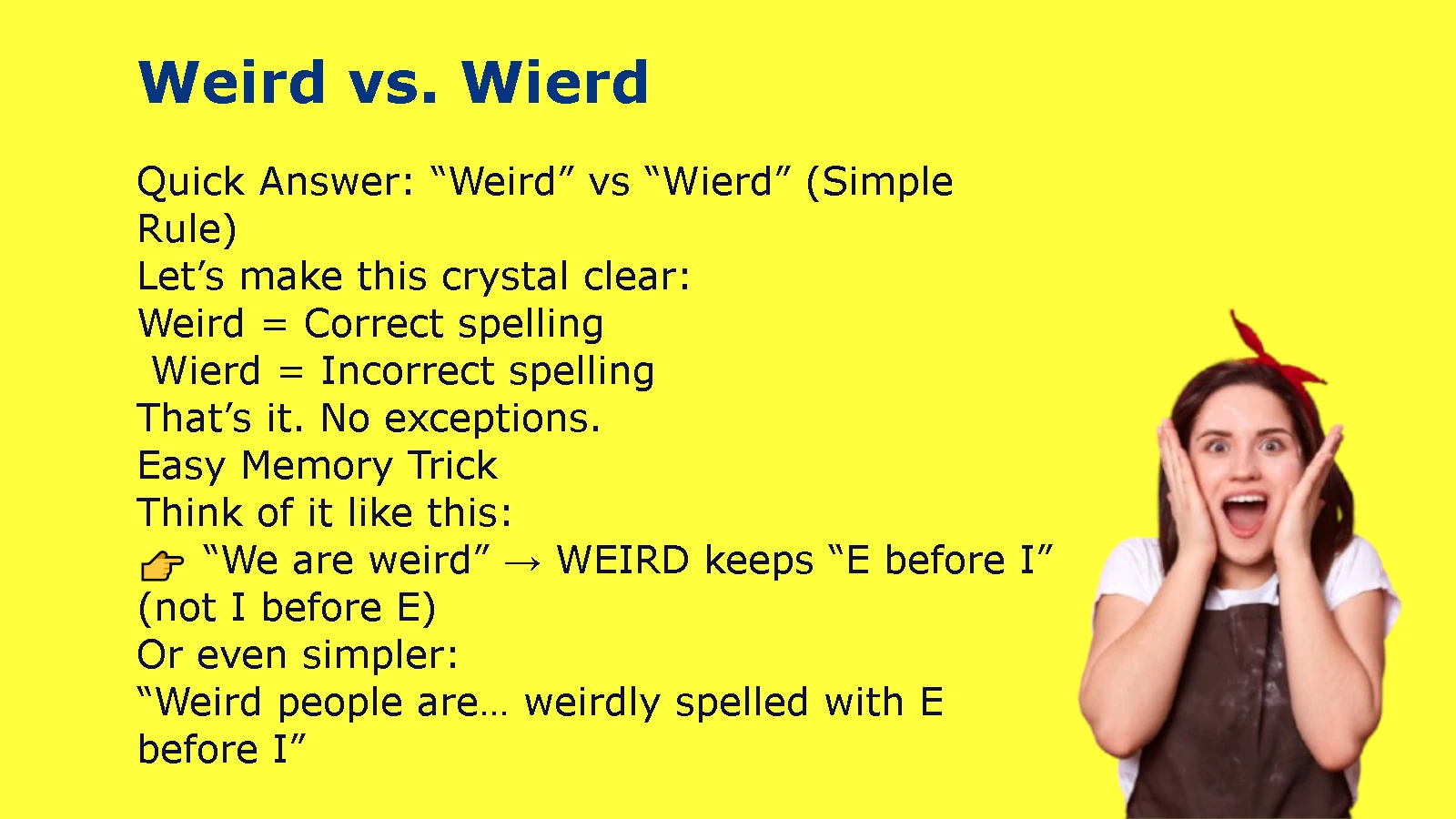
Quick Answer: “Weird” vs “Wierd” (Simple Rule)
Let’s make this crystal clear:
Weird = Correct spelling
Wierd = Incorrect spelling
That’s it. No exceptions.
Easy Memory Trick
Think of it like this:
👉 “We are weird” → WEIRD keeps “E before I” (not I before E)
Or even simpler:
- “Weird people are… weirdly spelled with E before I”
Why “Weird” Is So Confusing
The confusion mainly comes from English spelling rules like:
“I before E except after C”
That rule tricks people into thinking:
- “wierd” should be correct
But English is messy. This word breaks that expectation.
The Real Reason
The word “weird” comes from Old English wyrd, meaning fate or destiny. Over time, spelling evolved—but pronunciation stayed tricky.
So your brain tries to “fix” it into a more familiar pattern like wierd.
Correct Spelling: “Weird” Explained
Let’s break it down simply.
Meaning of “Weird”
“Weird” means:
- Strange
- Unusual
- Odd
- Unexpected
Pronunciation
/wiːrd/
It sounds like:
- “weerd”
Example Sentences
- That movie was really weird.
- He has a weird sense of humor.
- Something feels weird about this situation.
Key Insight
Even though it sounds like it could be spelled “wierd,” English keeps it as weird.
Incorrect Spelling: “Wierd” (And Why People Write It)
Let’s be honest—“wierd” looks right at first glance. But it’s always wrong.
Why People Write “Wierd”
- Fast typing (keyboard error)
- Overthinking “i before e” rule
- Sound-based spelling
- Habit from seeing others make the mistake
Important Rule
❌ “wierd” = never correct in standard English
✔ “weird” = always correct
Simple Memory Tricks to Never Forget It
Here are easy ways to lock it into your memory:
1. The “We Are Weird” Trick
Break it like this:
WE + IRD → WEIRD
Now notice:
- “WE” comes first
- Not “WI”
2. The Anti-Rule Trick
Forget “i before e” for this word.
Instead:
“Weird breaks the rule on purpose.”
3. Visual Trick
Picture the word:
WE + IRD = WEIRD
If you try “WI + ERD,” it just feels wrong.
Common Mistakes People Make
Let’s look at what actually goes wrong in real writing.
1. Typing Error Habit
People type “wierd” because fingers move faster than memory.
2. Rule Overgeneralization
Applying “i before e” everywhere—even when it doesn’t fit.
3. Autocorrect Dependence
Some devices don’t always correct it, so the mistake survives.
Side-by-Side Comparison Table
| Word | Correct? | Meaning Impact | Usage Status |
| weird | ✅ Yes | Strange / unusual | Standard English |
| wierd | ❌ No | No meaning | Spelling error |
Real-Life Examples of “Weird”
Let’s see how it’s used naturally:
- That noise in the room is weird.
- I had a weird dream last night.
- It feels weird to be back here.
- She gave me a weird look.
Notice:
All correct sentences use weird, never “wierd.”
Why Spelling Matters More Than You Think
You might think:
“It’s just one letter, does it matter?”
Yes—it does, especially in:
1. Academic Writing
Spelling errors reduce credibility.
2. Professional Emails
Small mistakes can affect first impressions.
3. SEO Content
Search engines recognize correct spelling only.
Quick Fix Guide (Use This Instantly)
When you’re unsure:
Step 1
Write the word slowly: weird
Step 2
Check:
- Does it start with “we”? → correct
- Does it start with “wi”? → wrong
Step 3
Remember:
“Weird people are always spelled W-E-I-R-D.”
FAQ: “Weird” vs “Wierd”
Is “wierd” ever correct?
No. It is always a spelling mistake in standard English.
Why does “wierd” feel correct?
Because of the “i before e” rule and how the word sounds.
What is the easiest way to remember it?
Think: WE are weird → WE comes first
Is “weird” formal or informal?
It is neutral and used in both formal and informal writing.
Final Takeaway: One Rule You’ll Never Forget
Let’s simplify everything:
- The correct spelling is weird
- “Wierd” is always wrong
- English spelling rules have exceptions
- Memory tricks make it easy to remember
So next time you pause mid-sentence wondering which one is right, just remember:
“We are weird—so WE comes first.”
That one small trick will save you from the mistake forever.