Have you ever stopped while writing and wondered whether “breath vs breathe” is just a spelling confusion or two completely different words? This is one of the most common English mistakes because both words look almost identical, yet their meaning, usage, and grammar function are totally different.
The confusion becomes even clearer once you understand their pronunciation and word class.
breath
Breath is a noun that refers to the air you take in and release from your lungs.
breathe
Breathe is a verb that describes the action of taking air in and out of your body.
In simple terms, the breath vs breathe meaning and definition difference is: breath = thing (noun), while breathe = action (verb). This small “-e” at the end completely changes the grammar role and usage in sentences.
For example, you might say: “Take a deep breath before speaking” or “Don’t forget to breathe slowly during exercise.” This is why learners often search for breath vs breathe examples, breath vs breathe in a sentence, and the difference between breath and breathe to avoid writing mistakes in everyday communication.
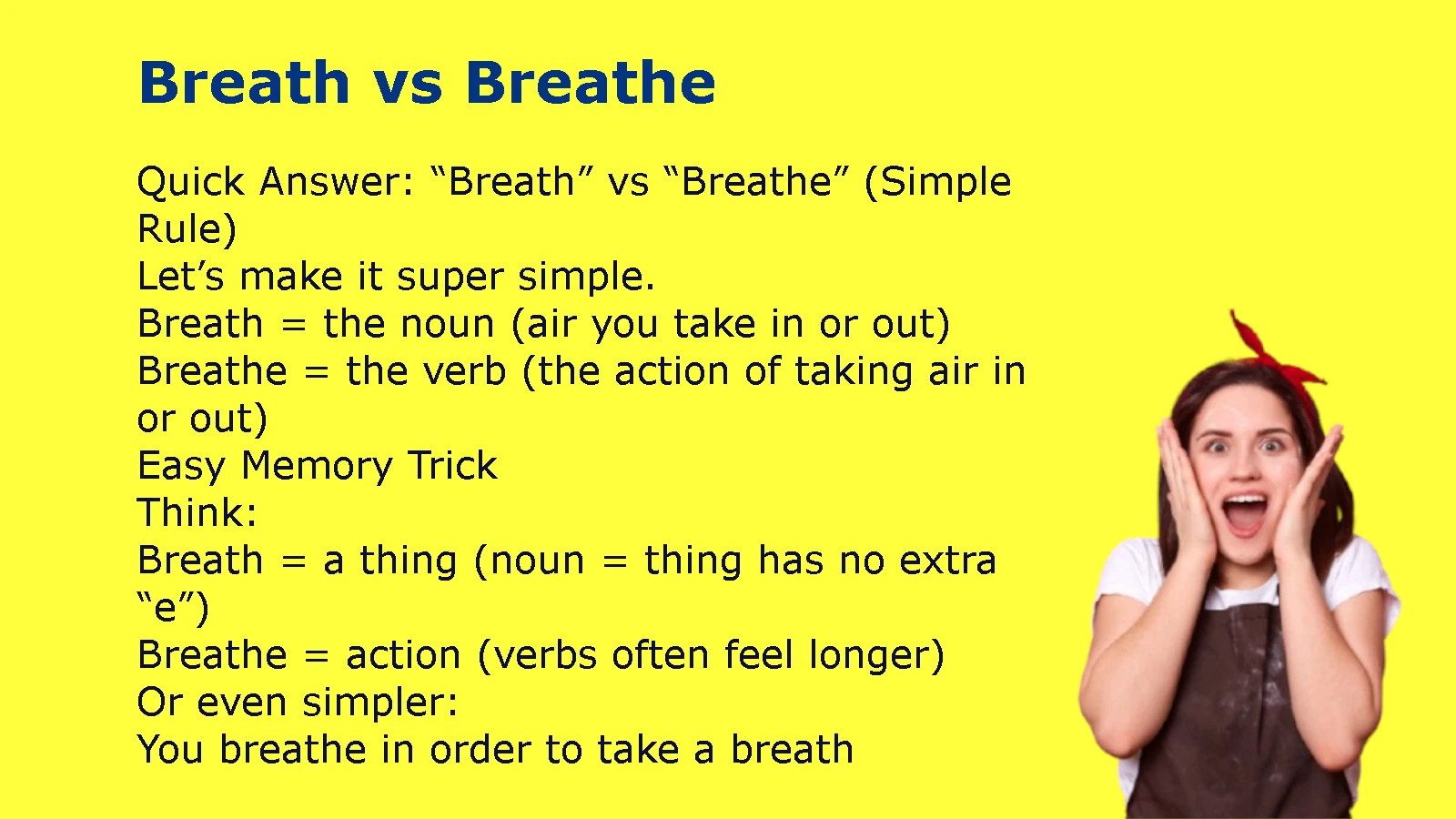
Quick Answer: “Breath” vs “Breathe” (Simple Rule)
Let’s make it super simple.
- Breath = the noun (air you take in or out)
- Breathe = the verb (the action of taking air in or out)
Easy Memory Trick
Think:
- Breath = a thing (noun = thing has no extra “e”)
- Breathe = action (verbs often feel longer)
Or even simpler:
You breathe in order to take a breath
Pronunciation: “Breath” vs “Breathe” (Simple Sound Difference)
One of the biggest reasons people confuse breath and breathe is pronunciation. They look similar, but the sound changes completely with just one letter.
Breath
- Pronounced: /breθ/
- Sound: short “e” (like “bread” without the “d”)
- Ending sound: soft “th”
👉 Example:
- “Take a deep breath.”
Breathe
- Pronounced: /briːð/
- Sound: long “ee” (like “see”)
- Ending sound: voiced “th” (softer and vibrating)
👉 Example:
- “Just breathe slowly.”
Quick Sound Trick
- Breath = short sound (quick, one-time air)
- Breathe = long sound (ongoing action)
If you stretch the sound, it becomes the verb:
breathee → action
Why “Breath” vs “Breathe” Is So Confusing
Here’s the real reason people mix them up.
They look almost identical—but behave differently.
The Hidden Problem
- Only one letter changes: “e”
- Pronunciation also changes slightly
- Both are used in the same topic (air, life, health)
So your brain blends them together.
Real-life confusion
- “Take a deep breathe” ❌ (wrong spelling)
- “Just breath” ❌ (wrong form)
Even native speakers sometimes slip in fast typing.
Grammar Logic Behind “Breath” vs “Breathe”
Let’s break it down simply.
Think in Terms of Word Type
- Breath → noun (a thing you can count or take)
- Breathe → verb (an action you do)
Simple Pattern
- Noun = shorter word → breath
- Verb = longer word → breathe
This pattern helps you remember instantly.
“Breath” Explained Clearly (With Edge Cases)
At its core, breath is the air you take in or release.
Standard Meaning
- A single inhale or exhale of air
Common Examples
- “Take a deep breath.”
- “Hold your breath.”
- “My breath was shaky.”
Important Insight
You can count breaths:
- One breath
- Two breaths
- Several breaths
That’s why it’s a noun.
“Breathe” Explained Clearly (With Edge Cases)
Now let’s look at the action word.
Standard Meaning
Breathe = to take air in and out of your lungs
Common Examples
- “Just breathe slowly.”
- “I can’t breathe properly.”
- “She breathes deeply during meditation.”
Verb Forms
- breathe (base)
- breathes (he/she/it)
- breathing (continuous)
- breathed (past)
Key Insight
If it’s something you do, it’s breathe.
The Biggest Mistake People Make
Here’s where most learners go wrong.
They focus on spelling instead of function.
What goes wrong
- Treating both words as interchangeable
- Writing “breathe” when a noun is needed
- Writing “breath” when a verb is needed
Real Scenario
“I need a deep breathe.”
❌ Wrong
Why? Because you don’t “need” an action—you need a thing (a breath).
Correct:
✔ “I need a deep breath.”
Side-by-Side Comparison Table
| Word | Type | Meaning | Example |
| Breath | Noun | Air taken in/out | Take a breath |
| Breathe | Verb | To take air in/out | Breathe slowly |
Real-Life Examples of “Breath”
Let’s ground it in real situations.
Common Usage
- “He took a deep breath before speaking.”
- “Her breath smelled like coffee.”
- “Give me a breath of fresh air.”
Mini Scenario
You’re nervous before a presentation:
You take a deep breath… and start speaking.
Real-Life Examples of “Breathe”
Now the action form.
Common Usage
- “Breathe slowly and relax.”
- “I can’t breathe in this room.”
- “She breathes through her nose while sleeping.”
Mini Scenario
You’re stressed:
Your friend says, “Just breathe. Everything will be fine.”
Why This Confusion Happens in Real Life
English pronunciation makes things harder.
- “breath” → short “e” sound
- “breathe” → long “ee” sound
But in fast speech, they can sound similar.
Typing problem
People rely on sound instead of spelling → mistakes happen.
How to Avoid Mistakes Every Time
Here’s your simple system.
Step 1: Ask yourself
- Is it a thing? → breath
- Is it an action? → breathe
2: Use the rule
- If you can “take it” → breath
- If you can “do it” → breathe
3: Quick check
Try adding “a” or “the”
- “a breath” ✔ correct
- “a breathe” ❌ wrong
What to Say Instead (Clear Usage Tips)
If you’re unsure, slow down and think:
Safer phrases
- “Take a deep breath”
- “Try to breathe slowly”
- “Control your breathing”
Professional writing tip
When writing formally:
- Always double-check spelling of “breathe”
Quick Decision Guide
Use this instantly:
- Thing (air) → breath
- Action (inhale/exhale) → breathe
- Still unsure → test “a/the” trick
Simple. Reliable. Done.
FAQ: “Breath” vs “Breathe”
Is “breathe” a noun or verb?
Verb only.
What is the noun form of breathe?
Breath.
Why do they look so similar?
Because English keeps related words close in spelling.
What is breathing?
The continuous action of taking air in and out.
Key Facts You Should Remember
- Breath = noun (thing)
- Breathe = verb (action)
- Only one letter changes, but meaning changes completely
- Context decides everything
Final Takeaway: The One Rule That Never Fails
Here’s the truth.
English confuses learners because small spelling changes carry big meaning shifts.
So keep it simple:
- If you can do it → breathe
- If you can take it → breath
Think of it like this:
You don’t “breathe a breathe.”
You “breathe” to take a “breath.”
And once you see that pattern clearly, you’ll never confuse them again.
Because in “breath” vs “breathe,” clarity always wins over guesswork.