Have you ever wondered whether “loose vs lose” is just a spelling mistake or two completely different words in English? This is one of the most common confusions in everyday writing and speech, especially among learners who often struggle with similar-looking English words in sentences, exams, and professional communication.
In simple terms, loose vs lose meaning is completely different. The word “loose” means something is not tight, fixed, or firmly attached—for example, loose clothes, loose screws, or loose hair. On the other hand, “lose” means to fail to keep something, misplace it, or not win a game, such as losing money, losing a match, or losing your keys. This clear difference makes loose vs lose definition very important for correct grammar usage and accurate writing.
This confusion becomes even more common in everyday situations like loose vs lose weight, where many people mistakenly write “loose weight” instead of “lose weight.” One small spelling change completely changes the meaning, turning a correct sentence into a grammar mistake.
If you’ve ever paused while writing sentences like “Don’t lose your phone” or “These pants feel loose,” you’re not alone. This is one of those tricky English pairs where pronunciation is similar, but meaning and usage are totally different.
In this guide, you’ll learn the full difference between loose vs lose, their meanings, definitions, real-life examples, and easy memory tricks so you never confuse them again in writing or conversation.
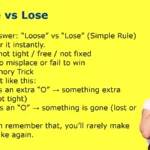
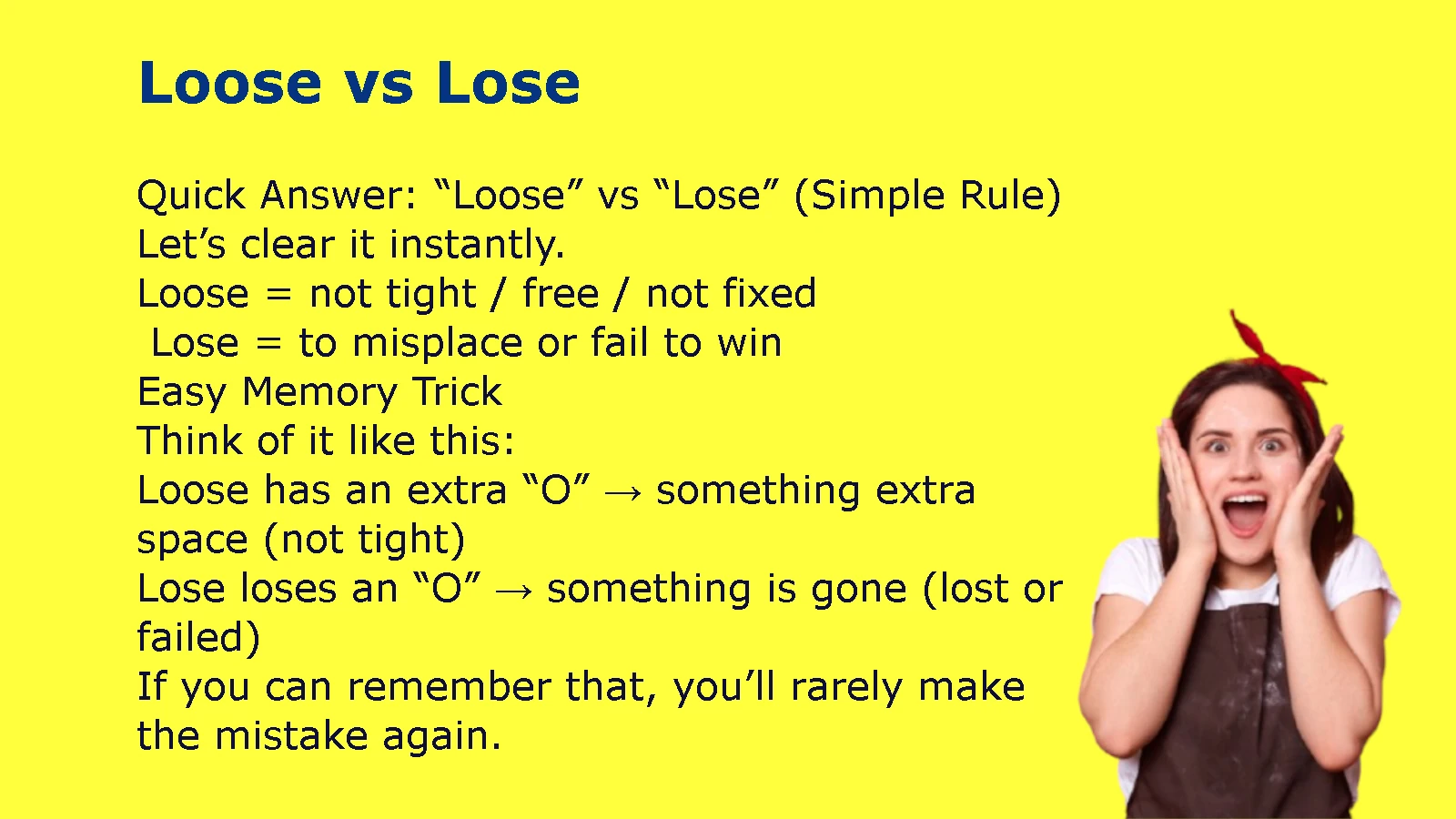
Quick Answer: “Loose” vs “Lose” (Simple Rule)
Let’s clear it instantly.
Loose = not tight / free / not fixed
Lose = to misplace or fail to win
Easy Memory Trick
Think of it like this:
- Loose has an extra “O” → something extra space (not tight)
- Lose loses an “O” → something is gone (lost or failed)
If you can remember that, you’ll rarely make the mistake again.
Why People Confuse “Loose” and “Lose”
This confusion is extremely common because:
- They look similar in writing
- They sound slightly similar in fast speech
- Auto-correct doesn’t always help
- People rely on intuition instead of meaning
But meaning is the key—once you lock that in, spelling becomes easy.
“Loose” Explained Clearly (Meaning + Usage)
The word “loose” is usually an adjective.
It means something is not tight, not fixed, or free to move.
Core Meanings of “Loose”
1. Not Tight
- My shirt is too loose
- The screw is loose
2. Free or Not Controlled
- The dog is loose in the yard
- He let the balloons go loose
3. Not Attached or Fixed
- A loose wire caused the issue
- One tooth is loose
Edge Case Confusion
People sometimes use “loose” incorrectly when they mean “lose.”
Example:
❌ I don’t want to loose the match
✔ I don’t want to lose the match
“Lose” Explained Clearly (Meaning + Usage)
The word “lose” is a verb.
It means to misplace something, fail to keep something, or not win.
Core Meanings of “Lose”
1. Not Winning
- We might lose the game
- Don’t lose the competition
2. Misplacing Something
- I always lose my keys
- Don’t lose your phone
3. Losing Something Abstract
- Try not to lose hope
- He didn’t want to lose confidence
Common Mistake Example
❌ I will loose weight
✔ I will lose weight
This is one of the most searched grammar errors online.
The Biggest Mistake People Make
Here’s the real issue:
People confuse spelling with sound, not meaning.
Both words sound similar in fast speech, so learners assume they are variations of the same word.
But they are completely different words with different jobs:
- Loose = describes condition
- Lose = describes action
Real-Life Scenario (Case Study)
A student writes:
“If I don’t study, I will loose my scholarship.”
What happens?
- Teacher marks it wrong
- Meaning confusion arises
- It changes credibility of writing
Correct version:
“If I don’t study, I will lose my scholarship.”
One letter completely changes correctness.
Side-by-Side Comparison Table
| Word | Type | Meaning | Example |
| Loose | Adjective | Not tight / free / not fixed | My belt is loose |
| Lose | Verb | To misplace or fail to win | I don’t want to lose |
Real-Life Examples of “Loose”
Let’s ground it in daily usage.
- The lid is loose
- My shoes feel loose
- A loose cable caused the fault
- The shirt is too loose on me
👉 Think: space, freedom, not tight
Real-Life Examples of “Lose”
Now compare.
- Don’t lose your wallet
- We might lose the match
- Try not to lose focus
- I always lose my pen
👉 Think: missing, failing, gone
Quick Memory Tricks That Actually Work
Trick 1: Extra “O”
- Loose = more space (extra O)
2: Missing “O”
- Lose = something is missing (lost O)
3: Sound Hint
- “Loose” = long “oo” sound
- “Lose” = short “ooz” sound
Why This Mistake Matters More Than You Think
This isn’t just grammar—it affects:
- Academic writing
- Professional emails
- Job applications
- Online communication credibility
One small spelling error can change how polished your writing looks.
How to Never Confuse Them Again
Use this 3-step system:
Step 1: Identify meaning
- Tight/free? → Loose
- Misplace/fail? → Lose
2: Check word type
- Adjective → Loose
- Verb → Lose
3: Double-check the sentence
If it involves action → it’s almost always lose
Quick Decision Guide (Use Instantly)
- Something not tight → Loose
- Something lost or failed → Lose
- Still unsure → replace sentence mentally with “misplace” or “not tight”
FAQ: Loose vs Lose
Is “loose” ever a verb?
No. “Loose” is almost always an adjective.
Why do people say “loose weight”?
Because of pronunciation confusion. Correct form is lose weight.
Do they sound the same?
Almost—but not exactly. “Loose” has a longer “oo” sound.
What is the easiest way to remember?
Loose = extra O
Lose = missing O
Final Takeaway: The One Rule That Never Fails
Here’s the simplest way to lock it in forever:
- If something is not tight → Loose
- If something is gone or failed → Lose
And if it still feels confusing, pause and think:
👉 “Am I talking about condition or action?”
Because in the battle of “Loose vs Lose,” clarity always wins over guessing.