Have you ever stopped while writing and wondered whether moral or morale are the same word with different spellings or two entirely different terms? You’re not alone. The confusion between moral vs. morale is common because the words look and sound similar, yet they have completely different meanings and are used in very different contexts. Understanding the difference between moral and morale is essential for improving your English vocabulary, grammar accuracy, and confidence in both writing and conversation.
In simple terms, moral refers to principles of right and wrong, ethical behavior, or the lesson learned from a story. It is commonly used when discussing values, character, honesty, and decision-making. By contrast, morale describes the confidence, enthusiasm, or emotional well-being of a person or group, especially in workplaces, schools, sports teams, or the military. Knowing the distinction between moral and morale helps you communicate more clearly and avoid one of the most frequently confused word pairs in English.
Many English learners search for moral meaning, morale meaning, moral definition, morale definition, moral vs morale difference, and morale vs moral because a single missing letter completely changes the meaning of the word. While moral is connected to ethics and personal values, morale is associated with motivation, confidence, and team spirit. Recognizing these differences will strengthen your understanding of English word usage and prevent common spelling mistakes.
In this guide, you’ll learn the difference between moral and morale, explore their meanings and definitions, see real-life examples, understand the grammar behind each word, and discover simple memory tricks that will help you choose the correct word every time.
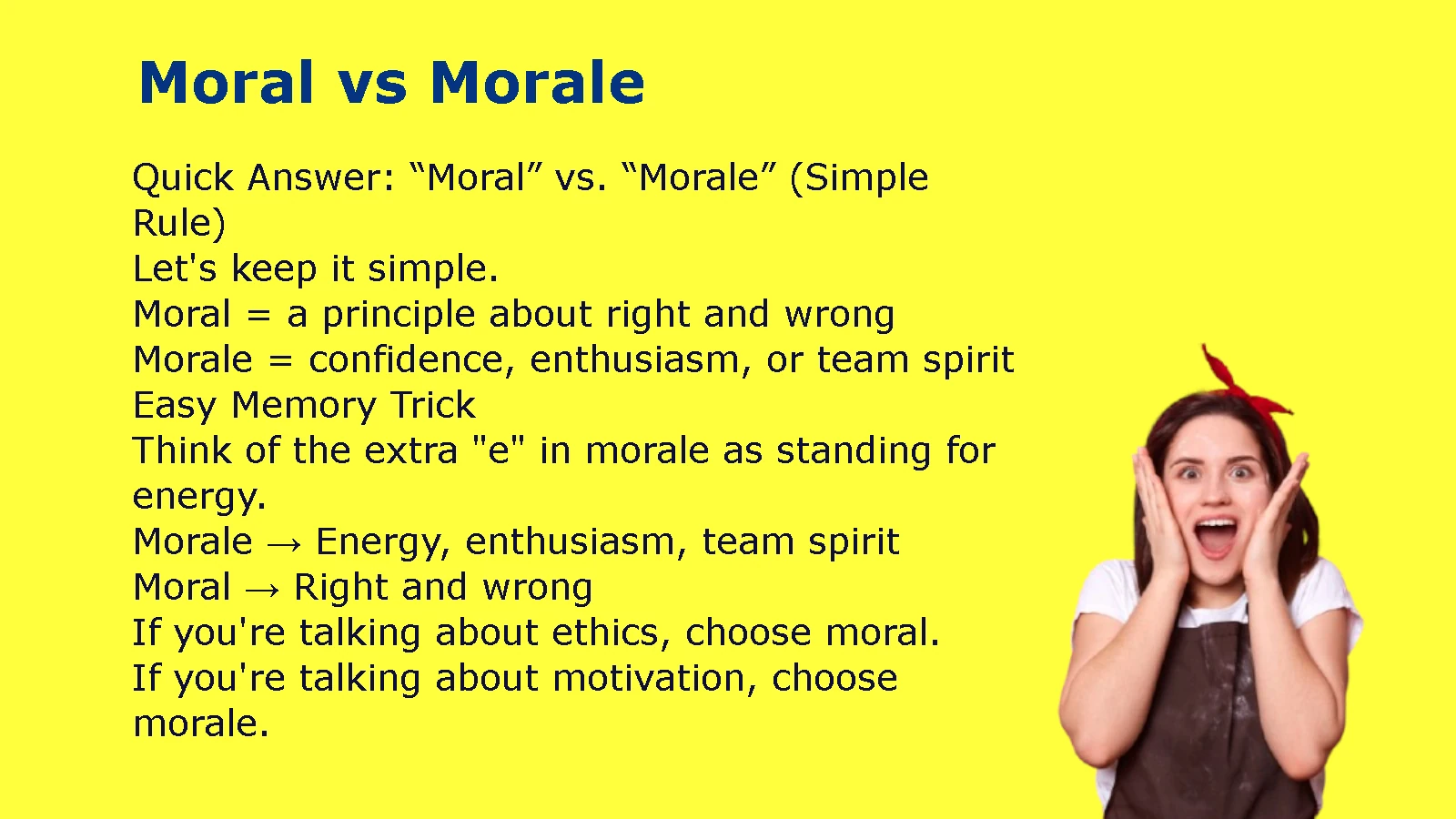
Quick Answer: “Moral” vs. “Morale” (Simple Rule)
Let’s keep it simple.
Moral = a principle about right and wrong
Morale = confidence, enthusiasm, or team spirit
Easy Memory Trick
Think of the extra “e” in morale as standing for energy.
- Morale → Energy, enthusiasm, team spirit
- Moral → Right and wrong
If you’re talking about ethics, choose moral.
If you’re talking about motivation, choose morale.
What Does “Moral” Mean?
A moral is a lesson, principle, or belief about what is right and wrong.
It often refers to ethics, values, honesty, fairness, and good behavior.
Common Uses
- Moral values
- Moral responsibility
- Moral decision
- Moral obligation
- Moral lesson
Examples
- Always tell the truth because it’s the moral thing to do.
- She faced a difficult moral dilemma.
- Respecting others is an important moral value.
- The story teaches an important moral lesson.
Key Insight
Whenever you’re discussing ethics or right versus wrong, the correct word is moral.
What Does “Morale” Mean?
Morale refers to the level of confidence, motivation, optimism, or enthusiasm within a person or a group.
It’s commonly used in workplaces, schools, sports teams, and the military.
Common Uses
- Team morale
- Employee morale
- Staff morale
- High morale
- Low morale
Examples
- The manager organized a celebration to improve employee morale.
- Winning the championship boosted the team’s morale.
- Poor communication can lower workplace morale.
- Good leadership helps maintain high morale.
Key Insight
Whenever you’re talking about motivation or team spirit, use morale.
The Core Difference Between “Moral” and “Morale”
Although the words look similar, they belong to completely different ideas.
| Word | Meaning | Think About |
| Moral | Right and wrong; ethical principles | Ethics, values |
| Morale | Confidence and enthusiasm | Motivation, team spirit |
Simple Comparison
Moral asks:
Is this the right thing to do?
Morale asks:
How motivated or confident are people?
Why People Confuse “Moral” and “Morale”
The confusion comes from several reasons.
They Look Nearly Identical
Only one extra letter separates them.
- Moral
- Morale
Many writers accidentally leave out the final e.
They Sound Similar
In fast speech, the pronunciation is close enough that many learners mix them up.
Spell Check Doesn’t Always Help
Both are real English words.
If you write:
Team moral is high.
Spell check may not flag it because moral is spelled correctly—even though it’s the wrong word.
“Moral” Explained with Real Examples
Let’s see how moral works in everyday English.
Ethics
- It’s our moral duty to help those in need.
- Honesty is a strong moral principle.
Stories
Many children’s stories end with a moral.
Example:
The moral of the story is that kindness is always rewarded.
Difficult Decisions
- Doctors sometimes face difficult moral questions.
- Leaders often make moral choices that affect many people.
Key Takeaway
If the sentence involves ethics, values, responsibility, or lessons, choose moral.
“Morale” Explained with Real Examples
Now let’s look at morale.
Workplace
- Employee morale improved after salaries increased.
- A supportive manager boosts office morale.
Sports
- The captain’s speech lifted the team’s morale.
- Losing several games hurt player morale.
School
- Fun activities improve classroom morale.
- Encouragement keeps student morale high.
Key Takeaway
If you’re discussing confidence, motivation, or enthusiasm, use morale.
Common Mistakes People Make
Here are the mistakes you should avoid.
Incorrect
❌ Employee moral is improving.
Correct
✅ Employee morale is improving.
Incorrect
❌ The moral of the workers is very high.
Correct
✅ The morale of the workers is very high.
Incorrect
❌ The story teaches good morale.
Correct
✅ The story teaches a good moral.
Side-by-Side Comparison Table
| Feature | Moral | Morale |
| Meaning | Ethics and right vs. wrong | Confidence and enthusiasm |
| Part of Speech | Noun, adjective | Noun |
| Common With | Values, lessons, principles | Teams, employees, soldiers |
| Refers To | Character | Motivation |
| Example | A moral lesson | High team morale |
Real-Life Examples of “Moral”
Here are common situations.
In School
“The teacher explained the moral of the story.”
At Home
“My parents taught me strong moral values.”
At Work
“It became a moral responsibility to report the problem.”
In Society
“Respect and honesty are important moral principles.”
Real-Life Examples of “Morale”
Now compare them.
Office
“The company introduced flexible hours to improve employee morale.”
Sports Team
“Winning three matches in a row increased team morale.”
Military
“The commander’s speech raised troop morale.”
School
“Teachers organized games to boost classroom morale.”
Easy Memory Tricks
Need a quick way to remember?
Moral = Morality
Both begin with Moral.
Think:
Moral → Morality → Right and wrong
Morale = Energy
The extra E reminds you of:
- Energy
- Enthusiasm
- Encouragement
These all describe morale.
How to Avoid Confusing Them Every Time
Use these simple checks.
Ask Yourself
Am I talking about ethics?
Use moral.
Am I talking about motivation?
Use morale.
Look at Nearby Words
If you see words like:
- ethics
- honesty
- values
- responsibility
Choose moral.
If you see:
- team
- employees
- motivation
- confidence
- spirit
Choose morale.
What to Say Instead (Helpful Alternatives)
If you’re unsure, these alternatives can help.
Instead of Moral
Use:
- ethical
- principled
- righteous
- virtuous
- honorable
Instead of Morale
Use:
- confidence
- motivation
- team spirit
- enthusiasm
- optimism
Quick Decision Guide (Use This Instantly)
When you’re deciding which word fits, remember this:
Right and wrong? → Moral
Confidence and motivation? → Morale
Still unsure?
Replace:
Morale with team spirit.
If the sentence still makes sense, you’ve chosen correctly.
FAQ: “Moral” vs. “Morale”
Is morale the same as moral?
No. Moral relates to ethics and right versus wrong, while morale refers to confidence, enthusiasm, or motivation.
Can moral be an adjective?
Yes.
Example:
“The company has a moral obligation to protect customer data.”
Is morale always about groups?
Usually, but not always. It often describes the confidence of a team, organization, or military unit, though it can also refer to an individual’s spirit.
Why do people confuse these words?
Because they’re spelled similarly, sound alike, and both are common English words.
Case Study: A Workplace Email Mistake
A company manager sent this message:
“We’re working hard to improve employee moral.”
The employees understood the message, but several noticed the spelling mistake.
What the manager actually meant was:
“We’re working hard to improve employee morale.”
Although only one letter was missing, the meaning changed from employee motivation to employee ethics.
After correcting the email, the message became clear and professional.
Key Facts You Should Remember
- Moral relates to ethics and right versus wrong.
- Morale means confidence, enthusiasm, or team spirit.
- The extra E in morale can remind you of energy.
- Moral can be both a noun and an adjective.
- Morale is always a noun.
- One missing letter can completely change your meaning.
Final Takeaway: The One Rule That Never Fails
The difference between moral and morale is easier than it first appears.
If you’re discussing ethics, values, principles, or lessons, the correct word is moral.
If you’re talking about motivation, confidence, enthusiasm, or team spirit, the correct word is morale.
Whenever you’re in doubt, remember this simple rule:
Right and wrong → Moral
Energy and enthusiasm → Morale
That single extra “e” can make all the difference. Master this distinction once, and you’ll use moral and morale correctly in conversations, emails, schoolwork, and professional writing every time.