Have you ever paused while writing and wondered whether Bale vs Bail are just different spellings of the same word? Although they sound almost identical, Bale vs. Bail is a common source of confusion for English learners, writers, and even native speakers. Using the wrong word can completely change the meaning of a sentence, making it important to understand how each term is used in everyday English.
In simple terms, bale usually refers to a large bundle of materials such as hay, cotton, paper, or straw that has been tightly bound for storage or transportation. In contrast, bail has several different meanings. It commonly refers to money or security paid to secure someone’s temporary release from jail, removing water from a boat, or helping someone out of a difficult situation. Although the words share the same pronunciation, they belong to entirely different contexts and should never be used interchangeably.
Confusion between bale and bail often arises because they are homophones—words that sound alike but have different spellings and meanings. Whether you’re writing about farming, legal matters, boating, or everyday conversations, choosing the correct word improves your grammar, spelling, vocabulary, and overall communication skills. Understanding this distinction also helps you avoid one of the most common English word mix-ups.
If you’ve ever hesitated while writing a sentence like “The farmer loaded a bale of hay onto the truck” or “The judge granted bail after the hearing,” you’re not alone. A single letter makes these words look different, but their meanings are completely unrelated.
In this guide, you’ll learn the clear difference between bale and bail, their meanings, pronunciation, grammar, real-life examples, and simple memory tricks so you can use each word confidently in both writing and conversation.
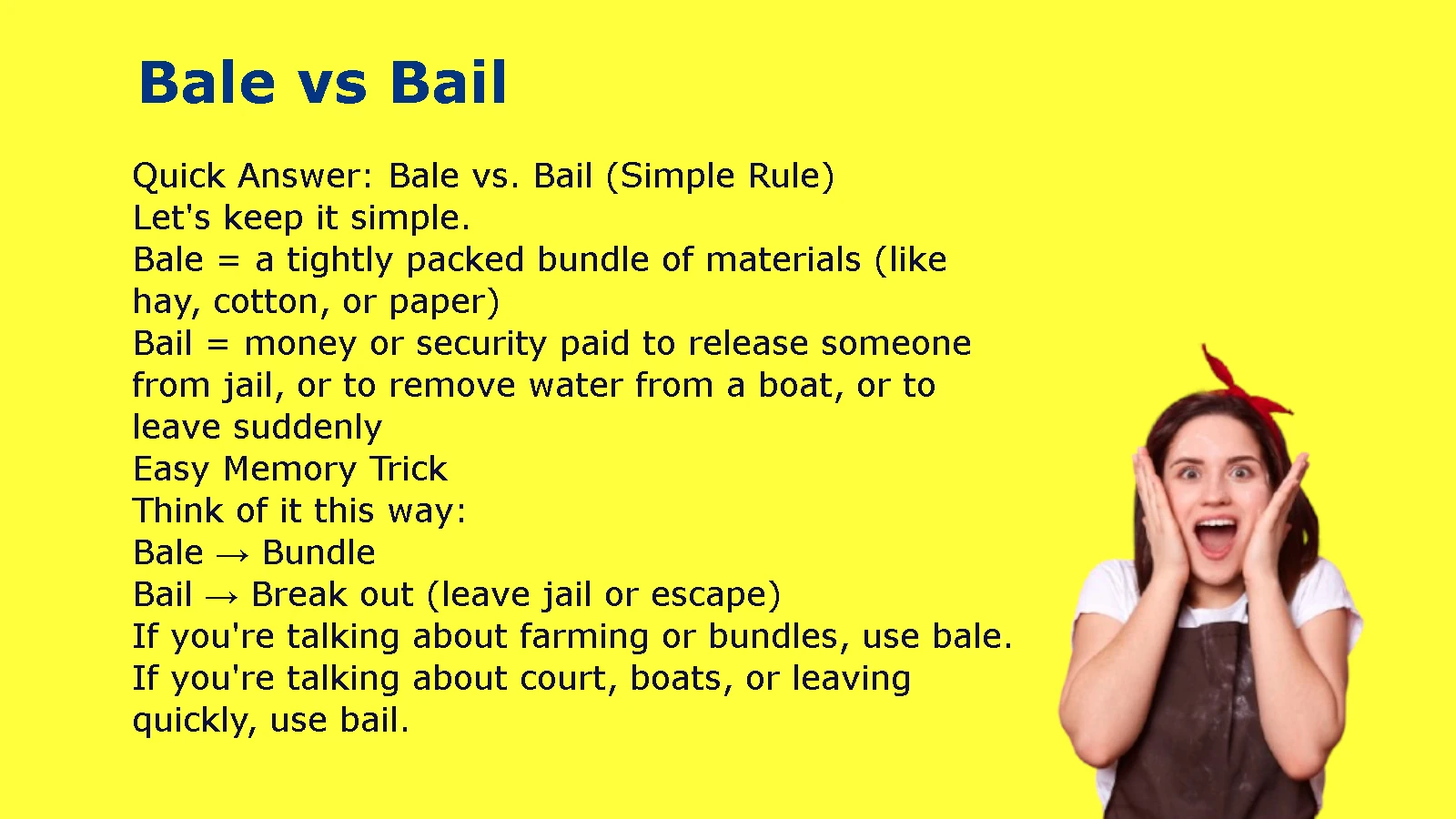
Quick Answer: Bale vs. Bail (Simple Rule)
Let’s keep it simple.
Bale = a tightly packed bundle of materials (like hay, cotton, or paper)
Bail = money or security paid to release someone from jail, or to remove water from a boat, or to leave suddenly
Easy Memory Trick
Think of it this way:
- Bale → Bundle
- Bail → Break out (leave jail or escape)
If you’re talking about farming or bundles, use bale.
If you’re talking about court, boats, or leaving quickly, use bail.
How People Actually Use “Bale” and “Bail”
Although the words sound identical, they’re used in very different conversations.
In Everyday Conversation
You’ll usually hear bail much more often.
Examples:
- “I had to bail on dinner.”
- “He was released on bail.”
Bale mostly appears when discussing farming, recycling, or packaging.
Example:
- “The tractor moved several bales of hay.”
Why People Confuse Them
The confusion comes from:
- Identical pronunciation
- Similar spelling
- Spell-check doesn’t always catch the mistake because both are real words
The Meaning Behind “Bale” vs. “Bail”
Here’s the easiest way to remember their meanings.
| Word | Meaning | Common Context |
| Bale | A tightly packed bundle | Farming, recycling, cotton |
| Bail | Release from jail, remove water, leave suddenly | Law, boating, everyday speech |
Key Insight
Bale is usually a noun.
Bail can be both a noun and a verb.
“Bale” Explained Clearly (With Examples)
A bale is a large bundle of something that’s tightly compressed and tied together.
Common Uses
Farmers create bales of hay.
Factories produce bales of cotton.
Recycling centers package cardboard into bales.
Examples
- The horses ate a bale of hay.
- Workers loaded cotton bales onto the truck.
- We sold several bales of recycled paper.
Key Takeaway
Whenever you’re talking about a bundle of materials, the correct word is bale.
“Bail” Explained Clearly (With Examples)
Bail has several meanings.
Meaning 1: Money Paid for Temporary Release
Example:
- She was released on bail.
Meaning 2: To Remove Water from a Boat
Example:
- We had to bail water out of the canoe.
Meaning 3: To Leave Suddenly
In informal English:
- I’m going to bail on the meeting.
- He bailed at the last minute.
Key Takeaway
Whenever the topic is courts, boats, or leaving unexpectedly, use bail.
The Biggest Mistake People Make
The most common mistake is writing bale when they mean bail, simply because the words sound alike.
Incorrect
“He couldn’t afford bale.”
Correct
“He couldn’t afford bail.”
Another common mistake:
Incorrect
“The farmer stacked twenty bails.”
Correct
“The farmer stacked twenty bales.”
Always think about the meaning before choosing the spelling.
Side-by-Side Comparison Table
| Feature | Bale | Bail |
| Pronunciation | Same | Same |
| Main Meaning | Bundle of materials | Release from jail, leave suddenly, remove water |
| Part of Speech | Mostly noun | Noun and verb |
| Common Topic | Farming | Law, boating, conversation |
| Common Mistake | Used instead of bail | Used instead of bale |
Real-Life Examples of “Bale”
Let’s look at how bale appears in everyday writing.
Common Sentences
- The farmer stored fifty bales of hay.
- Cotton bales were shipped overseas.
- The warehouse contained hundreds of paper bales.
- They purchased a bale of straw.
Mini Scenario
A farmer finishes harvesting and compresses the hay into large bundles.
Those bundles are called bales.
Real-Life Examples of “Bail”
Now compare that with bail.
Common Sentences
- His family paid his bail.
- The judge denied bail.
- We had to bail water from the boat.
- Sarah decided to bail on the party.
Mini Scenario
A friend texts:
“Sorry, I have to bail tonight.”
They’re not talking about farming—they’re saying they can’t come.
Common Expressions Using “Bail”
You’ll hear bail in several common English expressions.
Bail out
- The government bailed out struggling banks.
- Can you bail me out of this situation?
Jump bail
This means leaving after being released from jail without appearing in court.
Example:
- The suspect jumped bail.
Notice that bale isn’t used in these expressions.
How to Avoid Confusion Every Time
Here are three easy strategies.
Think About the Topic
Farming?
→ Bale
Court?
→ Bail
Leaving suddenly?
→ Bail
Remember the Memory Trick
Bale = Bundle
Bail = Break out
Read the Sentence Again
Ask yourself:
“Does this sentence talk about bundles or leaving?”
The answer tells you which spelling is correct.
What to Say Instead (When You’re Unsure)
If you’re worried about choosing the wrong word, rewrite the sentence.
Instead of:
“He posted bail.”
You could say:
“He paid money to be released from jail.”
Instead of:
“A bale of hay.”
You could write:
“A large bundle of hay.”
Sometimes rewording improves clarity.
Quick Decision Guide (Use This Instantly)
If the sentence mentions…
- Hay, cotton, straw, paper → Bale
- Court or jail → Bail
- Boat water → Bail
- Canceling plans → Bail
Still unsure?
Think:
Bundle = Bale
Everything else above = Bail
FAQ: Bale vs. Bail
Is it “bale of hay” or “bail of hay”?
The correct phrase is bale of hay because a bale is a tightly packed bundle.
What does “pay bail” mean?
It means paying money or providing security so someone can leave jail while waiting for court.
Can “bail” be a verb?
Yes. It can mean to leave suddenly, remove water from a boat, or help someone out of a difficult situation.
Are bale and bail pronounced the same?
Yes. They are homophones, meaning they have the same pronunciation but different meanings and spellings.
Case Study: A Costly Writing Mistake
A local newspaper published this headline:
“Farmer stores 5,000 bails of hay.”
Readers quickly noticed the error.
Why?
A bail is related to courts or leaving—not farming.
The editor later corrected it to:
“Farmer stores 5,000 bales of hay.”
One letter completely changed the meaning and credibility of the article.
Key Facts You Should Remember
- Bale means a tightly packed bundle.
- Bail usually relates to court, boats, or leaving suddenly.
- Both words sound exactly alike.
- Bail is commonly used as both a noun and a verb.
- Bale is mostly used as a noun in farming and packaging.
- Context is the easiest way to choose the correct spelling.
Final Takeaway: The One Rule That Never Fails
The difference between bale and bail is simple once you connect each word to its meaning.
If you’re talking about a bundle of hay, cotton, paper, or straw, choose bale.
If you’re talking about getting out of jail, removing water from a boat, or canceling plans, choose bail.
When in doubt, remember this simple rule:
Bundle → Bale
Court, boats, or leaving → Bail
One small spelling difference can completely change your sentence, so take a moment to think about the context. With that simple habit, you’ll use bale vs. bail correctly every time.