Have you ever stopped while writing and wondered whether the correct word is passed or past? If so, you’re not alone. The confusion between past vs passed is one of the most common grammar challenges in English because the two words sound alike but serve completely different purposes. Understanding the difference between passed and past will help you write more accurately, avoid common mistakes, and communicate with confidence.
To understand the distinction, it helps to know the passed meaning and past meaning first. Passed is the past tense of the verb pass and describes an action that has already happened, such as passing an exam, passing a ball, or passing by a building. Past, however, usually refers to a previous time or something beyond a particular place, although it can also function as an adjective, adverb, noun, or preposition. Learning the passed definition and past definition makes it much easier to recognize which word belongs in a sentence.
Many learners also struggle with when to use passed and when to use past, especially because a single letter changes both the grammar and the meaning. For example, “She passed the driving test” uses a verb to describe a completed action, while “She walked past the school” uses a preposition to describe movement beyond a place. Looking at a passed in a sentence example alongside a past in a sentence example is one of the easiest ways to remember the difference.
In this guide, you’ll master passed vs past grammar with clear explanations, practical examples, and easy memory tips. By the end, you’ll know exactly when to use each word and avoid confusing passed and past in both writing and everyday conversation.
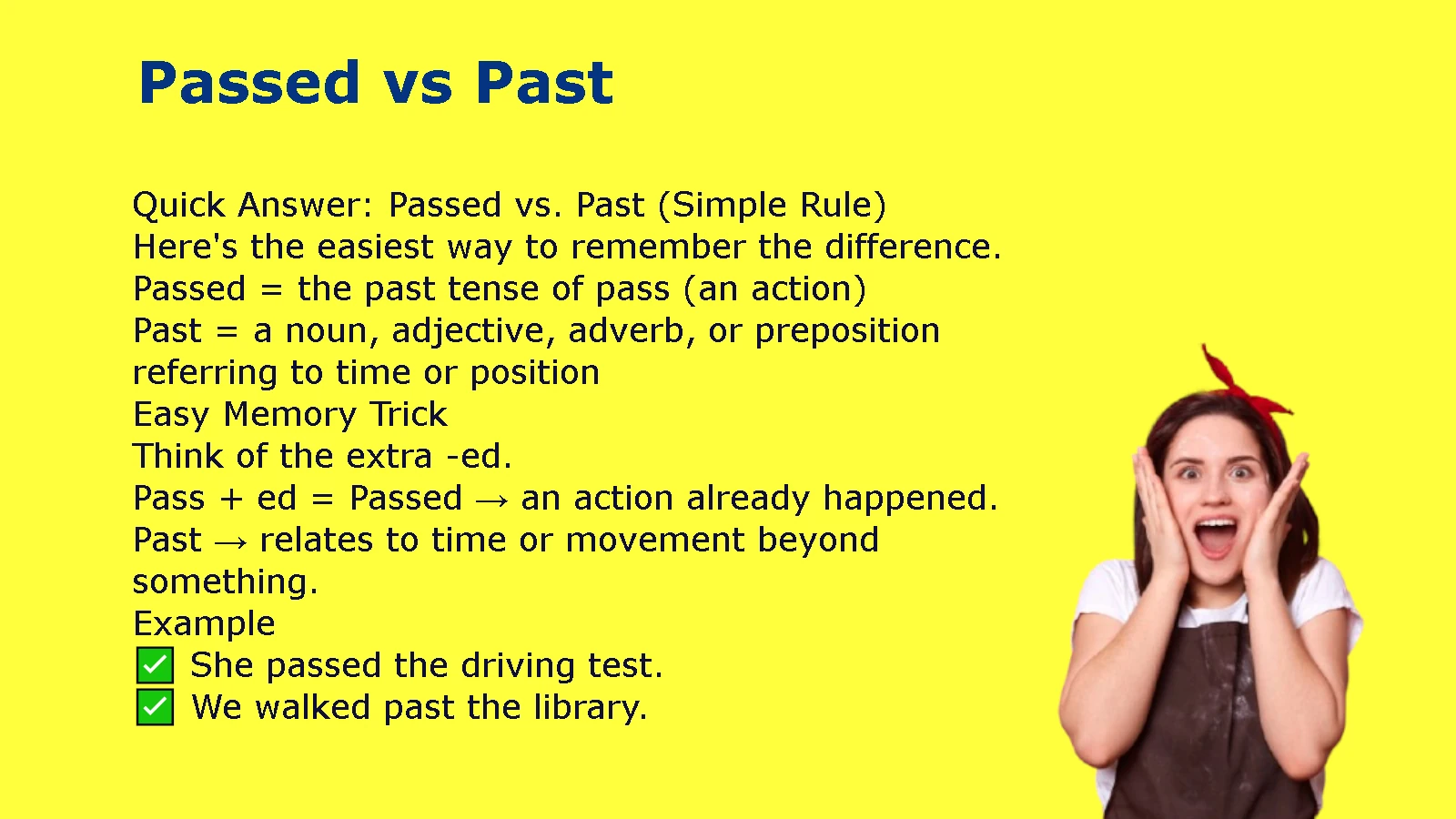
Quick Answer: Passed vs. Past (Simple Rule)
Here’s the easiest way to remember the difference.
Passed = the past tense of pass (an action)
Past = a noun, adjective, adverb, or preposition referring to time or position
Easy Memory Trick
Think of the extra -ed.
- Pass + ed = Passed → an action already happened.
- Past → relates to time or movement beyond something.
Example
✅ She passed the driving test.
✅ We walked past the library.
How People Actually Use “Passed” and “Past”
This is where many learners get confused.
Since both words are pronounced similarly, people often choose the wrong spelling without realizing it.
In Everyday Conversations
People usually say:
“I passed your house.”
“We drove past the park.”
Because the pronunciation is nearly identical, spelling mistakes are extremely common.
In Writing
Most errors happen because writers remember the sound rather than the meaning.
Examples of common mistakes:
❌ I past my math exam.
❌ He passed the museum without stopping.
Why This Happens
- They sound almost identical.
- One is a verb.
- The other serves several different grammar roles.
- Spell check doesn’t always catch the mistake because both are real words.
The Grammar Behind Passed vs. Past
The easiest way to understand the difference is to ask one question.
Is it an action?
If yes, use passed.
Example:
She passed the ball.
Is it talking about time or location?
If yes, use past.
Examples:
The meeting is in the past.
We walked past the school.
Key Insight
Passed always describes something someone did.
Past usually describes where or when something is.
Passed Explained Clearly (With Examples)
Passed is the past tense and past participle of the verb pass.
It always shows that an action has already happened.
Common Uses
Passing a Test
I passed my English exam.
She finally passed her driving test.
Moving Beyond Something
The train passed the station.
The car passed us on the highway.
Giving Something
He passed me the salt.
She passed the note to her friend.
Dying (Polite Expression)
His grandfather passed away peacefully.
Past Explained Clearly (With Examples)
Unlike passed, past isn’t a verb.
It can be several different parts of speech.
As a Preposition
We walked past the hospital.
She drove past my house.
As an Adjective
The past year has been exciting.
Learn from past mistakes.
As a Noun
Forget the past.
The past shapes our future.
As an Adverb
The runner sped past.
Time flew past quickly.
Key Insight
If the word isn’t describing an action, it’s probably past.
The Biggest Mistake People Make
The biggest mistake is using past when they actually need the verb passed.
Incorrect
I past the interview.
Correct
I passed the interview.
Another common mistake is the opposite.
Incorrect
We passed the library.
(when you mean you walked beyond it)
Correct
We walked past the library.
Side-by-Side Comparison Table
| Word | Meaning | Part of Speech | Example |
| Passed | Completed an action of passing | Verb | She passed the exam. |
| Past | Time gone by or beyond something | Noun, adjective, adverb, preposition | We walked past the park. |
Real-Life Examples of Passed
Here are some everyday examples.
School
“I passed my chemistry test.”
Sports
“He passed the ball to his teammate.”
Driving
“We passed three trucks on the highway.”
Work
“She passed the interview.”
Family
“My grandfather passed away last year.”
Real-Life Examples of Past
Now compare these.
Time
The past cannot be changed.
Location
Walk past the bank.
Direction
Drive past the traffic lights.
History
People often learn from the past.
Everyday Conversation
It’s ten minutes past five.
Common Expressions Using Past
Many English expressions use past, not passed.
Examples include:
- Past midnight
- Past experience
- Past few days
- Past tense
- Half past six
- Beyond the past
- Looking to the past
Remember, none of these use passed.
How to Avoid Confusion Every Time
Follow these three simple steps.
Step 1
Ask:
Is someone doing an action?
If yes → passed
Step 2
Ask:
Is this about time or location?
If yes → past
Step 3
Replace the word with went by.
If it still makes sense as an action, choose passed.
What to Say Instead (When You’re Unsure)
If you’re editing your writing, try replacing the sentence.
Instead of wondering,
“I ___ the store.”
Think:
“I went past the store.”
Now it’s obvious:
“We passed the store.”
Or
“We walked past the store.”
Quick Decision Guide (Use This Instantly)
Need a verb?
→ Passed
Talking about time?
→ Past
Talking about moving beyond something?
→ Past
Talking about completing an action?
→ Passed
Simple. Reliable. Done.
FAQ: Passed vs. Past
Is it “passed away” or “past away”?
Always say passed away.
It comes from the verb pass.
Is it “walked past” or “walked passed”?
Use walked past.
Here, past shows direction.
Is it “passed the exam” or “past the exam”?
The correct phrase is passed the exam.
Passing an exam is an action.
Why do people confuse these words?
Because they sound almost identical in spoken English, even though they have different meanings and grammar.
Can past ever be a verb?
No.
Only pass is a verb.
Its past tense is passed.
Case Study: One Small Spelling Mistake, One Big Impression
A university student emailed a professor:
“I past all my final exams.”
The professor understood the meaning, but the spelling mistake made the email appear less polished.
The corrected version read:
“I passed all my final exams.”
A single letter changed the sentence from incorrect to grammatically accurate.
The lesson? Even small word choices can influence how professional your writing appears.
Key Facts You Should Remember
- Passed is the past tense of pass.
- Past refers to time, direction, or position.
- Passed is always a verb.
- Past can be a noun, adjective, adverb, or preposition.
- They sound alike but have different meanings.
- Ask whether you’re describing an action or time/location.
Final Takeaway: The One Rule That Never Fails
Here’s the easiest rule to remember.
If someone did something, use passed.
If you’re talking about time, history, or moving beyond something, use past.
When in doubt, ask yourself one question:
“Is this an action or a description of time or place?”
If it’s an action, choose passed.
If it’s about time or position, choose past.
That simple habit will help you avoid one of English’s most common spelling mistakes. And once you master passed vs. past, your writing becomes clearer, more accurate, and more professional every time.