Have you ever noticed how easily people mix up words like passed or past, or similar confusing pairs like immigrate vs emigrate? English is full of such tricky word combinations where a single letter or a small shift in perspective completely changes the meaning. One of the most commonly confused pairs in this category is immigrate vs emigrate, and understanding the difference between immigrate and emigrate is essential for clear and accurate communication.
In simple terms, immigrate means to move into a new country to live there permanently. It focuses on the destination. For example, someone immigrates to Canada or the United States when they move there from another country. On the other hand, emigrate means to leave your own country to live somewhere else. It focuses on the origin. So, a person emigrates from Pakistan when they move out to settle abroad. Although both words describe the same movement, the perspective changes the correct usage.
Many learners search for immigrate meaning, emigrate meaning, immigrate definition, emigrate definition, when to use immigrate, when to use emigrate, and difference between immigrate and emigrate because the distinction is subtle but very important in grammar and writing. Just like confusing pairs such as passed or past, this pair often leads to mistakes in both academic and everyday English.
For example, you can say, “My family immigrated to Australia in 2010,” focusing on the new country, or “My grandparents emigrated from India many years ago,” focusing on the country they left. These small shifts in wording completely change the grammatical perspective of the sentence.
In this guide, you will learn the difference between immigrate and emigrate, their meanings, definitions, grammar rules, and real-life sentence examples so you can confidently use both words correctly in writing and conversation.
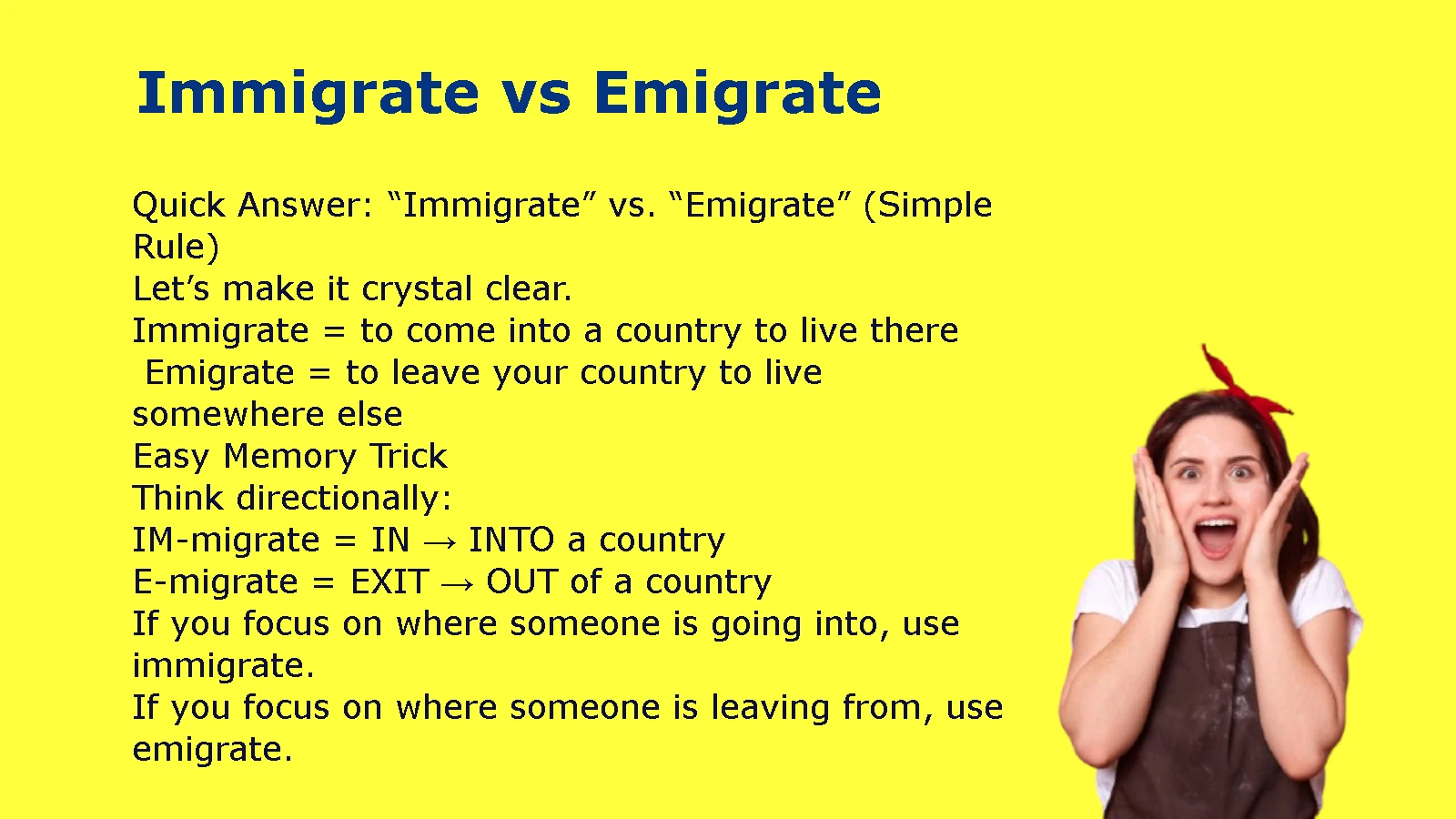
Quick Answer: “Immigrate” vs. “Emigrate” (Simple Rule)
Let’s make it crystal clear.
Immigrate = to come into a country to live there
Emigrate = to leave your country to live somewhere else
Easy Memory Trick
Think directionally:
- IM-migrate = IN → INTO a country
- E-migrate = EXIT → OUT of a country
If you focus on where someone is going into, use immigrate.
If you focus on where someone is leaving from, use emigrate.
The Core Idea: It’s All About Perspective
The biggest reason people get confused is this:
Both words describe the same movement, but from different viewpoints.
Example Situation
Ali moves from Pakistan to Canada.
- From Pakistan’s perspective → Ali emigrates
- From Canada’s perspective → Ali immigrates
Same person. Same move. Different direction of focus.
“Immigrate” Explained Clearly (With Examples)
To immigrate means to enter and settle in a new country.
Simple Meaning
You are arriving in a new place to live permanently.
Real Examples
- “She immigrated to Australia in 2018.”
- “Many workers immigrate to the UAE for job opportunities.”
- “He plans to immigrate to the United States next year.”
Key Insight
Immigrate always answers:
👉 Where is the person coming into?
“Emigrate” Explained Clearly (With Examples)
To emigrate means to leave your home country to live elsewhere.
Simple Meaning
You are exiting your country of origin.
Real Examples
- “He emigrated from India in search of better opportunities.”
- “Thousands of people emigrate from rural areas every year.”
- “She decided to emigrate after finishing university.”
Key Insight
Emigrate always answers:
👉 Where is the person leaving from?
The Easiest Way to Never Confuse Them Again
Use this mental switch:
- Think IMMIGRATE = MOVE IN
- Think EMIGRATE = EXIT OUT
Or even simpler:
👉 Immigration = arrival
👉 Emigration = departure
Side-by-Side Comparison Table
| Word | Meaning | Direction Focus | Example |
| Immigrate | Enter a new country to live | Into the country | She immigrated to Canada. |
| Emigrate | Leave your country permanently | Out of the country | She emigrated from Pakistan. |
Real-Life Examples (Made Simple)
Immigrate Examples
- “My uncle immigrated to Germany for work.”
- “They immigrated to Canada last year.”
- “Many doctors immigrate to the UK.”
Emigrate Examples
- “He emigrated from Pakistan in 2020.”
- “Families emigrate for better education systems.”
- “She emigrated after getting a visa approval.”
Why People Mix Them Up So Often
The confusion happens because:
- Both refer to the same movement
- Only the reference point changes
- Everyday speech doesn’t emphasize direction
- People focus on the person, not the perspective
So instead of thinking “correct word,” think:
👉 Which side am I describing from?
Regional Usage Differences
In American English
- “Immigrate to” is used more commonly in formal writing
- “Emigrate from” is used to emphasize origin
British English
- Both words are commonly used but often interchanged in casual speech
- Context plays a big role in meaning
Global Communication
Confusion increases because speakers assume shared perspective—but don’t always clarify direction.
How to Avoid Mistakes Every Time
Use this simple checklist:
Step 1: Ask yourself
Am I talking about entering or leaving?
Step 2: Choose the word
- Entering → Immigrate
- Leaving → Emigrate
Step 3: Add clarity if needed
Instead of just:
- “He immigrated.”
Say:
- “He immigrated to Canada from Pakistan.”
What to Say Instead (Clear Alternatives)
To avoid confusion completely:
- “Moved to Canada” (neutral and simple)
- “Left Pakistan to live in Canada”
- “Relocated internationally”
Best Practice
In formal writing or immigration contexts, always specify both:
👉 “Emigrated from X to Y”
Quick Decision Guide (Use This Instantly)
- Focus on arrival → Immigrate
- Focus on departure → Emigrate
- Still unsure → Use “move to/from”
Simple. Clear. Foolproof.
FAQ: “Immigrate” vs. “Emigrate”
Can both words be used for the same person?
Yes. It depends on perspective.
Is one more correct than the other?
No. Both are correct in their own context.
Which one is more commonly used?
“Immigrate” is often used in destination countries, while “emigrate” is used in origin contexts.
Can I just say “move” instead?
Yes, and it avoids confusion completely.
Key Facts You Should Remember
- Immigrate = go into a country
- Emigrate = leave a country
- Same action, different viewpoint
- Context determines the correct word
- Direction is everything
Final Takeaway: The One Rule That Never Fails
Here’s the simplest way to remember it:
👉 If you’re talking about the destination, use immigrate.
👉 If you’re talking about the starting point, use emigrate.
Think of it like a journey:
One person leaves home (emigrates)
and arrives somewhere new (immigrates).
Same story—just told from two sides.
And once you see that clearly, “immigrate vs emigrate” stops being confusing forever.