
Have you ever come across Traunch vs. Tranche and wondered which spelling is actually correct? You’re not alone. Many writers, students, and professionals mistakenly use traunch spelling when they really mean tranche, especially in discussions involving finance, investments, and loan agreements.
The confusion is understandable because the two words look and sound similar. But here’s the kicker: one is the recognized tranche spelling, while the other is often considered a common misspelling. Using the wrong term can affect the accuracy and professionalism of your writing.
The good news? The difference is easier to understand than you might think.
In this guide, you’ll learn the truth behind Traunch vs. Tranche, discover the tranche meaning, explore the tranche definition, and see real tranche examples in sentences. You’ll also find answers to common questions like is traunch a word, how to spell tranche, tranche pronunciation, and tranche vs traunch correct spelling.
By the end, you’ll know exactly which form belongs in formal writing, financial documents, and everyday communication—and you’ll never second-guess the spelling again.
Traunch Meaning
Traunch meaning: “Traunch” is generally considered a misspelling of tranche, a word that means a portion, segment, or installment of a larger amount, especially in finance and investments. In professional English, “tranche” is the correct spelling.
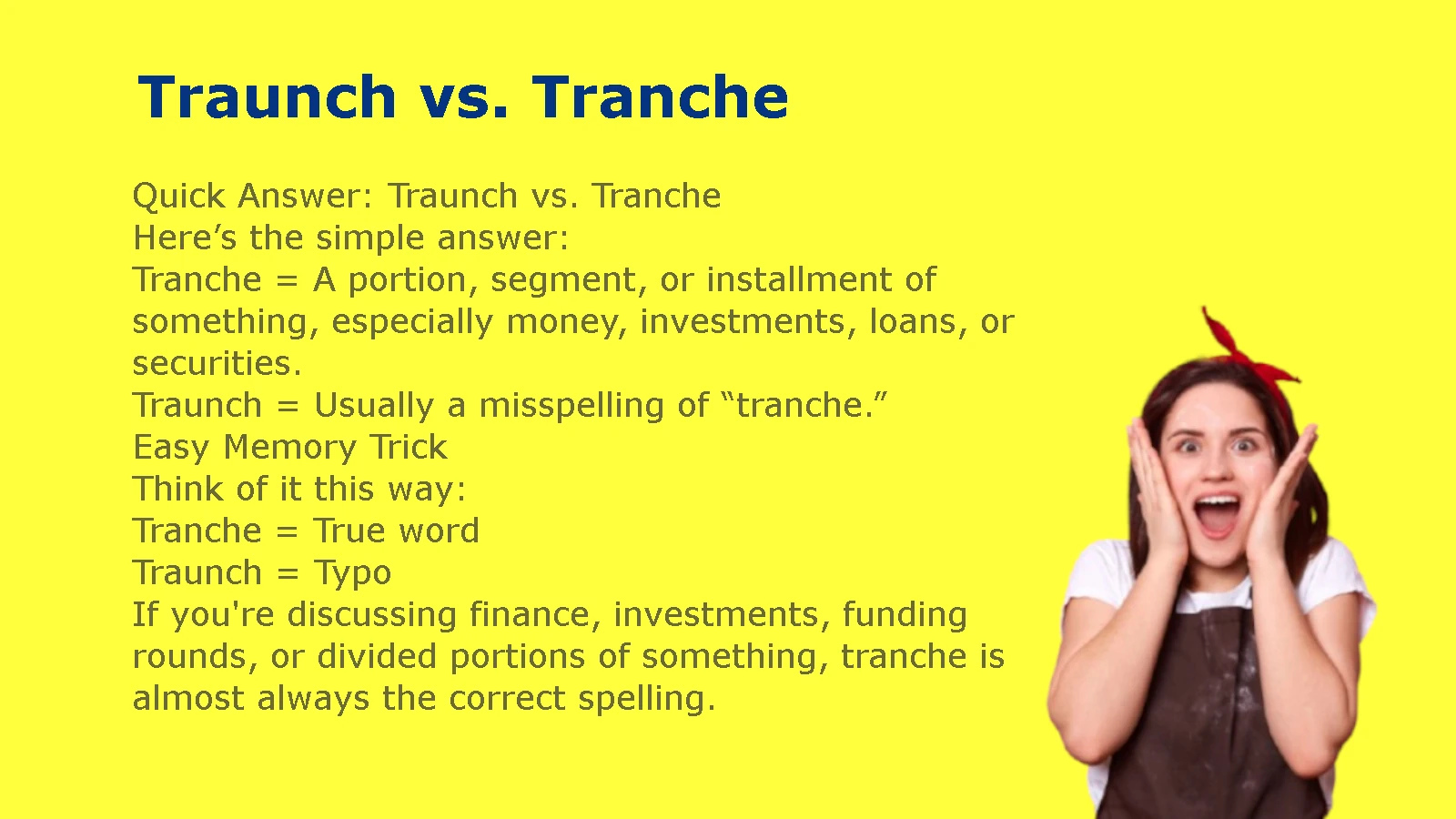
Quick Answer: Traunch vs. Tranche
Here’s the simple answer:
Tranche = A portion, segment, or installment of something, especially money, investments, loans, or securities.
Traunch = Usually a misspelling of “tranche.”
Easy Memory Trick
Think of it this way:
Tranche = True word
Traunch = Typo
If you’re discussing finance, investments, funding rounds, or divided portions of something, tranche is almost always the correct spelling.
What Does “Tranche” Mean?
The word tranche comes from French and means a slice, portion, or section of a larger whole.
Today, it is most commonly used in:
- Finance
- Banking
- Investment markets
- Business funding
- Government aid programs
Simple Definition
A tranche is a part of a larger amount that is released, invested, or distributed separately.
Example
A company receives:
- First tranche: $1 million
- Second tranche: $2 million
- Third tranche: $3 million
Each payment is a separate tranche of the total funding package.
Key Idea
A tranche is not the whole amount.
It is one piece of a larger amount.
What Does “Traunch” Mean?
In modern English, traunch is generally not recognized as a standard word in finance, business, or everyday usage.
Most of the time, when people write “traunch,” they actually mean:
Tranche
Why It Happens
People often:
- Hear the word spoken aloud
- Guess the spelling
- Replace the “e” with “u”
The result is the incorrect spelling:
❌ Traunch
Instead of:
✅ Tranche
Key Takeaway
If you are writing professional documents, reports, emails, or financial content, avoid “traunch” and use tranche.
Why People Confuse Traunch and Tranche
The confusion isn’t surprising.
Similar Pronunciation
Many English speakers pronounce tranche in a way that sounds like:
“trawnch”
Because of this, people assume the spelling should contain “au.”
Unfamiliar French Origin
Unlike common English words, tranche comes from French.
That means the spelling doesn’t always match what people expect.
Rare Exposure
Many people first encounter the word in:
- Investment reports
- Financial news
- Business contracts
Since they may hear it before seeing it written, spelling mistakes become common.
The Correct Spelling in Professional Writing
If you’re writing in a professional setting, the correct spelling is almost always:
✅ Tranche
Examples include:
- Loan tranche
- Funding tranche
- Investment tranche
- Bond tranche
- Aid tranche
❌ Traunch
Avoid using this spelling unless you’re intentionally discussing the misspelling itself.
Quick Rule
If you’re talking about portions of money, financing, or investments, write:
Tranche
Not:
Traunch
The Finance Meaning of “Tranche”
The word is especially important in finance.
How Tranches Work
Large financial deals are often divided into smaller sections.
Instead of providing all funds at once, money may be released gradually.
Example:
Total funding: $10 million
| Tranche | Amount |
| First Tranche | $3 Million |
| Second Tranche | $4 Million |
| Third Tranche | $3 Million |
Each payment represents a separate tranche.
Why Companies Use Tranches
Benefits include:
- Better risk management
- Performance monitoring
- Controlled spending
- Flexible financing
Real-Life Examples of “Tranche”
Let’s look at practical examples.
Business Funding
“The startup received the first tranche of investment in January.”
Meaning:
The company received part of the total investment.
Government Aid
“The government approved a second tranche of relief funding.”
Meaning:
Another portion of aid was released.
Construction Projects
“The next tranche of funds will be released after project completion.”
Meaning:
The following installment depends on progress.
Common Mistakes People Make
Mistake #1: Writing “Traunch”
Incorrect:
“The company received the first traunch of funding.”
Correct:
“The company received the first tranche of funding.”
Mistake #2: Assuming Both Words Exist
Many writers think:
- Traunch = one version
- Tranche = another version
This is incorrect.
Only tranche is widely accepted in modern professional English.
Mistake #3: Copying Incorrect Spellings Online
A misspelled term can spread quickly across blogs, forums, and social media.
Always verify the spelling before publishing.
Side-by-Side Comparison Table
| Feature | Tranche | Traunch |
| Standard English Word | Yes | No (usually) |
| Used in Finance | Yes | No |
| Found in Dictionaries | Yes | Rarely |
| Professional Usage | Correct | Incorrect |
| Meaning | Portion or installment | Usually a misspelling |
Examples in Sentences
Correct Uses of Tranche
- The lender released the first tranche of the loan.
- Investors approved a new tranche of capital.
- The project depends on the next tranche of funding.
- The company secured multiple funding tranches.
- Aid organizations received another tranche of support.
Incorrect Uses
- The lender released the first traunch of the loan.
- Investors approved a new traunch of capital.
These should be written as tranche.
When You Might See “Traunch”
Although uncommon, you may encounter “traunch” in:
- Online comments
- Discussion forums
- Draft documents
- User-generated content
In most cases, it is simply a spelling error.
What Should You Do?
If editing professional content:
Replace:
❌ Traunch
With:
✅ Tranche
How to Remember the Difference
Here are three easy memory tricks.
Trick #1: Think Finance
Whenever you see funding or investments, think:
Tranche
Trick #2: Remember the French Spelling
The word comes from French, which explains the unusual spelling.
Trick #3: The “E” Is Essential
Tranche
That final “e” helps identify the correct version.
Quick Decision Guide
Use this whenever you’re unsure.
Are you talking about:
- Funding?
- Investments?
- Loans?
- Securities?
- Installments?
If yes:
➡ Use Tranche
Do you mean a portion of a larger amount?
➡ Use Tranche
Are you about to write “Traunch”?
➡ Change it to Tranche
FAQ: Traunch vs. Tranche
Is “traunch” a real word?
In modern professional English, it is generally treated as a misspelling of “tranche.”
What does tranche mean?
A tranche is a portion, installment, or segment of a larger amount, especially in finance.
Which spelling is correct?
Tranche is the accepted spelling.
Why do people write “traunch”?
Because the pronunciation can make it sound like it contains “au,” leading to spelling mistakes.
Is tranche only used in finance?
No. While it is most common in finance, it can refer to any portion or segment of a larger whole.
Case Study: A Business Proposal Error
A startup founder prepared an investment proposal for potential investors.
The document stated:
“We are seeking the first traunch of capital.”
What Happened?
Investors immediately noticed the spelling mistake.
While the error was minor, it reduced the document’s professional appearance.
The Correction
The proposal was updated to:
“We are seeking the first tranche of capital.”
Lesson
Small spelling errors can affect credibility, especially in financial and business communications.
Key Facts to Remember
- Tranche is the correct spelling.
- A tranche is a portion or installment of a larger amount.
- The term is common in finance, investing, and lending.
- Traunch is usually a misspelling.
- Professional documents should always use tranche.
- The word comes from French.
- Using the correct spelling improves credibility.
Final Takeaway: Which One Should You Use?
The answer is straightforward.
When comparing Traunch vs. Tranche, only tranche is considered the standard and professionally accepted word.
A tranche refers to a portion, installment, or segment of a larger amount, especially in financial and business contexts. Meanwhile, “traunch” is usually nothing more than a spelling mistake caused by pronunciation confusion.
The safest rule is simple:
If you’re talking about funding, loans, investments, or divided portions of money, always use “tranche.”
When in doubt, remember:
Tranche is the real word. Traunch is almost always the typo.
That one rule will keep your writing accurate, professional, and clear every time.