Have you ever wondered whether Afterward vs. Afterwards mean different things, or if one is simply a misspelling of the other? This is a common question among English learners and even fluent writers because both words appear in books, articles, emails, and everyday conversations. While they look almost identical, the difference between Afterward vs. Afterwards is not about meaning—it is primarily about regional spelling preferences. Understanding when to use each form can improve your writing, grammar accuracy, and overall confidence in English.
Both Afterward and Afterwards are adverbs that mean at a later time or following a particular event. The key distinction is that Afterward is the preferred spelling in American English, whereas Afterwards is more common in British English and many other varieties of English. Aside from this regional preference, the two words have the same definition and can usually be used interchangeably without changing the meaning of a sentence.
Because these spellings are so similar, many writers search for topics such as Afterward meaning, Afterwards meaning, difference between Afterward and Afterwards, Afterward vs. Afterwards, and American English vs. British English spelling. This confusion is part of a broader group of commonly confused English words and spelling variations that can affect writing consistency and style.
In this guide, you’ll learn the complete difference between Afterward and Afterwards, including their meanings, grammar rules, regional usage, sentence examples, and simple memory tips to help you choose the correct form with confidence in any writing situation.
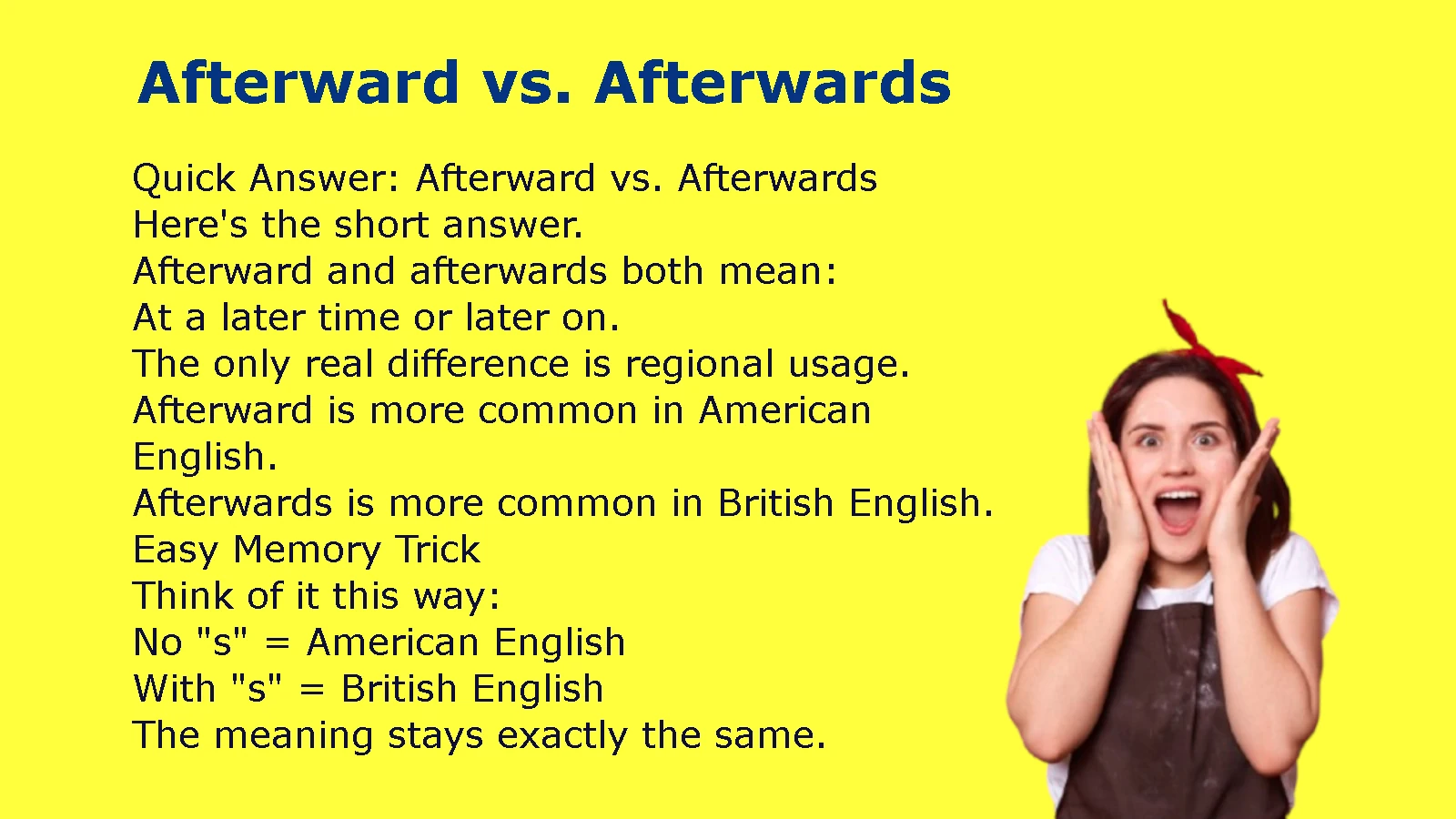
Quick Answer: Afterward vs. Afterwards
Here’s the short answer.
Afterward and afterwards both mean:
At a later time or later on.
The only real difference is regional usage.
- Afterward is more common in American English.
- Afterwards is more common in British English.
Easy Memory Trick
Think of it this way:
- No “s” = American English
- With “s” = British English
The meaning stays exactly the same.
What Do “Afterward” and “Afterwards” Mean?
Both words are adverbs that describe something happening later.
Examples:
- We went out for dinner and afterward watched a movie.
- We went out for dinner and afterwards watched a movie.
Both sentences are correct.
The choice depends mostly on the variety of English you’re using.
The Real Difference Between Afterward and Afterwards
Many learners expect a grammar rule, but there isn’t one.
The distinction is based on language conventions rather than meaning.
| Word | Preferred In | Meaning |
| Afterward | American English | Later; after that |
| Afterwards | British English | Later; after that |
Key Insight
Neither word is more formal or more correct.
They’re simply regional variants.
Why Do Both Words Exist?
English has many words that come in two versions.
Some American spellings dropped the final -s, while British English kept it.
You’ll notice the same pattern in words like:
- Toward / Towards
- Forward / Forwards
- Backward / Backwards
The meaning doesn’t change.
Only the preferred style does.
When to Use “Afterward”
Use afterward if you’re writing in American English.
You’ll commonly see it in:
- American newspapers
- Business writing
- School assignments
- Professional emails
- Blogs aimed at U.S. readers
Examples
- We had lunch, and afterward we returned to work.
- She apologized afterward.
- They spoke privately afterward.
Why Americans Prefer It
American English generally favors the shorter form without the final -s.
When to Use “Afterwards”
Choose afterwards if you’re writing for a British English audience.
It’s common in:
- UK newspapers
- British books
- Academic writing in the UK
- Everyday British conversation
Examples
- We visited the museum and afterwards went shopping.
- He thanked everyone afterwards.
- They chatted afterwards over coffee.
Key Takeaway
If your audience is British, afterwards sounds more natural.
Are They Interchangeable?
Yes.
In almost every sentence, you can replace one with the other.
Example 1
- I’ll call you afterward.
- I’ll call you afterwards.
Example 2
- We celebrated afterward.
- We celebrated afterwards.
Both versions are grammatically correct.
The important thing is to stay consistent throughout your writing.
The Biggest Mistake Writers Make
The most common mistake isn’t choosing the wrong word.
It’s mixing both forms in the same piece of writing.
For example:
❌ We talked afterward. Afterwards, we had dinner.
While it’s not technically incorrect, switching styles can make your writing look inconsistent.
Better
American style:
- We talked afterward. Afterward, we had dinner.
British style:
- We talked afterwards. Afterwards, we had dinner.
Side-by-Side Comparison Table
Here’s a quick comparison you can save for later.
| Feature | Afterward | Afterwards |
| Meaning | Later | Later |
| Grammar | Adverb | Adverb |
| American English | Preferred | Less common |
| British English | Less common | Preferred |
| Formality | Standard | Standard |
| Correct? | Yes | Yes |
Real-Life Examples of “Afterward”
Let’s see how Americans commonly use it.
Everyday Conversation
- We met for coffee and afterward went for a walk.
- Finish your homework first. You can play afterward.
- She felt much better afterward.
Workplace
- The meeting ended, and afterward everyone received the report.
- We’ll discuss the details afterward.
Real-Life Examples of “Afterwards”
Now compare the British preference.
Everyday Conversation
- We had tea and afterwards watched television.
- I’ll explain everything afterwards.
- They left shortly afterwards.
Workplace
- The presentation finished, and afterwards the team answered questions.
- We’ll meet afterwards to review the results.
Regional Differences
Your location often influences which word sounds natural.
In the United States
Most writers choose afterward.
In the United Kingdom
Most writers prefer afterwards.
In Canada and Australia
Both forms appear, although British-style writing often favors afterwards.
Key Tip
If you’re writing for an international audience, either word is acceptable. Just be consistent.
Common Mistakes to Avoid
Here are mistakes learners often make.
Mixing Both Styles
Choose one version and stick with it.
Thinking One Is Incorrect
Both words are accepted by major dictionaries.
Assuming One Is More Formal
Neither is more formal.
The difference is regional, not grammatical.
What Can You Say Instead?
If you want some variety, these alternatives work well.
- Later
- Later on
- After that
- Following that
- Subsequently
- Thereafter
Each has a slightly different tone, but they all express something happening later.
Quick Decision Guide
Still unsure?
Use this simple checklist.
Writing for an American audience?
→ Use afterward
Writing for a British audience?
→ Use afterwards
Writing for a global audience?
→ Either is correct—just stay consistent.
FAQ: Afterward vs. Afterwards
Is “afterwards” grammatically correct?
Yes. It’s the standard form in British English.
Is “afterward” wrong?
Not at all. It’s the preferred form in American English.
Do they have different meanings?
No. Both mean “later” or “after that.”
Which one should I use in professional writing?
Match your audience’s preferred variety of English and use that form consistently.
Case Study: A Style Guide Fix
A content writer was preparing blog posts for a U.S.-based company.
During editing, the reviewer noticed sentences using both afterward and afterwards throughout the article.
The Solution
The editor changed every instance to afterward to match the company’s American English style guide.
The Result
The article looked more polished, professional, and consistent without changing the meaning.
Key Facts to Remember
- Afterward and afterwards mean exactly the same thing.
- Afterward is preferred in American English.
- Afterwards is preferred in British English.
- Both are grammatically correct.
- The best choice depends on your audience.
- Avoid mixing both forms in the same piece of writing.
Final Takeaway: Which One Should You Choose?
Here’s the simplest rule to remember.
If you’re writing for an American audience, use afterward. If you’re writing for a British audience, choose afterwards. In terms of meaning, there’s no difference at all.
Instead of worrying about which word is “more correct,” focus on writing consistently. Readers are far more likely to notice mixed styles than your choice between these two perfectly acceptable words.
So the next time you hesitate between afterward and afterwards, remember this:
Same meaning. Different regional preference. Consistency is what matters most.