Have you ever paused while writing and wondered whether to use Do To or Due To? Although these two phrases look similar at a glance, they have completely different meanings and functions in the English language. This mix-up is common among students, professionals, and even fluent speakers because a single letter changes the entire meaning of the phrase. Understanding the difference between Do To vs. Due To is essential for improving your grammar, writing accuracy, vocabulary, and overall communication skills.
In simple terms, Due To means because of or caused by and is commonly used to explain the reason for something. For example, a flight may be delayed due to bad weather, or a meeting may be canceled due to technical issues. Do To, on the other hand, is rarely used as a fixed phrase. Instead, it usually appears when do functions as a verb followed by to, such as in expressions like “things to do” or “what to do.” Because these words can appear next to each other in certain sentences, many learners mistakenly assume they are interchangeable.
This confusion often appears in searches like difference between do to and due to, due to meaning, do to meaning, when to use due to, and commonly confused English words. It also relates to broader topics such as English grammar rules, spelling confusion, word usage, and formal writing, making it an important concept for anyone learning or refining their English.
In this guide, you’ll learn the exact difference between Do To and Due To, explore their meanings, grammar rules, sentence examples, common mistakes, and simple memory tricks so you can use each phrase correctly and write with greater confidence.
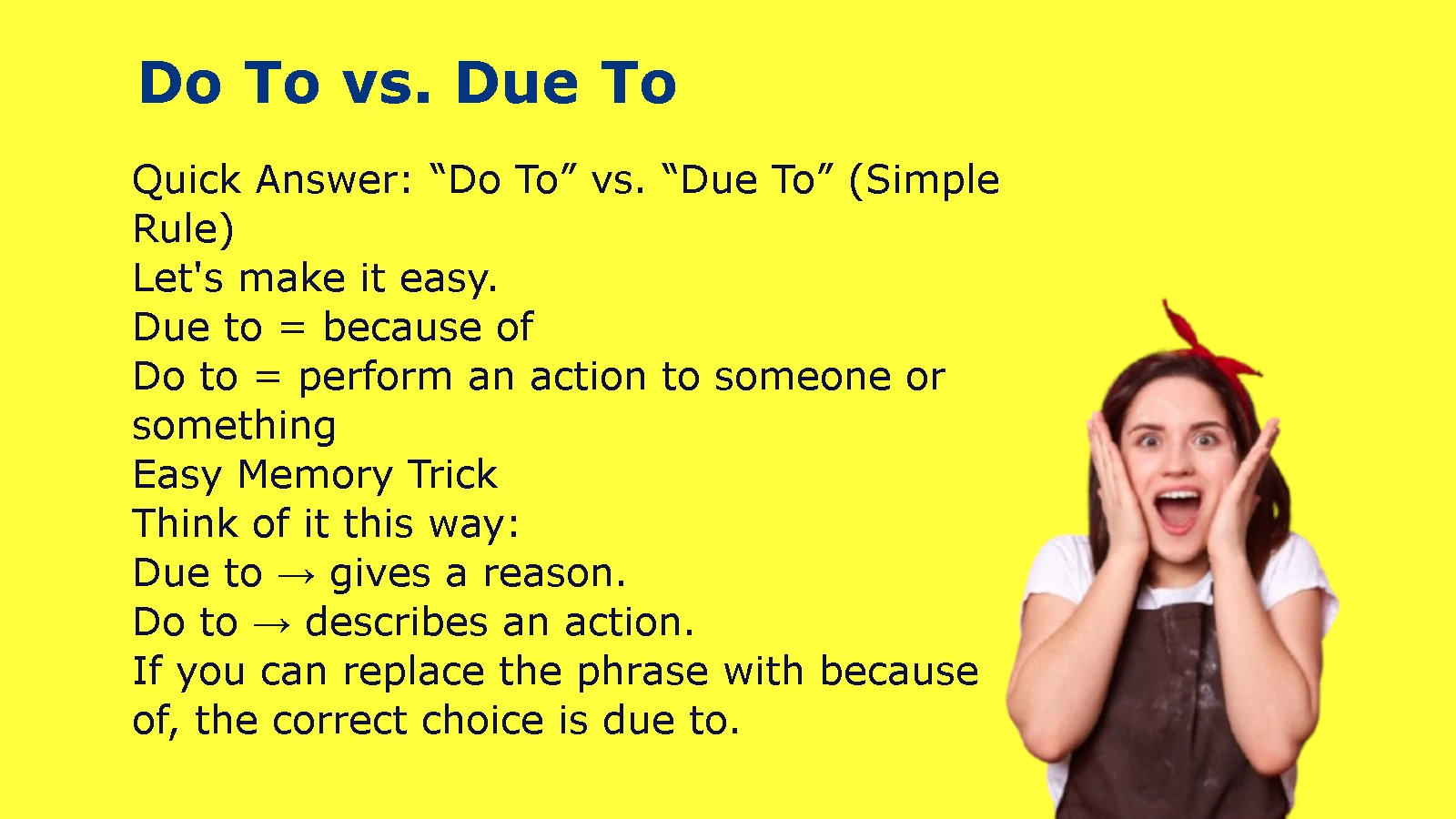
Quick Answer: “Do To” vs. “Due To” (Simple Rule)
Let’s make it easy.
Due to = because of
Do to = perform an action to someone or something
Easy Memory Trick
Think of it this way:
- Due to → gives a reason.
- Do to → describes an action.
If you can replace the phrase with because of, the correct choice is due to.
How People Actually Use “Do To” and “Due To”
This mistake appears everywhere—from emails to social media posts.
In Everyday Writing
Many people accidentally write:
❌ The game was canceled do to rain.
They mean:
✅ The game was canceled due to rain.
In Speech
The two phrases sound nearly identical, so many writers spell them the way they hear them.
Why This Happens
- They have almost the same pronunciation.
- Spell-check doesn’t always catch the mistake.
- Many people never learn the grammatical difference.
The Grammar Behind “Do To” vs. “Due To”
Understanding the grammar makes everything easier.
Think About Their Jobs
Due to
- Acts as a phrase showing cause or reason.
- Means because of or caused by.
Do to
- Combines the verb do with the preposition to.
- Means to perform an action toward someone or something.
Key Insight
One explains why something happened.
The other explains what action someone performs.
“Due To” Explained Clearly (With Examples)
At its core, due to means because of.
Standard Meaning
It introduces the reason for something.
Examples:
- The flight was delayed due to bad weather.
- The school closed due to heavy snow.
- Attendance dropped due to illness.
Replace-It Test
If because of fits naturally, due to is correct.
Example:
The picnic was canceled due to rain.
↓
The picnic was canceled because of rain.
Both sound natural.
Key Takeaway
Whenever you’re giving a reason, choose due to.
“Do To” Explained Clearly (With Examples)
Now let’s look at the less common phrase.
Do to simply combines the verb do with to.
Standard Meaning
It refers to performing an action toward someone or something.
Examples:
- Don’t do that to your brother.
- What did you do to the computer?
- Why would you do this to yourself?
Notice that do is the action.
Key Insight
If someone is doing something to another person or object, do to is correct.
The Biggest Mistake People Make
The most common mistake is replacing due to with do to.
Incorrect
❌ The meeting was canceled do to traffic.
Correct
✅ The meeting was canceled due to traffic.
Why It Happens
People write what they hear instead of thinking about the meaning.
Remember:
If you’re explaining a reason, never write do to.
Side-by-Side Comparison Table
| Phrase | Meaning | Use | Example |
| Due to | Because of | Shows a reason | The delay was due to rain. |
| Do to | Perform an action toward | Describes an action | What did you do to my phone? |
Real-Life Examples of “Due To”
Let’s see it in everyday situations.
Common Sentences
- The concert was postponed due to bad weather.
- Flights were canceled due to fog.
- Sales increased due to holiday promotions.
- Schools closed due to flooding.
- Production stopped due to equipment failure.
Mini Scenario
Your boss says:
“The deadline has changed due to a client request.”
The phrase explains why the deadline changed.
Real-Life Examples of “Do To”
Now compare.
Common Sentences
- What did you do to your hair?
- Please don’t do that to the dog.
- What have they done to the building?
- Don’t do this to yourself.
- What did you do to my laptop?
Mini Scenario
Your friend sees your broken phone.
“What did you do to it?”
They’re asking what action caused the damage.
Common Mistakes to Avoid
Here are mistakes many learners make.
Incorrect
❌ Late do to traffic.
Correct
✅ Late due to traffic.
Incorrect
❌ The event ended do to rain.
Correct
✅ The event ended due to rain.
Incorrect
❌ Due to your homework.
Correct
✅ Do your homework.
How to Remember the Difference Every Time
Use these simple tricks.
Trick #1
If you mean because of, choose due to.
Trick #2
If someone is performing an action, use do to.
Trick #3
Ask yourself:
“Am I explaining a reason?”
If yes → due to
If no → do to
What to Say Instead (Clear Alternatives)
Sometimes you can avoid confusion completely.
Instead of due to, you can say:
- Because of
- As a result of
- Owing to
- Thanks to (for positive situations)
Instead of do to, you can often use:
- Cause
- Perform on
- Treat
- Affect
Quick Decision Guide (Use This Instantly)
Whenever you’re unsure, follow this:
Need to explain a reason?
→ Due to
Talking about someone’s action?
→ Do to
Still unsure?
→ Replace it with because of.
If it works, choose due to.
FAQ: “Do To” vs. “Due To”
Is “do to” ever correct?
Yes. It is correct when do is the verb.
Example:
What did you do to my bike?
Is “due to” the same as “because of”?
Almost always. Both explain the reason something happened.
Why do people confuse them?
Because they sound nearly identical in conversation.
Which phrase is more common?
Due to is far more common in writing because it frequently introduces reasons and causes.
Case Study: One Small Typo, Big Difference
A company sent this email:
“The meeting has been postponed do to maintenance.”
Several employees noticed the spelling mistake and questioned whether it was an official message.
The corrected email read:
“The meeting has been postponed due to maintenance.”
A single letter changed the sentence from incorrect to professional.
Key Facts You Should Remember
- Due to means because of.
- Do to means perform an action toward someone or something.
- Most spelling mistakes happen because both phrases sound alike.
- Replace due to with because of to check if it’s correct.
- When talking about actions, use do to.
Final Takeaway: The One Rule That Never Fails
Here’s the easiest rule to remember.
If you’re explaining why something happened, use due to.
If you’re talking about what someone did, use do to.
Think of due to as the phrase that introduces a reason, while do to always involves an action. Whenever you’re in doubt, try replacing the phrase with because of. If the sentence still makes sense, due to is the correct choice.
Master this simple distinction, and you’ll never confuse “Do To” vs. “Due To” again.