Have you ever wondered whether Can vs. May is simply a matter of politeness or whether these two words have different meanings in English? This is one of the most common grammar questions among English learners because both words are often used when asking for permission or talking about possibility. Although people frequently use them interchangeably in everyday conversation, understanding the difference between Can and May helps you communicate more accurately and confidently in both formal and informal situations.
In simple terms, Can is primarily used to express ability, capability, or informal permission, while May is traditionally used to ask for or grant permission in a more formal way and to express possibility. For example, you might say, “I can swim” to describe an ability, but “May I leave early?” when politely asking for permission. Knowing when to use each word improves your grammar, writing, and overall communication skills.
Many learners search for the difference between Can and May, Can meaning, May meaning, Can vs. May grammar, and how to use Can and May in a sentence because the distinction can be confusing. The topic also relates to broader areas of English grammar, including modal verbs, permission, ability, possibility, and common grammar mistakes. Learning these concepts will help you write more naturally and speak with greater confidence in academic, professional, and everyday settings.
If you’ve ever paused before writing a sentence like “Can I borrow your pen?” or “May I borrow your pen?” you’re not alone. While both sentences are widely understood, choosing the appropriate word depends on the level of formality and the meaning you want to convey.
In this guide, you’ll learn the clear difference between Can and May, their meanings, grammar rules, real-life examples, common mistakes to avoid, and simple memory tricks so you’ll always know which word fits the context.
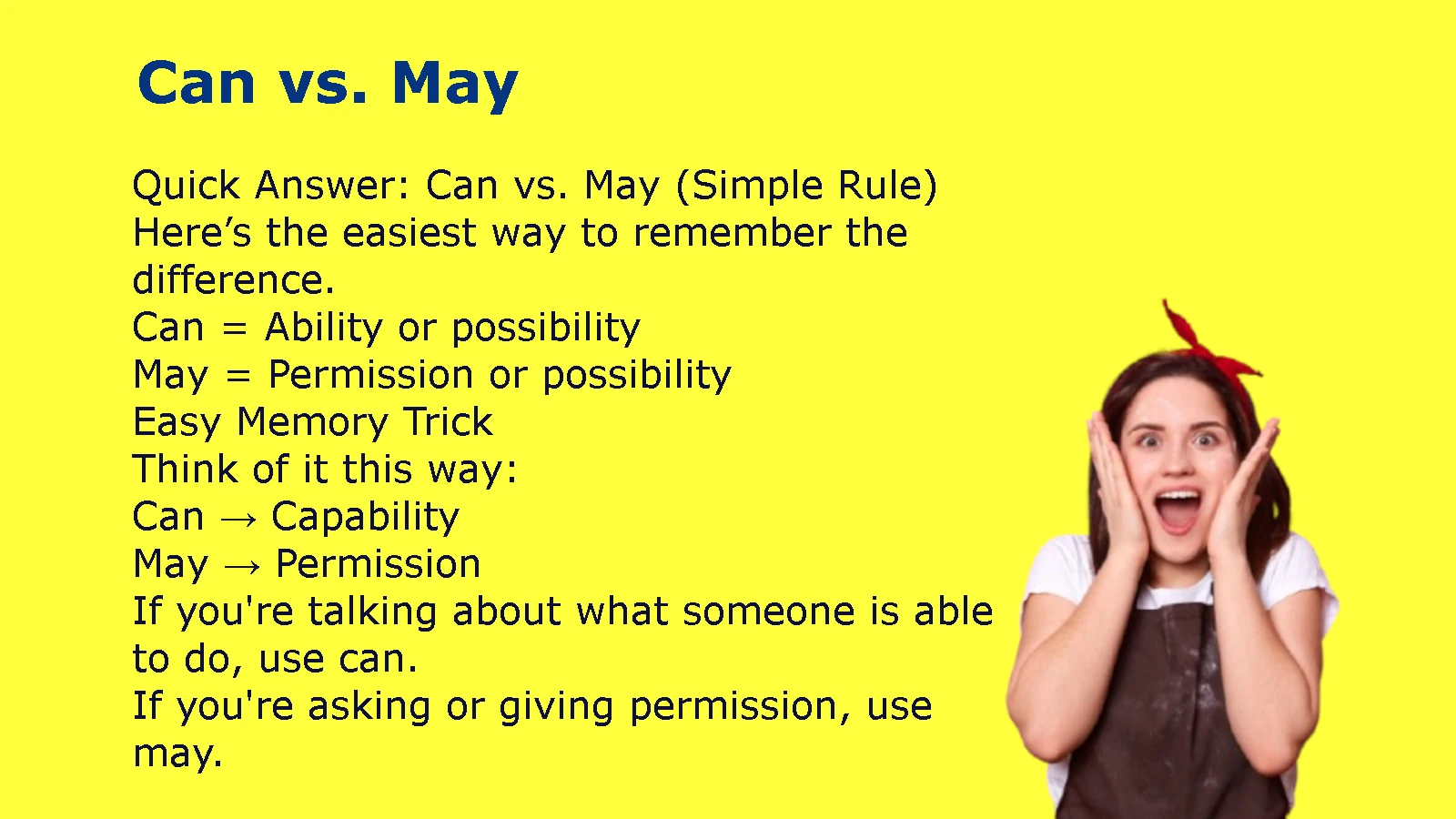
Quick Answer: Can vs. May (Simple Rule)
Here’s the easiest way to remember the difference.
Can = Ability or possibility
May = Permission or possibility
Easy Memory Trick
Think of it this way:
- Can → Capability
- May → Permission
If you’re talking about what someone is able to do, use can.
If you’re asking or giving permission, use may.
How People Actually Use Can and May
English speakers don’t always follow textbook grammar.
In Everyday Conversations
Most people say:
- “Can I borrow your pen?”
- “Can I sit here?”
Even though grammar books traditionally recommend may for permission.
In Formal Situations
Schools, workplaces, and official writing often prefer:
- “May I come in?”
- “May I ask a question?”
Why This Happens
Language changes over time.
Today, can is widely accepted for permission in casual English, while may sounds more formal and polite.
The Grammar Logic Behind Can vs. May
The difference becomes easier when you think about meaning instead of memorizing rules.
Think About the Question
Can asks:
Is it possible?
May asks:
Is it allowed?
Example
“Can you swim?”
→ Are you able to swim?
“May you swim here?”
→ Are you allowed to swim here?
Key Insight
Ability and permission are different ideas, even if they sometimes overlap.
Can Explained Clearly (With Edge Cases)
At its core, can expresses ability.
Standard Meaning
- I can drive.
- She can cook.
- They can speak French.
Here, can means someone has the skill or capability.
Can for Permission
People commonly say:
- Can I leave now?
- Can we start?
Although informal, these are perfectly natural in modern English.
Can for Possibility
It can get very hot here.
This means something is possible.
Key Takeaway
Can mainly expresses:
- Ability
- Possibility
- Informal permission
May Explained Clearly (With Edge Cases)
Now let’s look at may.
Standard Meaning
May is used to ask for or give permission.
Examples:
- May I come in?
- You may leave now.
- Students may use calculators.
May for Possibility
May can also express uncertainty.
Examples:
- It may rain tomorrow.
- She may arrive late.
- We may need more time.
Formal Tone
Because may sounds more polite, it’s often preferred in:
- Business communication
- Academic writing
- Professional conversations
Key Takeaway
May mainly expresses:
- Permission
- Possibility
- Formal politeness
The Biggest Mistake People Make
Many learners think can and may always mean the same thing.
They don’t.
What Goes Wrong
Someone asks:
“Can I use your phone?”
Technically, they’re asking whether they’re able to use it—not whether they’re allowed.
Why It Isn’t Always Wrong
Modern English accepts can for permission in casual speech.
The difference is mostly about formality rather than correctness.
Lesson
Use may when you want to sound especially polite or formal.
Side-by-Side Comparison Table
| Word | Main Meaning | Formality | Best Use |
| Can | Ability, possibility, informal permission | Casual | Everyday conversations |
| May | Permission, possibility | Formal | Professional and polite situations |
Real-Life Examples of Can
Let’s look at everyday situations.
Common Examples
- I can solve this problem.
- Can you help me?
- We can finish today.
- Can I borrow your notebook?
- She can run very fast.
Mini Scenario
Friend:
“Can I use your charger?”
You reply:
“Sure.”
This sounds completely natural in casual conversation.
Real-Life Examples of May
Now compare.
Common Examples
- May I speak with the manager?
- You may begin the exam.
- It may snow tonight.
- Employees may work remotely.
- May I ask a question?
Mini Scenario
Student:
“May I leave early today?”
Teacher:
“Yes, you may.”
This sounds respectful and formal.
Common Situations Where Both Are Used
Sometimes either word works, but the tone changes.
Example 1
Can I open the window?
Friendly and casual.
May I open the window?
More polite.
Example 2
Can I ask something?
Natural conversation.
May I ask something?
Formal presentation or meeting.
Key Insight
The meaning is almost the same.
The difference is mainly the level of politeness.
Common Mistakes to Avoid
Here are mistakes learners often make.
Using May for Ability
❌ I may swim very well.
✅ I can swim very well.
Using Can in Very Formal Requests
Less formal:
Can I enter?
More formal:
May I enter?
Confusing Possibility with Permission
“It may happen.”
This means it’s possible—not that someone has permission.
How to Choose the Right Word Every Time
Ask yourself one simple question.
Are you talking about ability?
Use can.
Are you asking for permission?
Use may.
Are you discussing possibility?
Either word may work depending on meaning.
Example:
“It can be dangerous.”
“It may be dangerous.”
The first refers to general possibility.
The second suggests uncertainty.
What to Say Instead (Clear Alternatives)
Sometimes other expressions sound even more natural.
Instead of Can
- I’m able to…
- I know how to…
- I’m capable of…
Instead of May
- Am I allowed to…?
- Is it okay if I…?
- Would it be alright if I…?
These alternatives often sound clearer in conversation.
Quick Decision Guide (Use This Instantly)
When you’re unsure, remember this:
Talking about ability → Can
Asking permission politely → May
Giving permission → May
Casual permission → Can
Talking about uncertainty → May
Simple. Reliable. Done.
FAQ: Can vs. May
Is it wrong to say “Can I go to the bathroom?”
No. It’s perfectly acceptable in everyday English. May I is simply more formal.
Which is more polite?
May is generally considered more polite than can.
Can both express possibility?
Yes.
- It can happen.
- It may happen.
However, may usually expresses uncertainty, while can often describes general possibility.
Which should I use in professional writing?
Use may when requesting or granting permission in formal writing.
Case Study: A Classroom Conversation
A teacher asks the class:
“Any questions?”
One student says:
“Can I leave early?”
The teacher smiles and replies:
“You may leave early.”
What Happened?
The teacher isn’t saying the student’s sentence is completely wrong.
Instead, they’re emphasizing the traditional grammar rule that may is used for permission.
Result
The student learns that while can is common in everyday speech, may sounds more formal and appropriate in certain settings.
Key Facts You Should Remember
- Can expresses ability.
- May expresses permission.
- Both can talk about possibility.
- Can is more common in casual conversations.
- May sounds more formal and polite.
- Modern English often accepts can when asking permission.
- Choosing between them depends on context and tone.
Final Takeaway: The One Rule That Never Fails
The difference between Can vs. May is easier than many people think. Can focuses on ability and everyday communication, while may is the better choice when asking or giving permission in formal situations. Although modern English speakers frequently use can for permission, understanding the traditional distinction helps you communicate more clearly and confidently.
Whenever you’re unsure, remember this simple rule:
Ability → Can
Permission → May
If you’re writing a professional email, speaking in a formal setting, or want to sound especially polite, choose may. For everyday conversations, can is usually the natural choice. Knowing the difference allows you to match your language to the situation, making your English both accurate and effective.