Have you ever paused while writing and wondered whether to use Your or You’re? You’re not alone. The confusion between Your vs. You’re is one of the most common grammar mistakes in the English language because the two words sound exactly alike but serve completely different purposes. Using the wrong one can change the meaning of a sentence and make your writing appear less polished, whether you’re sending an email, writing a school assignment, posting on social media, or communicating at work. Understanding the difference between these commonly confused words is an easy way to improve your grammar, writing accuracy, and overall confidence in English.
In simple terms, Your is a possessive adjective that shows ownership or belonging, while You’re is a contraction of “you are.” For example, “Your notebook is on the desk” refers to something that belongs to someone, whereas “You’re doing a great job” means “you are doing a great job.” Although they share the same pronunciation, their meanings and grammatical functions are entirely different, making them easy to mix up but simple to master once you understand the rule.
Many English learners search for phrases like your meaning, you’re meaning, difference between your and you’re, your vs. you’re examples, and how to use your and you’re correctly because this pair appears frequently in everyday conversations, academic writing, business communication, and online messaging. It is also one of the most frequently tested topics in English grammar since it combines spelling, contractions, and possessive forms.
In this guide, you’ll learn the clear difference between Your and You’re, their definitions, grammar rules, real-life examples, common mistakes to avoid, and easy memory tricks that will help you choose the correct word every time you write or speak.
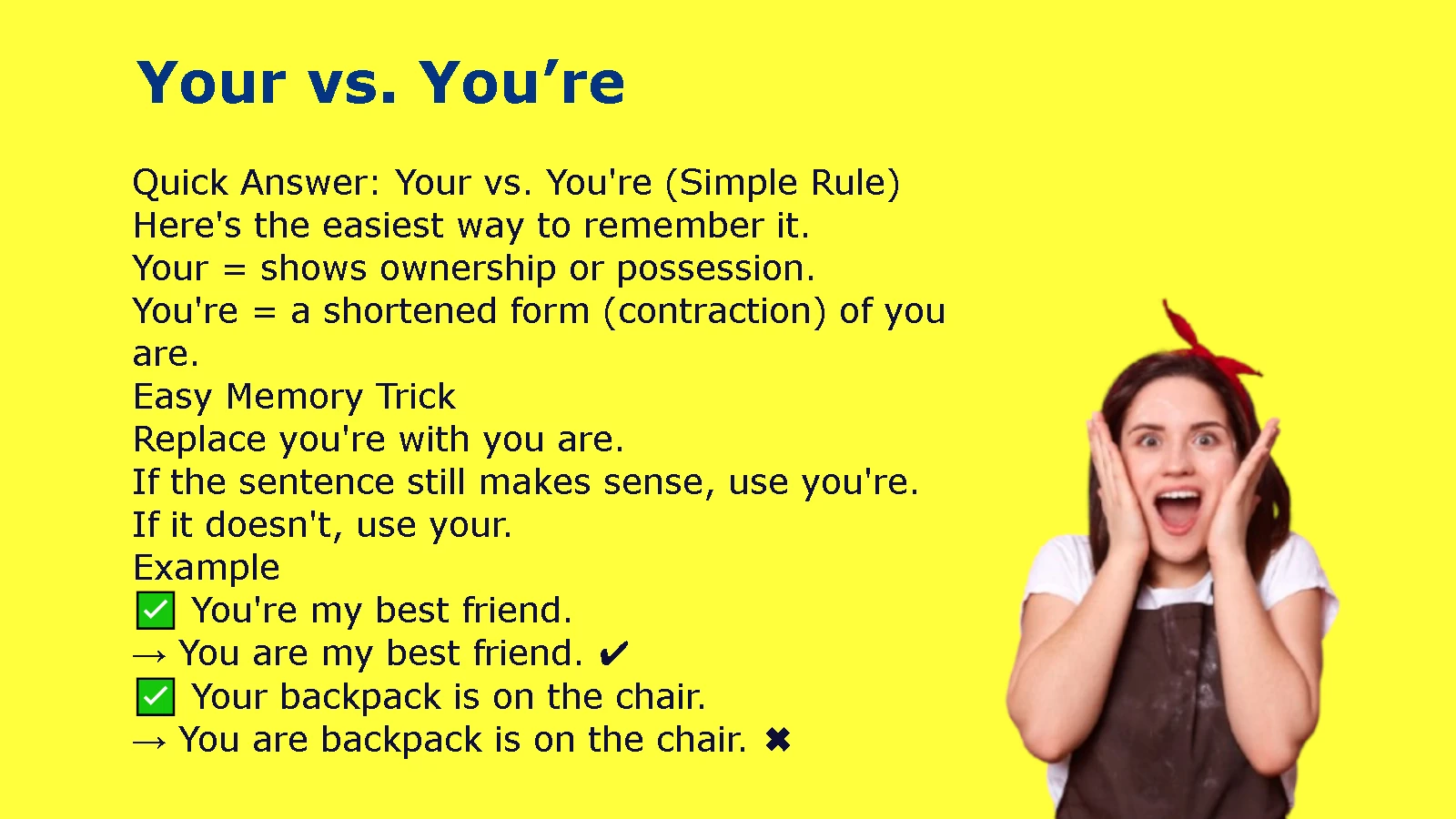
Quick Answer: Your vs. You’re (Simple Rule)
Here’s the easiest way to remember it.
Your = shows ownership or possession.
You’re = a shortened form (contraction) of you are.
Easy Memory Trick
Replace you’re with you are.
If the sentence still makes sense, use you’re.
If it doesn’t, use your.
Example
✅ You’re my best friend.
→ You are my best friend. ✔
✅ Your backpack is on the chair.
→ You are backpack is on the chair. ✖
How People Actually Use Your and You’re
This mistake happens because both words sound identical when spoken.
In Everyday Conversations
People rarely notice the difference while speaking.
The mistake usually appears in writing.
On Social Media
Fast typing leads many people to write the wrong word.
Autocorrect doesn’t always catch the error.
At School or Work
Using the wrong form can make writing appear careless, even when the message is clear.
Why This Happens
- They are pronounced the same.
- One shows possession.
- One is a contraction.
- People often type faster than they proofread.
The Grammar Logic Behind Your vs. You’re
Instead of memorizing dozens of rules, remember one simple idea.
Think About the Word’s Job
Your owns something.
You’re describes someone by meaning you are.
Quick Formula
Your + noun
Examples:
- your phone
- your idea
- your homework
You’re = You are
Examples:
- you’re amazing
- you’re late
- you’re ready
Key Insight
Ownership = Your
“You are” = You’re
Your Explained Clearly (With Edge Cases)
At its core, your is a possessive adjective. It tells us that something belongs to someone.
Standard Meaning
Your book
Your family
Your computer
Your opinion
Example
Your keys are on the table.
The keys belong to you.
Edge Case: Before Gerunds
Sometimes your appears before words ending in -ing.
Example:
I appreciate your helping me.
Although it may sound unusual, it’s grammatically correct.
Edge Case: More Than One Thing
Your can describe one or many items.
Your shoes look new.
Your ideas are excellent.
Key Takeaway
Whenever you’re talking about something that belongs to someone, choose your.
You’re Explained Clearly (With Edge Cases)
Now let’s look at you’re.
It is simply a contraction of you are.
Standard Meaning
You’re welcome.
You’re doing great.
You’re my favorite teacher.
Example
You’re very kind.
Expand it:
You are very kind.
The sentence still works perfectly.
Edge Case: Before Verbs
You’re can come before verbs ending in -ing.
You’re running late.
You’re learning English.
Edge Case: Informal Writing
You’re is common in conversations, emails, and messages.
In very formal writing, some writers prefer you are instead of the contraction.
Key Insight
If you are fits naturally, use you’re.
The Biggest Mistake People Make
Here’s what causes most errors.
People choose the word based on sound instead of meaning.
What Goes Wrong
They hear:
“your”
They type:
your
Even when they actually mean:
you are
Real Scenario (Case Study)
A student writes:
“Your the best teacher.”
The teacher immediately notices the grammar mistake.
The intended sentence was:
“You’re the best teacher.”
Lesson
Always test the sentence by replacing you’re with you are.
If it works, you’ve found the correct answer.
Side-by-Side Comparison Table
Here’s a quick comparison you can remember.
| Word | Meaning | Grammar Role | Example |
| Your | Belonging to you | Possessive adjective | Your jacket is blue. |
| You’re | You are | Contraction | You’re very kind. |
Real-Life Examples of Your
Let’s see your in action.
Common Situations
Your phone is ringing.
I like your handwriting.
Please bring your notebook.
Is this your seat?
What They Mean
Every example shows ownership.
Mini Scenario
Teacher:
“Please submit your assignment.”
The assignment belongs to the student.
Real-Life Examples of You’re
Now compare.
Common Situations
first: You’re doing an excellent job.
second: You’re invited to the party.
third: You’re almost finished.
You’re always helpful.
What They Mean
Each sentence can be expanded into you are.
Mini Scenario
Friend:
“You’re coming tonight, right?”
Expanded:
“You are coming tonight, right?”
The meaning stays the same.
Common Mistakes to Avoid
Here are mistakes people make every day.
❌ Your welcome.
✅ You’re welcome.
❌ I like you’re car.
✅ I like your car.
❌ Your going to love this movie.
✅ You’re going to love this movie.
❌ Is this you’re backpack?
✅ Is this your backpack?
How to Avoid Confusion Every Time
Want to get it right every time?
Use these simple techniques.
Replace “You’re”
If you can say you are, choose you’re.
Look for a Noun
If the next word is a thing someone owns, use your.
Proofread Before Sending
Take five seconds to reread your message.
Small grammar mistakes are easy to fix before hitting send.
Why This Works
You’re checking the meaning instead of guessing.
What to Say Instead (Clear Alternatives)
Sometimes you can avoid contractions altogether.
Instead of:
You’re amazing.
Say:
You are amazing.
Instead of:
You’re welcome.
Say:
You are welcome.
These versions sound slightly more formal and remove any chance of confusion.
Quick Decision Guide (Use This Instantly)
When you’re unsure, follow this simple process.
Talking about ownership?
→ Your
Can you replace it with you are?
→ You’re
Still unsure?
Read the sentence aloud using you are.
If it sounds wrong, choose your.
FAQ: Your vs. You’re
Is “you’re” always short for “you are”?
Yes. You’re is always a contraction of you are.
Is “your” ever a verb?
No. Your only shows possession.
Why do people confuse these words?
Because they sound exactly alike but have different meanings and spellings.
Which mistake is more common?
Writing your instead of you’re is one of the most frequent grammar mistakes in English.
Case Study: An Embarrassing Email Mistake
A job applicant emailed a hiring manager.
They wrote:
“Your the perfect company for me.”
The recruiter noticed the error immediately.
Although the applicant was qualified, the mistake made the email seem rushed and unprofessional.
The Fix
The sentence should have been:
“You’re the perfect company for me.”
A quick proofread could have prevented the mistake.
Key Facts You Should Remember
- Your shows ownership.
- You’re means you are.
- Both words sound the same.
- Most mistakes happen in writing, not speaking.
- Replace you’re with you are to test the sentence.
- If something belongs to someone, use your.
Final Takeaway: The One Rule That Never Fails
The difference between Your and You’re is much simpler than it seems. One word shows ownership, while the other is just a shortened way of saying you are. Although they sound identical, choosing the correct one makes your writing clearer and more professional.
Whenever you hesitate, remember this simple rule:
Ownership → Your
You are → You’re
The situation is serious—whether you’re writing a school paper, a work email, or an important message—take a moment to replace you’re with you are. If the sentence still makes sense, you’ve chosen correctly.If it doesn’t, use your instead.
A few extra seconds of proofreading can prevent one of the most common grammar mistakes in English. Once you build this habit, confusing Your and You’re will become a thing of the past.