Tyre vs. Tire is one of the most common spelling differences that confuses English learners and writers. At first glance, these two words appear to have different meanings, but they actually refer to the same part of a vehicle. The real distinction lies in the type of English being used. Understanding the difference between Tyre and Tire can improve your spelling accuracy, writing confidence, and overall command of English, whether you’re preparing academic work, creating professional content, or communicating in everyday situations.
In simple terms, Tyre is the standard spelling in British English, Australian English, and most other varieties of Commonwealth English, while Tire is the preferred spelling in American English. Both words describe the rubber covering fitted around a wheel to provide grip, cushioning, and safe movement for vehicles. However, in American English, tire also functions as a verb meaning “to become weary or exhausted,” making context important when reading or writing.
This spelling difference frequently appears in searches such as tyre vs. tire, difference between tyre and tire, tyre meaning, tire meaning, British vs. American spelling, and commonly confused English words. Although the spellings differ by just one letter, choosing the correct form depends on your audience and the variety of English you are using.
If you’ve ever wondered whether to write “car tyre” or “car tire,” you’re not alone. It’s one of those English spelling variations that can cause uncertainty, especially for learners switching between British and American English.
In this guide, you’ll learn the clear difference between Tyre and Tire, their meanings, spelling differences, pronunciation, real-life examples, grammar tips, and simple memory tricks to help you use the correct spelling with confidence every time.
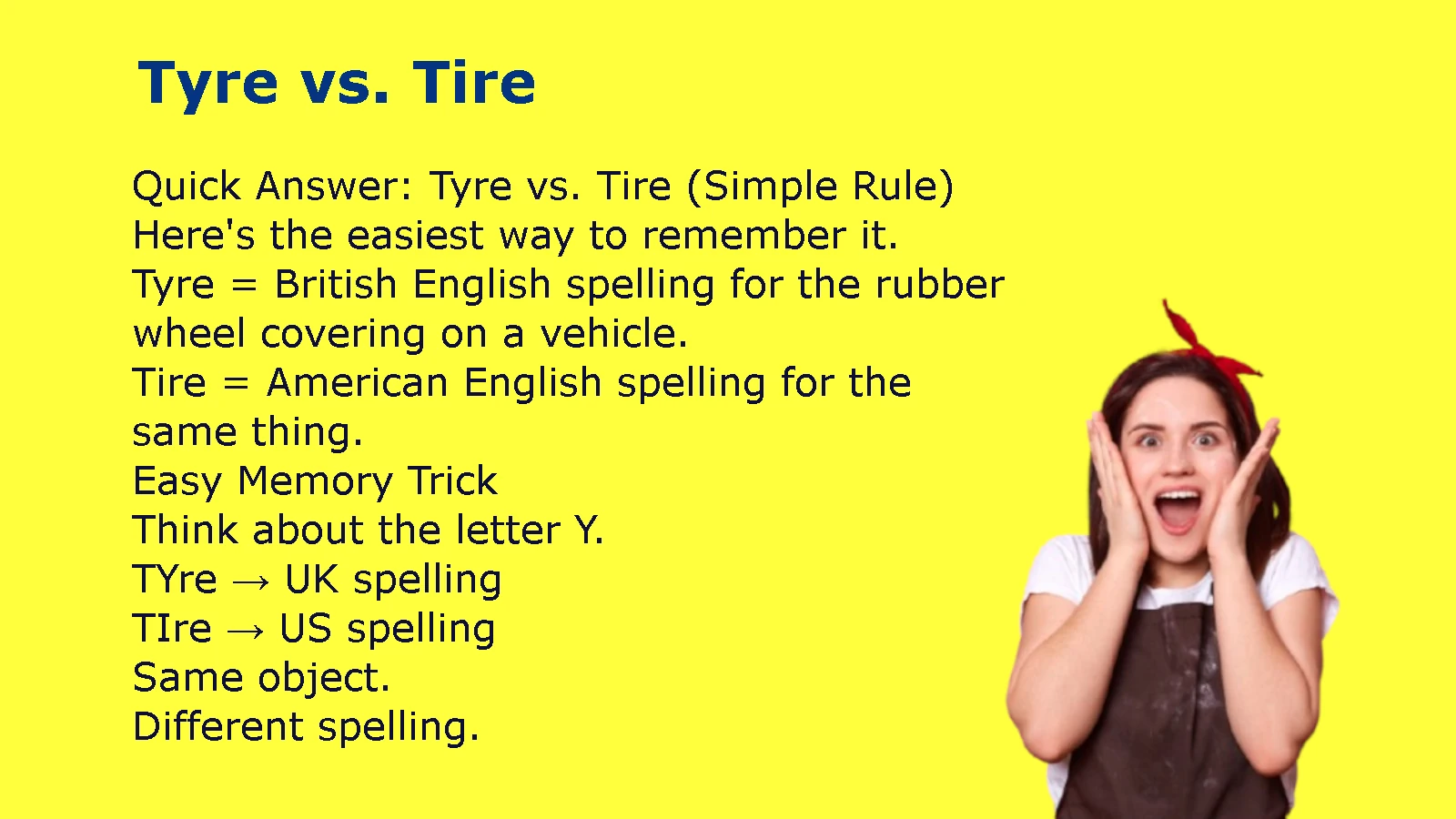
Quick Answer: Tyre vs. Tire (Simple Rule)
Here’s the easiest way to remember it.
Tyre = British English spelling for the rubber wheel covering on a vehicle.
Tire = American English spelling for the same thing.
Easy Memory Trick
Think about the letter Y.
TYre → UK spelling
TIre → US spelling
Same object.
Different spelling.
Are “Tyre” and “Tire” the Same Thing?
Yes.
They both refer to the rubber covering fitted around a vehicle’s wheel.
Whether you’re talking about a bicycle, motorcycle, car, truck, or bus, the meaning stays exactly the same.
Examples:
British English:
- I need to replace my tyre.
American English:
- I need to replace my tire.
Only the spelling changes—not the meaning.
Why Are There Two Spellings?
The difference comes from the evolution of English.
When American English developed its own spelling conventions, many words were simplified.
As a result:
British English kept tyre for vehicle wheels.
American English standardized tire.
Interestingly, tire had already existed in English as a verb meaning “to become weary,” which is why the spelling can sometimes confuse learners.
The Difference Between “Tyre” and “Tire”
Here’s the comparison at a glance.
| Word | Meaning | Used In |
| Tyre | Rubber wheel covering | British English |
| Tire | Rubber wheel covering | American English |
| Tire | To become exhausted | All English varieties |
“Tyre” Explained Clearly
Tyre is the standard spelling in countries that follow British English.
You’ll commonly see it in:
- United Kingdom
- Australia
- New Zealand
- India
- Pakistan
- South Africa
Examples:
- My car has a flat tyre.
- The mechanic changed both front tyres.
- Check your tyre pressure regularly.
If you’re writing for a British or international audience, tyre is usually the correct choice.
“Tire” Explained Clearly
In American English, tire is the accepted spelling for the wheel covering.
Examples:
- My tire needs more air.
- The truck has brand-new tires.
- Always inspect your tire before a long trip.
If you’re writing for readers in the United States, always use tire.
Don’t Confuse “Tire” (Noun) with “Tire” (Verb)
This is where many learners get confused.
The word tire has two completely different meanings.
As a noun
It refers to the rubber covering on a wheel.
Example:
“I replaced my tire yesterday.”
As a verb
It means to become tired or exhausted.
Example:
“Running five miles can tire anyone.”
The meaning becomes obvious from the sentence.
The Biggest Mistake People Make
Many writers accidentally mix British and American spelling.
For example:
❌ My car needs a new tyre, and the color is black.
This combines British and American spelling.
Better:
British English:
- Tyre
- Colour
- Centre
- Favourite
American English:
- Tire
- Color
- Center
- Favorite
Choose one style and stay consistent.
Side-by-Side Comparison Table
| Feature | Tyre | Tire |
| Meaning | Vehicle wheel covering | Vehicle wheel covering |
| English Variety | British | American |
| Correct in UK | ✅ | Rare |
| Correct in US | Rare | ✅ |
| Also a Verb? | ❌ | ✅ (to become exhausted) |
Real-Life Examples of “Tyre”
Common sentences:
- The tyre burst during the journey.
- Check your tyre pressure every month.
- I bought two new tyres yesterday.
- My bicycle tyre has a puncture.
Mini Scenario
You’re visiting London.
A mechanic says:
“Your rear tyre needs replacing.”
That’s completely standard British English.
Real-Life Examples of “Tire”
Common sentences:
- I got a flat tire.
- The mechanic rotated all four tires.
- My spare tire saved the trip.
- Buy winter tires before the snow starts.
Mini Scenario
You’re driving in New York.
The roadside assistant says:
“You’ve got a flat tire.”
That’s standard American English.
Regional Differences
English spelling changes depending on the country.
British English
Uses:
- Tyre
- Colour
- Favourite
- Centre
American English
Uses:
- Tire
- Color
- Favorite
- Center
International English
Many countries that teach British English—including Pakistan, India, Australia, and New Zealand—prefer tyre.
How to Avoid Confusion Every Time
Follow these simple rules.
Writing for the UK?
Use tyre.
Writing for the US?
Use tire.
Unsure about your audience?
Match the spelling style used throughout your document.
Consistency is more important than the choice itself.
What to Say Instead
If you’re worried about spelling differences, you can often use more specific phrases like:
- Vehicle wheel
- Car wheel
- Wheel assembly
- Flat wheel (in casual conversation)
However, tyre/tire remains the most natural choice.
Quick Decision Guide
Use this whenever you’re unsure.
British English → Tyre
American English → Tire
Talking about being exhausted → Tire
Simple. Reliable. Done.
FAQ: Tyre vs. Tire
Is “tyre” correct?
Yes. It’s the standard British English spelling.
Is “tire” wrong?
No. It’s the correct American English spelling.
Which spelling should I use?
Use the spelling that matches your audience.
Does “tire” always mean exhaustion?
No. As a noun, it refers to the rubber wheel covering. As a verb, it means becoming tired.
Why are there two spellings?
Because British and American English developed different spelling conventions over time.
Case Study: A Small but Costly Editing Mistake
A UK automotive company hired a freelance writer to create product descriptions.
The writer used tire throughout the website.
What Happened
British customers noticed the American spelling.
The content felt less local and less trustworthy.
The Fix
The company changed every instance of tire to tyre.
The website became consistent with British English, creating a better experience for its audience.
Key Facts You Should Remember
- Tyre is the British English spelling.
- Tire is the American English spelling.
- Both words mean the same thing when referring to a vehicle wheel.
- Tire can also be a verb meaning “to become exhausted.”
- Always stay consistent with one variety of English.
Final Takeaway: The One Rule That Never Fails
The difference between Tyre vs. Tire is simple once you know the audience you’re writing for. Both spellings describe the same part of a vehicle, but each belongs to a different variety of English.
Keep this rule in mind:
- British English → Tyre
- American English → Tire
If you’re writing professionally, always match the spelling to your readers and avoid mixing British and American English in the same document. A small spelling choice can make your writing look polished, consistent, and easier for your audience to understand.