Have you ever stopped mid-sentence wondering whether it should be “Descendent vs Descendant”? You are not alone—this is one of the most common spelling confusions in English, especially because both words look and sound almost identical. However, their usage in modern English is not equal, and understanding the difference can significantly improve your writing accuracy, grammar confidence, and vocabulary precision.
In simple terms, Descendant is the correct and widely accepted word used in English to refer to a person who comes from a particular ancestor or family line. For example, someone can be a descendant of a historical figure, royal family, or cultural lineage. On the other hand, Descendent is rarely used as a noun in modern English; it mainly appears as an adjective meaning “moving downward” or “declining,” such as a descendent slope or path.
This confusion often appears in searches like descendent vs descendant meaning, difference between descendant and descendent, and how to use descendant in a sentence, especially among learners trying to improve formal writing, academic English, and professional communication.
If you’ve ever written a sentence like “He is a descendant of ancient kings,” but paused to question the spelling, this guide will clear that confusion once and for all with simple definitions, usage examples, and memory tricks.
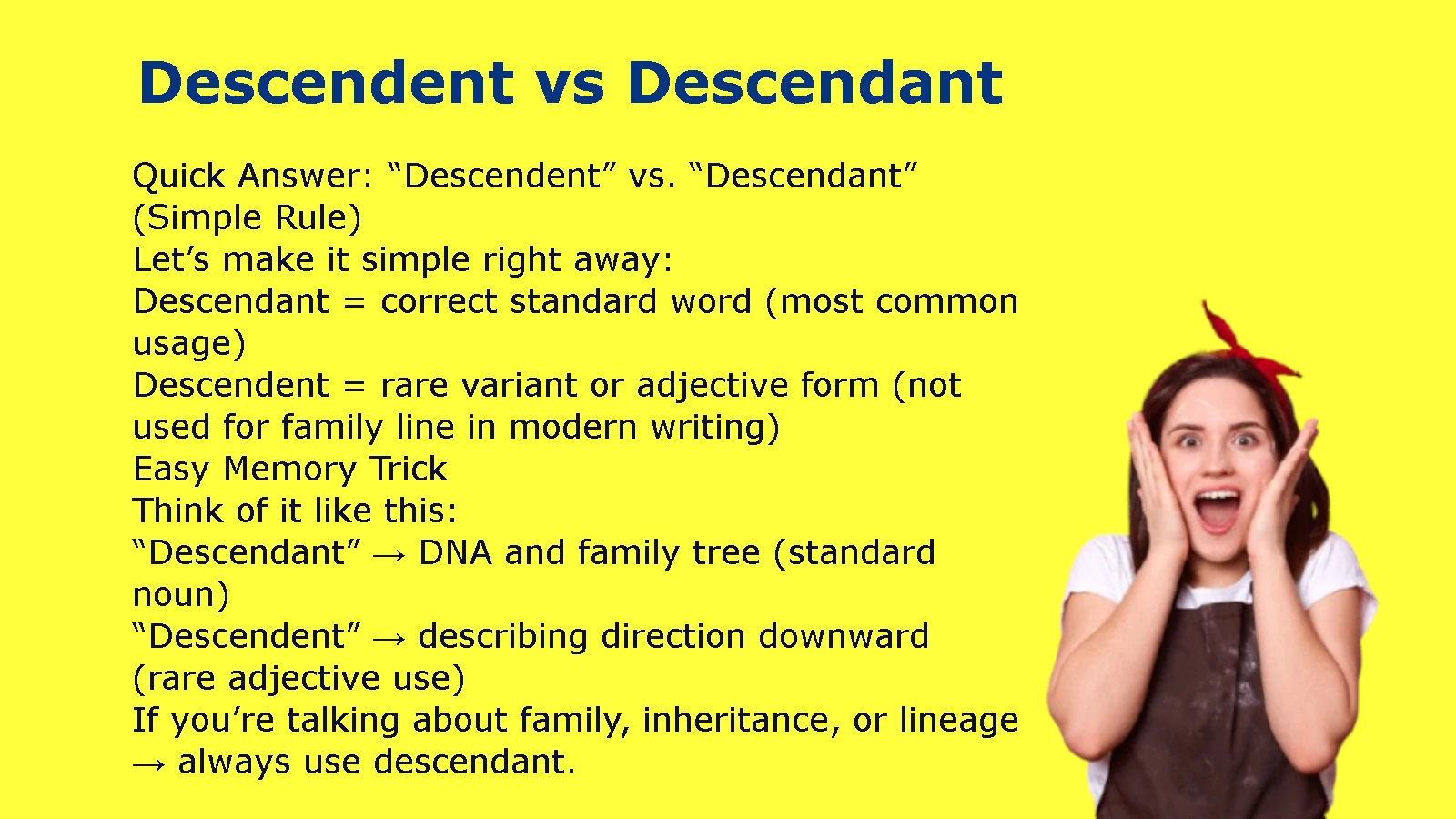
Quick Answer: “Descendent” vs. “Descendant” (Simple Rule)
Let’s make it simple right away:
Descendant = correct standard word (most common usage)
Descendent = rare variant or adjective form (not used for family line in modern writing)
Easy Memory Trick
Think of it like this:
- “Descendant” → DNA and family tree (standard noun)
- “Descendent” → describing direction downward (rare adjective use)
If you’re talking about family, inheritance, or lineage → always use descendant.
The Core Meaning of “Descendant”
A descendant is a person who comes from a particular ancestor.
It’s used in genealogy, history, biology, and everyday language.
Simple Definition
A descendant is someone who is directly or indirectly related to an ancestor.
Real Examples
- She is a descendant of a royal family.
- The villagers are descendants of ancient settlers.
- Many modern languages are descendants of Latin.
Key Idea
It always connects past → present generations.
Where “Descendant” Is Used Most
You’ll mostly see it in:
Family & Genealogy
Talking about ancestry, lineage, and heritage.
History
“Descendants of immigrants” or “descendants of crew.”
Science & Evolution
Species can be described as descendants of earlier forms.
Everyday Writing
Used when describing origin or background.
What About “Descendent”?
Now here’s where things get tricky.
“Descendent” is technically a word—but not the one you usually want.
Rare Meaning
It can function as an adjective meaning:
- moving downward
- declining in order or direction
Example (rare usage)
- A descendent slope of the hill
But here’s the important truth:
👉 In modern English, this usage is extremely uncommon
👉 Most native speakers never use it in this way
The Biggest Mistake People Make
The real problem is assumption.
People think:
- “They sound the same, so both are interchangeable.”
But that leads to errors like:
What Goes Wrong
- “She is a descendent of kings.” ❌
- “He is a descendent of that crew.” ❌
Correct Version
- “She is a descendant of kings.” ✔️
- “He is a descendant of that crew.” ✔️
Key Insight
If you are referring to people or lineage, “descendant” is always correct.
Simple Comparison Table
| Word | Correct Usage | Meaning | Common? |
|---|---|---|---|
| Descendant | Yes | A person from an ancestor | Very common |
| Descendent | Rare | Moving downward (adjective) | Very rare |
Real-Life Examples of “Descendant”
Let’s make it practical.
- “He is a descendant of a famous warrior.”
- “These plants are descendants of ancient species.”
- “The family claims to be descendants of explorers.”
- “She discovered she is a descendant of migrants from Asia.”
In all these cases, only one word works naturally: descendant.
Why This Confusion Happens
There are three main reasons:
1. Similar spelling
Only one letter changes, so the brain mixes them easily.
2. Sound similarity
Both words are pronounced almost the same.
3. Old English variation
“Descendent” existed in older texts, but modern usage simplified it.
How to Never Confuse Them Again
Use this quick rule:
The Golden Rule
If you can replace it with “family line,” use descendant.
Example Test
- “She is a ___ of the king.”
- If it relates to ancestry → descendant ✔️
Quick Decision Guide
Still unsure? Use this:
- Talking about family or ancestry → descendant
- Talking about downward direction (rare formal description) → descendent
- Any normal writing → descendant
When in doubt, choose descendant—it is always safe.
FAQ: “Descendent” vs. “Descendant”
Is “descendent” ever correct?
Yes, but only as a rare adjective meaning downward direction. It is not used for family relationships.
Which one should I use in exams or writing?
Always use descendant unless specifically told otherwise.
Why do dictionaries list both?
Because English preserves historical forms, even if one becomes rare.
Key Facts You Should Remember
- “Descendant” = correct and standard
- “Descendent” = rare and mostly outdated in modern usage
- Family + ancestry = always “descendant”
- Confusion comes from spelling similarity
Final Takeaway: The One Rule That Never Fails
English often keeps old words alive, even when they fall out of everyday use. That’s exactly what happened here.
So here’s your safe rule:
👉 If you’re talking about people, families, or lineage—always use “descendant.”
Think of it like a family tree. You don’t need two labels for the same branch. You just need the correct one.
And in modern English, that correct branch is always descendant.