Have you ever paused while writing and wondered whether “Lacy vs. Lacey” is the correct spelling? You’re not alone—this is one of those tricky English spelling variations that often confuses writers, learners, and even native speakers. Because the two words look and sound almost identical, it’s easy to assume they mean the same thing or can be used interchangeably.
In reality, “Lacy” and “Lacey” can refer to different spellings depending on context, name usage, or regional preference. One may appear more commonly in descriptions related to lace-like patterns, fabric texture, or delicate designs, while the other is often found as a surname, place name, or alternative spelling in English usage.
This confusion frequently shows up in searches like lacy meaning, lacey meaning, difference between lacy and lacey, and correct spelling of lacy vs lacey. It also connects to broader issues in English spelling variations, pronunciation-based mistakes, and commonly confused words in writing and communication.
If you’ve ever written a sentence and stopped to question which version is correct, this guide will clear up the confusion with simple explanations, real examples, and easy memory tips so you never mix them up again.
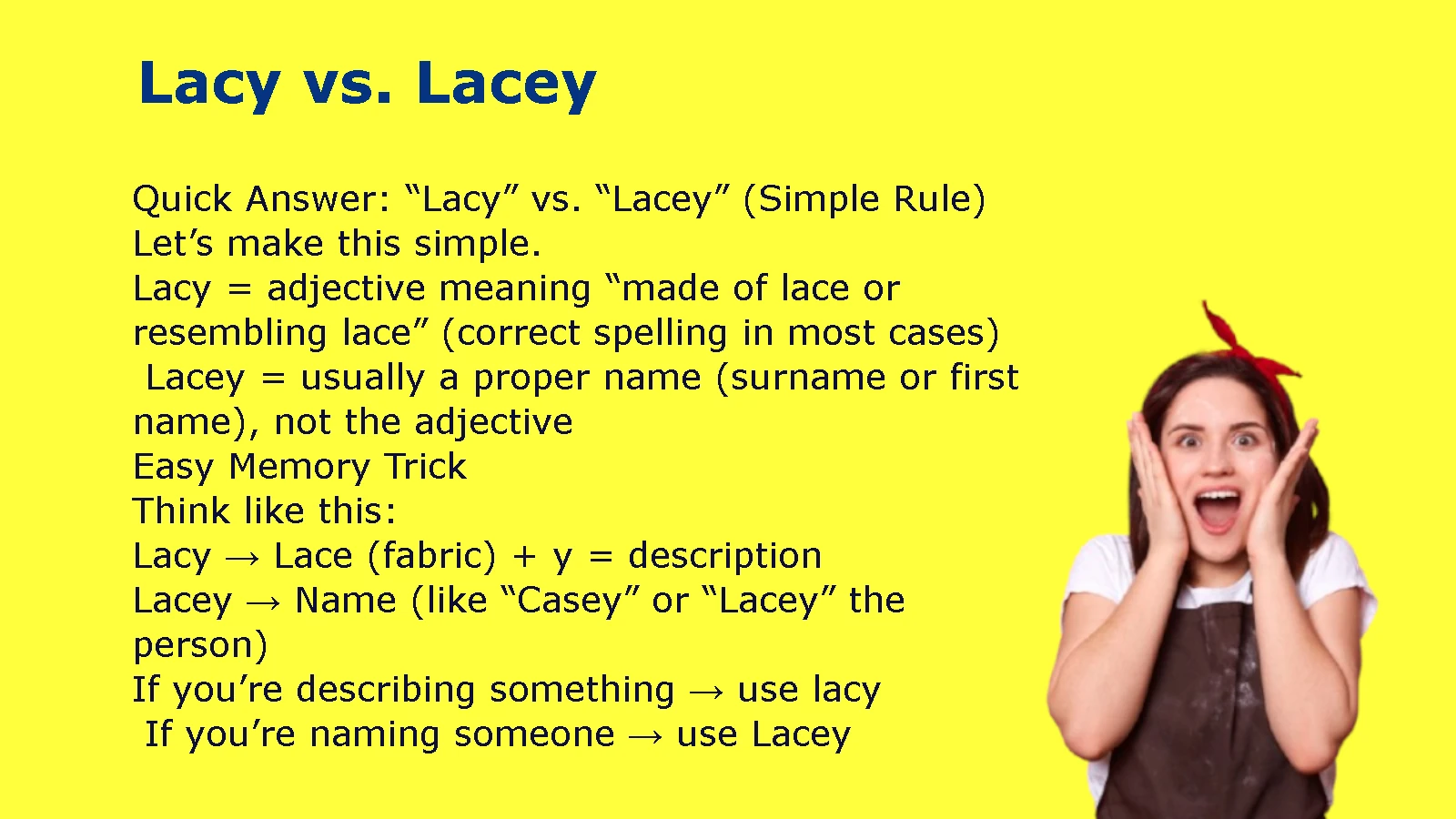
Quick Answer: “Lacy” vs. “Lacey” (Simple Rule)
Let’s make this simple.
Lacy = adjective meaning “made of lace or resembling lace” (correct spelling in most cases)
Lacey = usually a proper name (surname or first name), not the adjective
Easy Memory Trick
Think like this:
- Lacy → Lace (fabric) + y = description
- Lacey → Name (like “Casey” or “Lacey” the person)
If you’re describing something → use lacy
If you’re naming someone → use Lacey
Why “Lacy” vs “Lacey” Confuses So Many People
The confusion happens because English often blends:
- adjectives (describing words)
- proper nouns (names)
- spelling variations over time
And here, both words look natural.
People also get influenced by:
- usernames and social media handles
- brand names
- character names in books or shows
- autocorrect suggestions
So even though one is grammatically standard, both appear in real life.
“Lacy” Explained Clearly (Correct Usage)
The word “lacy” is an adjective. It describes something that looks like lace or has lace-like patterns.
Meaning
Something delicate, decorative, or patterned like lace fabric.
Examples
- She wore a lacy dress to the party.
- The curtains had a lacy design.
- Snowflakes formed a lacy pattern on the window.
- The blouse looked soft and lacy.
Key Idea
If you can replace it with “made of lace” or “lace-like,” then lacy is correct.
“Lacey” Explained Clearly (Name Usage)
Now let’s look at “Lacey.”
This is usually a proper noun, not an adjective.
Where it appears
- First names (e.g., Lacey)
- Surnames (e.g., someone’s family name)
- Fictional characters
- Brand or username styling
Examples
- Lacey is joining us for dinner tonight.
- Mr. Lacey signed the document.
- The character Lacey appeared in the story.
- @lacey_official (social media handle)
Key Idea
If it refers to a person or identity, it’s Lacey.
Side-by-Side Comparison Table
Here’s a quick breakdown for instant clarity:
| Word | Type | Meaning | Example Use Case |
| Lacy | Adjective | Made of lace / lace-like | lacy dress, lacy fabric |
| Lacey | Proper noun | Name (person/surname/brand) | Lacey is here, Mr. Lacey |
Common Mistakes People Make
Let’s fix the confusion points.
Mistake 1: Using “lacey” for clothing
❌ She wore a lacey dress
✔ She wore a lacy dress
Mistake 2: Thinking both are adjectives
Only lacy is an adjective in standard English.
Mistake 3: Assuming spelling doesn’t matter
In formal writing, spelling changes meaning completely.
Real-Life Examples of “Lacy”
Here’s how it appears in natural usage:
- The wedding gown had a lacy hemline.
- Her top was light and lacy, perfect for summer.
- The design looked lacy and elegant.
- He noticed a lacy pattern on the glass.
Mini Scenario
You’re describing fashion:
“This blouse looks lacy and soft.”
That’s correct, natural, and grammatically clean.
Real-Life Examples of “Lacey”
Now compare proper noun usage:
- Lacey arrived late to the meeting.
- I spoke to Mr. Lacey yesterday.
- Lacey is the lead character in the novel.
- The award was given to Lacey Thompson.
Mini Scenario
You’re talking about a person:
“Lacey said she will join us later.”
No confusion here—it’s a name.
Why Both Spellings Exist
This is where language history plays a role.
- “Lacy” evolved as the adjective form of “lace”
- “Lacey” developed as a surname and later a first name
- Over time, both became common in different contexts
So technically:
- one belongs to grammar
- the other belongs to identity
How to Never Confuse “Lacy” and “Lacey” Again
Here’s a simple system:
Step 1: Ask “Am I describing something?”
- Yes → use lacy
2: Ask “Is it a person or name?”
- Yes → use Lacey
3: Still unsure?
- Replace it with “lace-like”
- If it fits → lacy is correct
What to Use in Formal Writing
If you’re writing:
- essays
- articles
- SEO content
- descriptions
Always default to:
👉 lacy (for descriptions)
👉 Lacey (only for names)
Never mix them in formal contexts.
FAQ: “Lacy” vs. “Lacey”
Is “lacey” ever correct?
Yes—but only as a name or proper noun, not as an adjective.
Can I use “lacey” in fashion writing?
No. The correct form is lacy.
Why do people write “lacey dress”?
Because pronunciation makes both sound similar, and names influence spelling habits.
Is “lacy” a real word?
Yes, it is a standard English adjective.
Case Study: A Small but Common Writing Error
A fashion blogger wrote:
“This lacey summer outfit is trending.”
Result:
- Readers noticed the spelling issue
- The brand credibility dropped slightly
- The post was later corrected
Fixed version:
“This lacy summer outfit is trending.”
Small change, big difference in professionalism.
Key Facts You Should Remember
- Lacy = adjective (lace-like appearance)
- Lacey = name (person or surname)
- Only one is used in descriptions
- Context decides everything
- Spelling affects meaning more than people think
Final Takeaway: The One Rule That Never Fails
Here’s the simplest way to lock it in:
If you’re describing something delicate, patterned, or lace-like → use “lacy.”
If you’re talking about a person or name → use “Lacey.”
That’s it.
No overthinking. No confusion.
Because when it comes to “lacy vs lacey,” clarity isn’t optional—it’s the difference between correct English and avoidable mistakes.