Have you ever wondered whether Elfs vs. Elves is simply a spelling variation or whether one of these words is actually incorrect? This is a common question among English learners, fantasy readers, writers, and gamers who frequently encounter magical creatures in books, movies, folklore, and role-playing games. Because the two words look so similar, it’s easy to assume they can be used interchangeably. However, only one is considered the standard plural form in modern English.
In simple terms, elves is the correct plural of elf, while elfs is generally regarded as a nonstandard or incorrect spelling in contemporary English. Understanding the difference helps improve your English grammar, spelling accuracy, vocabulary, and overall writing confidence. Whether you’re discussing fantasy literature, writing a story, or referring to mythical beings in everyday conversation, choosing the correct form makes your writing more polished and professional.
The confusion often arises because many English nouns simply add -s to form their plural, but elf follows an irregular plural pattern by changing -f to -ves, just like wolf → wolves, leaf → leaves, and calf → calves. Learning this spelling rule not only helps you use elves correctly but also strengthens your understanding of other irregular plural nouns in English.
In this guide, you’ll learn the complete difference between Elfs and Elves, their meanings, correct grammar usage, real-life examples, common mistakes to avoid, and easy memory tricks so you can confidently use the right word in both writing and conversation.
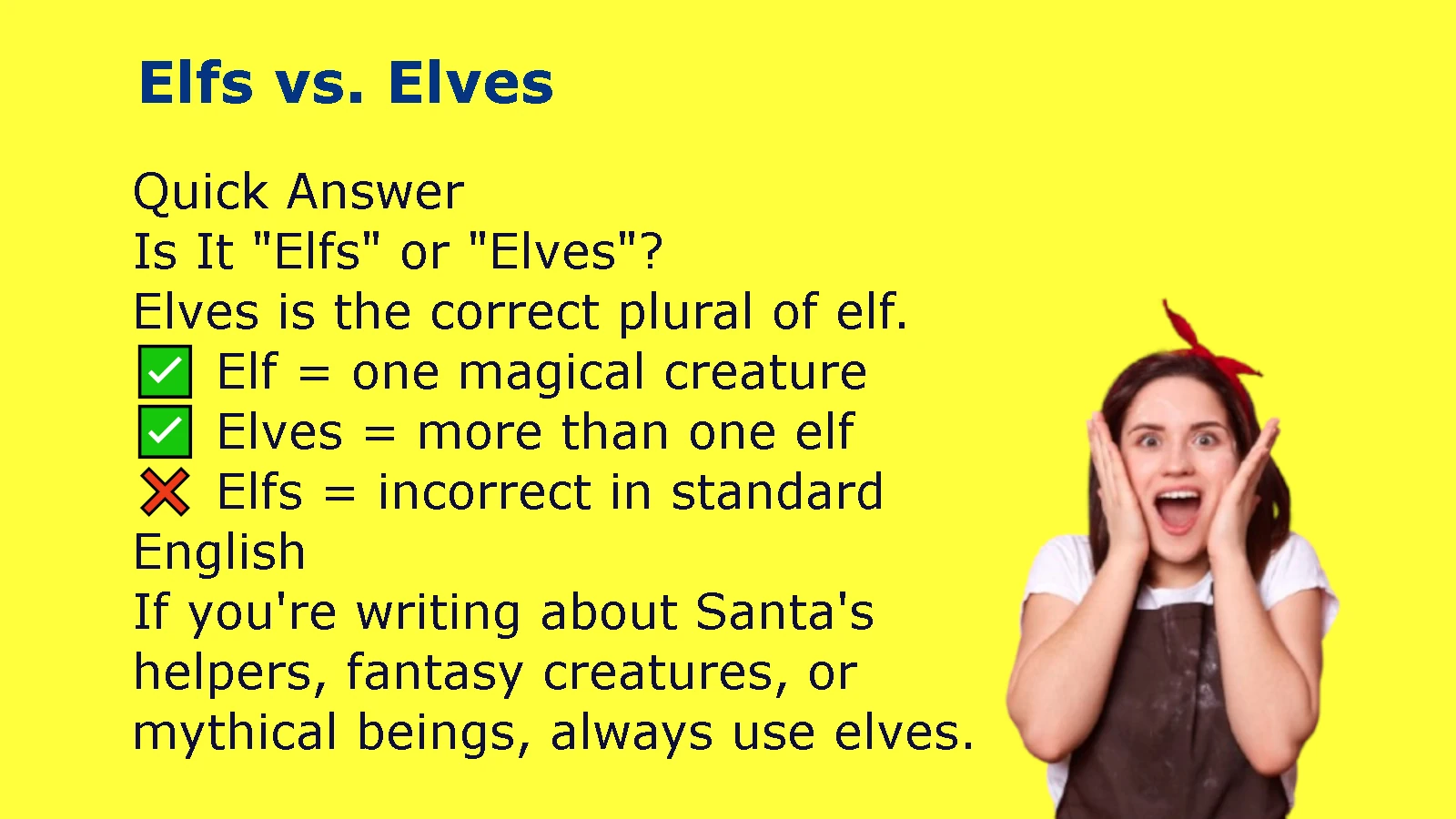
Quick Answer
Is It “Elfs” or “Elves”?
Elves is the correct plural of elf.
- ✅ Elf = one magical creature
- ✅ Elves = more than one elf
- ❌ Elfs = incorrect in standard English
If you’re writing about Santa’s helpers, fantasy creatures, or mythical beings, always use elves.
What Does “Elf” Mean?
An elf is a mythical or magical creature that appears in folklore, fairy tales, fantasy literature, and modern entertainment.
Examples include:
- Santa’s elf
- A forest elf
- A magical elf
- An elf in a fantasy novel
The word elf is always singular.
Examples
- An elf delivered the gift.
- Every elf had a special responsibility.
- The little elf smiled happily.
What Does “Elves” Mean?
Elves is the plural form of elf.
Use it whenever you’re referring to two or more magical creatures.
Examples
- The elves worked all night making toys.
- Friendly elves lived deep inside the forest.
- Several elves guarded the ancient kingdom.
- Children enjoy stories about Santa’s elves.
Why Is “Elves” Correct?
Unlike regular nouns, elf is an irregular plural noun.
Instead of adding -s, English changes the ending from -f to -ves.
| Singular | Plural |
| Elf | Elves |
| Wolf | Wolves |
| Leaf | Leaves |
| Shelf | Shelves |
| Knife | Knives |
This spelling pattern has been part of English for centuries, making elves the only accepted plural form.
Why Isn’t “Elfs” Correct?
Although elfs may seem logical, it isn’t recognized in standard English dictionaries or grammar guides.
Many people write elfs because they apply the regular plural rule:
elf + s = elfs
However, elf belongs to a special group of irregular nouns that change -f into -ves.
So, while elfs looks reasonable, it is considered a spelling mistake in standard English.
The Grammar Rule Behind Elf → Elves
Most English nouns become plural by adding -s or -es.
Examples:
- Book → Books
- Tree → Trees
- Box → Boxes
However, some nouns ending in -f or -fe change to -ves.
Examples:
- Wolf → Wolves
- Leaf → Leaves
- Knife → Knives
- Elf → Elves
This is known as an irregular plural noun.
Why Do Some Words Change from -f to -ves?
This rule comes from the history of the English language.
In Old English, certain nouns ending in -f were pronounced differently when pluralized. Over time, their spellings changed to match their pronunciation, resulting in forms like:
- wolf → wolves
- leaf → leaves
- life → lives
- elf → elves
Although modern English has simplified many spelling rules, these traditional plural forms have remained.
Do All Words Ending in -f Become -ves?
No.
Some nouns simply add -s.
Examples:
| Singular | Plural |
| Roof | Roofs |
| Chief | Chiefs |
| Belief | Beliefs |
| Proof | Proofs |
| Cliff | Cliffs |
Because English has exceptions, it’s helpful to memorize the most common irregular plural nouns.
How to Pronounce “Elf” and “Elves”
Elf
- Pronunciation: /elf/
Elves
- Pronunciation: /elvz/
Notice that elves ends with a “vz” sound instead of “fs.”
Dictionary References
Major English dictionaries consistently list:
- Elf — singular noun
- Elves — plural noun
None of the major dictionaries recognize elfs as the standard plural form.
This confirms that elves is the accepted spelling in formal and informal English.
Elfs vs. Elves Comparison Table
| Word | Correct? | Meaning | Usage |
| Elf | ✅ Yes | One magical creature | Singular |
| Elves | ✅ Yes | More than one elf | Plural |
| Elfs | ❌ No | Incorrect spelling | Avoid |
Real-Life Examples
Correct
- The elves decorated Santa’s workshop.
- Two elves carried the presents.
- Ancient elves protected the magical kingdom.
- Every Christmas, children imagine helpful elves making toys.
Incorrect
❌ The elfs built the sleigh.
✅ The elves built the sleigh.
❌ Three elfs entered the castle.
✅ Three elves entered the castle.
Common Places You’ll See “Elves”
The word elves appears frequently in:
- Christmas stories
- Santa Claus traditions
- Fantasy novels
- Fairy tales
- Mythology
- Role-playing games
- Adventure movies
- Video games
Professional authors consistently use elves, never elfs.
Common Mistakes to Avoid
Mistake 1
❌ Elfs
✅ Elves
Mistake 2
Using elf for multiple creatures.
❌ Five elf worked together.
✅ Five elves worked together.
Mistake 3
Applying the regular plural rule.
Not every noun forms its plural by adding -s.
Easy Memory Trick
Remember this simple pattern:
- Wolf → Wolves
- Shelf → Shelves
- Leaf → Leaves
- Elf → Elves
If you remember one, you’ll remember them all.
Similar Irregular Plural Nouns
Many English nouns follow the same spelling pattern.
| Singular | Plural |
| Wolf | Wolves |
| Leaf | Leaves |
| Shelf | Shelves |
| Knife | Knives |
| Life | Lives |
| Calf | Calves |
| Half | Halves |
| Elf | Elves |
Learning these together makes them much easier to remember.
Quick Decision Guide
Ask yourself:
Are you talking about one magical creature?
→ Use elf
Are you talking about two or more?
→ Use elves
If you’re tempted to write elfs, replace it with elves.
Frequently Asked Questions
Is “elfs” a real word?
No. In standard English, elfs is considered incorrect. The accepted plural is elves.
What is the correct plural of elf?
The correct plural is elves.
Why does elf become elves?
Because elf follows the traditional -f → -ves plural spelling rule used by several irregular English nouns.
Is elf an irregular noun?
Yes. It forms its plural irregularly by changing -f to -ves.
Do fantasy books use “elves”?
Yes. Fantasy novels, games, and mythology consistently use elves as the plural form.
Are Santa’s helpers called elves?
Yes. The correct expression is Santa’s elves.
Is “elven” the same as “elves”?
No.
- Elves is the plural noun.
- Elven is an adjective.
Example:
- The elves gathered together.
- She wore an elven cloak.
Key Takeaways
- Elf is singular.
- Elves is the correct plural.
- Elfs is incorrect in standard English.
- Elf follows the irregular -f → -ves plural rule.
- Major dictionaries recognize only elves.
- The same rule applies to words like wolf, leaf, knife, and shelf.
Final Thoughts
The difference between Elfs vs. Elves is straightforward once you know the rule. Although elfs may seem like a logical plural, standard English recognizes only elves. This irregular spelling follows a long-standing English pattern shared by words like wolf → wolves, leaf → leaves, and knife → knives.
Whether you’re writing a school assignment, a fantasy novel, a Christmas story, or simply improving your English grammar, using elves will ensure your writing is accurate and natural. Whenever you’re unsure, remember one simple rule: one elf, many elves. Keeping this pattern in mind will help you avoid common spelling mistakes and write with greater confidence.